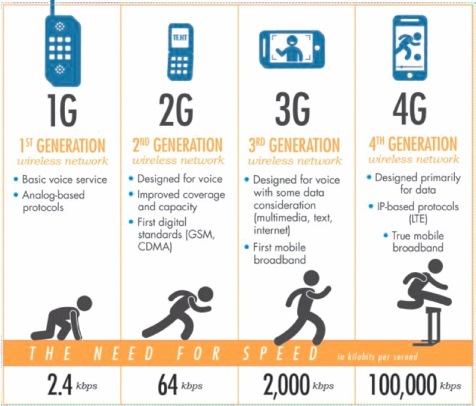
Figure 1. Evolution of 1G to 4G Technology
In this work, an overview of design and challenges faced by RF engineers in the LTE/4G implementation from an RF system design perspective has been provided. LTE and LTE Advance form the next generation of the mobile communication standard in few countries. Although, LTE has already been implemented in various parts of the world, researchers are still coming up with new design challenges of such complex systems. Much focus has been thrown upon the antenna design aspect of the LTE/4G based systems. It has been noted that MIMO technology is best suited for the implementation of such robust technology, which aims in providing better channel utilization and reduced signal correlation between the adjacent channels present in the communication link. Further, a compact microstrip antenna operating at 2.4 GHz providing operation at 4G frequency band is presented. The presented antenna has good electrical and radiation characteristics for providing better services for 4G application.
Over the years with advancements in semiconductor technology, several advanced wireless communication technologies have been introduced to suffix the increasing demands of the customers for better Quality of Service (QoS). This has spurred up an urgent need to design efficient RF systems. With continuous development of communication standards from the early GSM based systems to the high speed data and voice services using 3GPP configurations, customers' access to data has seen a drastic improvement. This evolution of technology is explained in Figure 1.
Figure 1. Evolution of 1G to 4G Technology
In order to meet these demands of higher data rates and QoS, reliable infrastructure capable of addressing these challenges is needed, thereby keeping RF engineers under constant pressure to meet these challenges. It is evident that Long Term Evolution (LTE) or 4G technology is the key successor to the current 3G technology.
4G technology has already rooted its roots in commercial applications while 5G technology is gearing up for making space in commercial applications in few countries. 4G has been introduced to provide a wide area network for internet access. It provided high bandwidth and broadband. 4G networks are projected to provide speeds of 100 Mbps while moving and 1 Gbps while stationary. 4G technologies is still facing major challenges, specifically in antenna design, which can be addressed by developing new antenna structures to meet these needs.
LTE/4G based systems would primarily focus on:
Multiple-Input Multiple-Output (MIMO) technology is a wireless technology that uses multiple transmitters and receivers to transfer more data at the same time.
With the rapid development of MIMO technology, relevant research on its antenna design has become significant and valuable. For a multi-antenna MIMO wireless system, the antenna elements must have large space between in order to have diversity function which is different from the conventional smart antenna. On the other hand, the antenna element should be as much as possible to receive the scattered waves in all directions. The number of antenna elements, antenna element spacing and antenna placement are all important factors for MIMO system. Different techniques used in MIMO are volumetric linear spacing's, defected ground structures, defected ground structures with slits and changing orientation of MIMO elements (Ban et al., 2016).
The basic structure of MIMO is shown in Figure 2. Antennas of MIMO communication systems include multiple elements and require high isolation between the radiators. However, integration of multiple antennas closely in a small and compact device with maintenance of good isolation between the antenna elements is rather complicated.
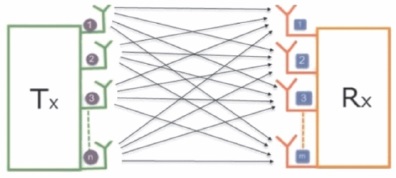
Figure 2. Basic Structure of MIMO
Based on the channel capacity/function and the type of communication equipment used in the wireless link, there are various efficient ways in which MIMO technique can be harnessed for LTE systems. Following are the types of different MIMO implementations.
The simplest form of the communication link which is widely used consists of single antenna which handles both data and voice services to and fro in the user equipment. With advancements in usage of number of antennas at the receiving end techniques such as Single-Input Multiple- Output (SIMO) have been developed, wherein a single data stream is accessed by one or more different receiver antennas in the communication link.
Systems that require higher signal quality over lower data rate request can use transit diversity techniques to meet the standard QoS specifications. This may include multiple input antennas (MI) to transmit a single data stream, in one or more combinations and are widely used in broadcast and common access channels in general.
In general, the performance of a communication system can be improved by incorporating multiplexing techniques for the data transfer. This multiplexing can be achieved by using two or more antennas to transmit the different data streams and using two or more antennas at the receivers end to receive these data streams. This kind of structure is usually termed as Multiple-Input Multiple-Output (MIMO) system and results in improved channel usage. However, these systems should be smart enough to distinguish and tune themselves to receive the data correctly. Two ways to achieve such spatial multiplexing are Open and Closed Loop models, and this enables the receiver/user equipment to separate the different data streams in the incoming signal.
The Multi User (MU) MIMO systems can be deployed where the numbers of users are more and each user accesses different kind of data.
The 4G MIMO antenna system is based on 4-element wideband monopoles, while the 5G one is based on 2- element linear connected arrays (Ikram et al., 2018). As the wireless mobile network has already migrated from 2G to 4G mobile technology, higher data transmitting rate can be acquired by utilizing higher frequency band with wide operating bands. New eight-port dual-polarized multipleinput multiple-output (MIMO) antenna array design is used for 5G smartphone (Chen et al., 2018). It is very important for the antenna to be with small size and wide operating band or many operating bands (Zhao et al., 2013). Rapid development of the wireless communication systems, especially the wide use of 2G/3G/4G devices and mobile phone antennas with small size and wide operating bands, are more attractive for practical applications (Yang et al., 2019). MIMO antenna can enhance wireless system capacity by multi-path data transmission and reception (Parchin et al., 2019). Mutual coupling between various antenna elements degrades the performance of MIMO systems (Saxena et al., 2018). Today's mobile user wants faster data speeds and more reliable service. It is known that multi-input multi-output (MIMO) operation can lead to a much higher channel capacity for enhanced data throughput. When more antennas are included in the MIMO operation, much higher channel capacity can be obtained. So, massive MIMO looks very promising for the future mobile communications. However, owing to the very limited space in the smartphone, it is a great design challenge to embed more antennas inside (You et al., 2019). To be able to satisfy the continuous increased demand in data rate requirements in future communication systems, MIMO technology with wider bandwidth should be used hand in hand with other enabling ones (Sharawi et al., 2017). Recent wireless consumer electronics devices need higher data rate and throughput in numerous short range wireless personal area network (WPAN) applications (Mathur & Dwari, 2019). Multiple antenna technologies have attracted large research interest for several decades and have gradually made their way into mainstream communication systems (Zhang et al., 2020). The first generation (1G) used the analog transmission to fulfill basic mobile voice transmission. The 2G systems used digitally enhanced multiple access technologies leading towards early data services and enhanced spectral efficiency. In 3G, technologies enhanced the improvement in video and audio streaming capabilities. Bhatti (2019) developed the long term evolution (LTE) to offer a complete 4G capable mobile broadband and an upgrade to existing 3G networks. Smart antennas play a key-role due to their capability of rejecting undesired signals and thus at the receiver enhances the quality of service (Sridevi & Rani, 2018). In the development of an adaptive antenna array, the DOA estimation played a significant role to detect the angle of every incoming wave front received by an antenna array (Ganage & Ravinder, 2018). Traditionally, smart antennas are considered to be adaptive array systems which modify antenna radiation beam by using an additional processing circuitry that provides either phased signals or other control signals based on some algorithms (Pant et al., 2018). Mobile communication is the basis for personal communication and one of the technologies st with the greatest potential in the 21 century (Zhai, 2017). Today, the significance of the wireless communication is known all over the world. In order to achieve better communication, many techniques and methods have been introduced. Among these techniques, smart antennas are trending topic in the research domain (Shivapanchakshari & Aravinda, 2017). A matching stub is added in the loop mode, and the parasitic design is adapted in the monopole mode. These two methods greatly improve the bandwidth performance (Liu et al., 2018). Circular polarized antennas can avoid antenna orientation by reducing the loss due to polarization mismatch (Saini et al., 2017).
The design of compact micro-strip antenna for 4G applications has been done. The proposed antenna consists of simple radiating patch on the top side and full ground plane on the back side. The patch is excited with EM waves travelling through a 50 Ω micro-strip feedline. The antenna has compact size of 36.27 × 36.27 × 1.6 mm3 and is designed on a low cost FR4 substrate having dielectric constant of 4.4. Figure 3 shows the design of the presented antenna.
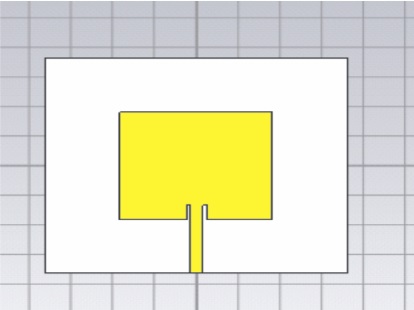
Figure 3. Presented Compact Microstrip 4G Antenna
The antenna presented in Figure 3 operates at fundamental frequency of 2.42 GHz having -10 dB return loss as shown in Figure 4. Figure 5 and 6 shows VSWR and radiation characteristics of the presented antenna respectively along E plane at the fundamental frequency of 2.42 GHz.
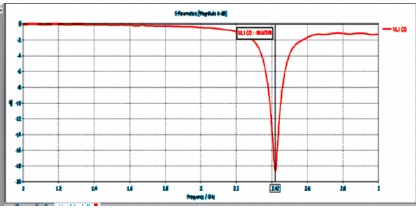
Figure 4. Simulated |S | Characteristics of the Presented Antenna
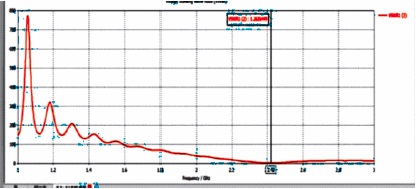
Figure 5. VSWR Characteristics of the Presented Antenna
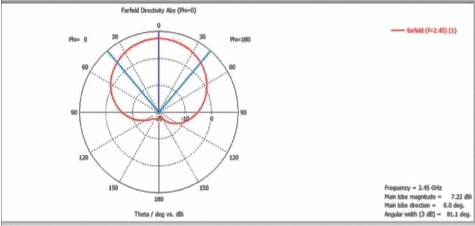
Figure 6. Radiation Characteristics along E-plane at 2.45 GHz
With rapid advancements in wireless technology development to meet customer requirements for data and voice services, 4G technology is outperforming its predecessor 3G technology. However, there are still numerous challenges, and an unexplained issue needs the attention of an RF engineer. These challenges are particularly significant when building antennas for mobile devices, and they can be solved using modern technologies such as MIMO technology. We have discussed several of these technologies in this paper, which can help to reduce the problems of 4G technology. Further, we have presented the design of a compact micro strip antenna that facilitates operation at 4G frequency of 2.42 GHz. The presented antenna offers excellent electrical and radiation characteristics which can be thus deployed in single ended 4G devices.