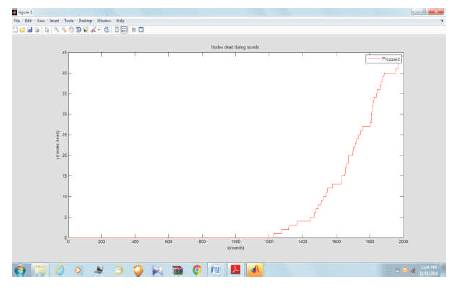
Figure 1. Nodes Dead during Each Round
Clustering is a popular routing technique in configuring Wireless Sensor Networks (WSNs). It can determine the communications between all nodes to collect data in an efficient manner. It handles the main challenge of energyefficiency in WSNs, and can be used to re-configure the network according to changes in the nodes' conditions. In this paper, an energy aware clustering algorithm is proposed for utilizing the energy efficiency and prolonging the lifetime of the network. The proposed algorithm elects the Cluster Head based on the parameter of residual energy. The Cluster Head node gathers the information from its members and forwards it to the Base Station. The proposed algorithm constructs the virtual circle for balancing the energy consumption among the sensor nodes. The simulation results show that the proposed algorithm utilizes the energy efficiently and extends the lifetime of the network efficiently.
Wireless Sensor Network (WSN) is a wireless network comprising of spatially distributed self-sufficient devices utilizing sensors to considerately observe physical or environmental conditions, such as temperature, sound, vibration, pressure, motion pollutant at different locations [ 1]. Each node in a network is typically organized with a radio transceiver, a tiny microcontroller, and an energy source, usually a battery. These low-cost and low efficient sensor nodes collectively to form the structure of the network. The enlargement of WSNs was originally motivated by military.
Clustering is a vital method in energy efficient routing protocol for WSNs. In sensor network clustering, the network is separated into several clusters based on certain criterion, with each cluster managed by a Cluster Head (CH). Sensor nodes in a cluster convey sensed data to their CH [ 5]. The CH relays the data to a destination or an upper cluster in a hierarchy of clusters with possible aggregation and combination operations. Clustering scheme increases the energy efficiency by avoiding long distance transmissions through CHs as intermediate nodes. In addition, there are intra network data operations, such as data aggregation and fusion eliminate redundancy, thereby reducing the total energy consumption.
In this paper, the authors have proposed and evaluated an energy efficient clustering algorithm for prolonging the lifetime of the network. The proposed algorithm extends the network lifetime by electing the cluster head with high residual energy. This balances the remaining energy on nodes by rotating the role of nodes based on their current residual energy level. The proposed approach achieves increased network lifetime by minimizing the energy consumption of each node and extending the lifetime of the network.
The rest of the paper is organized as follows. Section 1 analyzes the related work. Section 2 describes the proposed energy efficient clustering algorithm for prolonging network lifetime. Section 3 evaluates the performance of the proposed approach. Finally, conclusions are given in the last section.
This section reviews in depth the various algorithms used for data gathering in wireless sensor networks. It brings out the weakness of the existing algorithms, finding out the research gap.
The first and most famous proposed protocol to decrease energy consumption using adaptive clustering of sensor nodes is Low Energy Adaptive Clustering Hierarchy (LEACH) [ 3] protocol. Although the Power Efficient Gathering in Sensor Information System (PEGASIS) [ 6] protocol does not be counted as a clustering protocol, its method for reducing energy consumption alike all clustering protocols is reducing the size of data sent to the centre by compression and elimination of redundant information. In this protocol, a chain is formed in the beginning of each round. Process of chain formation can be centralized as well as decentralized. Deficiency of this protocol is the assumption that all information of network has the ability to be compressed and converted into one data with an equal size to each of the nodes' data. In addition, delay of this protocol is also very much.
A Hybrid, Energy Efficient, Distributed clustering approach for ad hoc sensor networks (HEED) [ 11] is also a clustering protocol, which uses the multi-level energy feature to select the cluster head node. In fact, the combination of adjacent degree with neighbours and residual energy of each node is used to form clusters. In this algorithm, cluster heads are suitably distributed and sending data to the BS is performed in a multi-hop way.
An Energy Efficient Clustering Scheme in wireless sensor networks (EECS) [ 4] alleviates disadvantages of LEACH protocol to some extent. In this protocol, cluster head candidates with a constant and specific radius begin to compete with other candidates and among them, candidates with higher energy will be elected as cluster heads. Ordinary nodes also besides considering the distance to the cluster head employ the distance of cluster head to the centre as another criterion for selection of cluster head. Sending data from the cluster heads to the centre is done in a single hop way. Distribution of cluster heads in this protocol is appropriate.
On the other hand, taking into consideration the residual energy criterion in the cluster head selection, possibility of selecting cluster heads with low energy level is very low. The disadvantage of this protocol is its high data overhead.
Unequal cluster based routing protocol (UCR) [ 1] protocol is also one of the hierarchical clustering protocols. Cluster head selection process in this protocol is similar to EECS protocol with the difference that the radius of nodes' candidacy is variable so that the nodes farther away from the main centre have larger radiuses. The purpose of this process is that size of closer clusters to the centre be small so that intra-cluster energy in these clusters be less and since considering multi-hop communication between cluster heads impose higher consumption loads on the cluster heads closer to the BS, total energy consumption of the nodes which is the total of inter- and intra-cluster energy consumptions and being cluster head, balances for all the nodes near or far to centre.
In the Topology-Controlled Adaptive Clustering (TCAC) [ 9] protocol, the main objective is cluster heads proper distribution and load balancing on the cluster heads. The performance of this protocol is in a decentralised way. At first, some of the nodes are randomly selected as the cluster head candidates, and then some of them by the same process as EECS protocol will be elected as cluster head.
In TEEN [ 7], the cluster head broadcasts to its members, a hard threshold and a soft threshold. A hard threshold is the threshold value for the sensed attribute and it is the fixed value of the attribute beyond which, the node sensing this value must switch on its transmitter and transmit. A soft threshold is a small change in the value of the sensed attribute which triggers the node to switch on its transmitter and transmit. The nodes in the location sense the area continuously and the first time a parameter from the attribute set reaches its hard threshold, it switches on its transmitter and sends the sensed data.
APTEEN [ 8] is an extension of TEEN. It is a hybrid protocol with both reactive and proactive modes of operation. It has been shown experimentally that APTEEN outperforms LEACH in terms of energy dissipation and network lifetime.
The proposed algorithm uses a radio energy dissipation model to transmit the data to the Base Station. In this algorithm, sensor nodes are evenly distributed in square field area. The Base Station is located at the centre of the sensing field [ 10]. Once the senor nodes are deployed, the nodes and Base Station are stationary. If the transmission power is given, a distance from one node to another node is calculated based on the received signal strength [ 2]. The proposed algorithm consists of two phases, viz., Cluster Head Selection Phase and Data Transmission Phase.
The nodes are assembled into layers taking into account the distance from the base station, and a unique-id can be allotted to all the nodes according to their layer. The base station broadcast HELLO-MSG message with a node id utilizing less power. Neighbor node information collection achieved by broadcast HELLO-MSG, receives the information of its neighbors and updates the neighbor. Neighbor node information gives cluster distribution far than others and achieves good distribution of clusters. Then, CH is selected based on the residual energy and Average residual energy of nodes.
In Cluster formation Phase, CHs close to Base Station have smaller cluster sizes to preserve some energy for inter cluster data forwarding. Entire network is divided into equal size grid format. CH in lowest level selects the nearest higher layer CH for constructing clusters.
Cluster members sense and collect local data from the environment, and sends the collected data to the cluster heads.
Cluster heads receive and Compressed Sensing (CS) is done on the data from their cluster members, and then the encoded compressed data is sent to the next hop nodes.
The proposed algorithm is simulated using MATLAB tool for analyzing the performance in an efficient manner. There are 200 nodes deployed in the sensing field. The initial energy of each node is assigned to 5J. Figure 1 shows that the nodes are dead during each round. In this figure, the number of dead nodes is analyzed at each round.
Figure 1. Nodes Dead during Each Round
Figure 2 depicts the number of alive nodes by varying the execution time. The number of alive nodes are gradually decreased when the number of rounds is increased. The network lifetime is increased by maximizing the number of alive nodes for a longer time. The performance of the network lifetime is thus increased significantly.
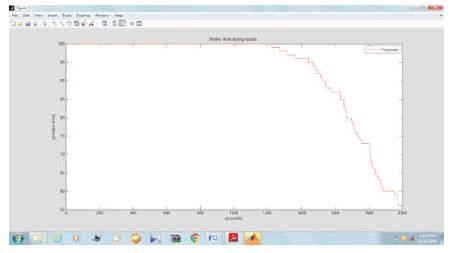
Figure 2. Nodes Alive during Each Round
Figure 3 shows that how the proposed algorithm constructs the number of clusters by varying the number of nodes in the sensing field. The proposed algorithm constructs more number of clusters nearer to the Base Station to avoid hot spot issue.
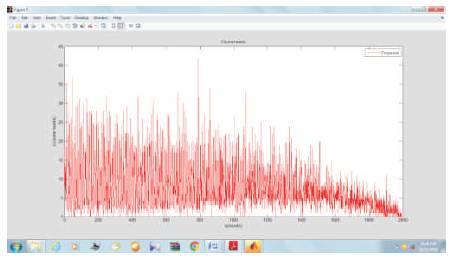
Figure 3. Cluster Formation
Figure 4 describes the ratio between the number of nodes transmitted over a number of nodes sent to the Base Station. The proposed algorithm delivers the data properly from the sensing node to the Base Station effectively. The PDR is greater in the proposed algorithm.
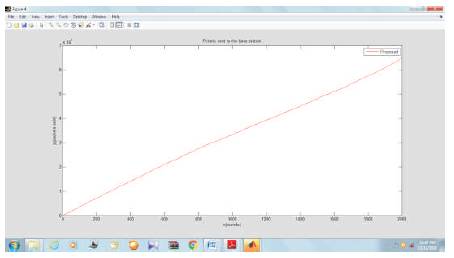
Figure 4. Packet Delivery Ratio
In this paper, the proposed algorithm uses residual energy for electing the Cluster Head. The cluster Head is responsible for gathering the data and forwards the gathered data to the Base Station. This algorithm selects the Cluster Head as a next hop for forwarding the data to the Base Station. Therefore, the proposed algorithm consumes less energy and extends the lifetime of the network efficiently.