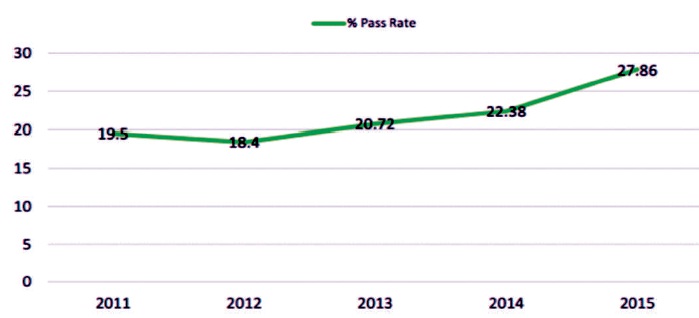
Figure 1. Geography National Pass Rate for Ordinary Level from 2011-2015 (Source: ZIMSEC, 2016)
The present study was aimed at investigating the integration of ICT in Geography in two selected schools in Kadoma. The objectives of the study were to assess the exposure of learners to ICT and technological devices, identify the positive contribution of ICT in Geography learning, and to assess the teacher' attitude and competencies in ICT integration in geography education. Questionnaires, interviews, and participant observation research tools were employed to both teachers, administration, and learners in two selected schools. The study revealed that learners at Jameson High school were more exposed to ICT devices than those at Munyaradzi High school. It was identified that ICT integration produces positive outcome when integrated correctly into teaching and learning of Geography as indicated by high pass rate at Jameson High school. The study found that teachers' attitude towards ICT integration in school was generally favourable particularly at Jameson High. The study recommends that ICT should be taken seriously in Geography learning by both teachers and administration; Geography rooms should be equipped with ICT equipment for learning.
Recent improvements and developments in the arena of Information and Communication Technology (ICT) has brought about a complete overhaul in the discipline of geography education and other disciplines in education. Literature from many scholars support the fact that the integration of technology in instruction can improve student performance (Molenda & Pershing, 2008). A related study by International Society for Technology Education (ISTE) revealed that 'integration of technology into instruction has a positive outcome on student achievement' (ISTE, 2008, p. 3) Less than a decade in Zimbabwe, the most momentous mechanisms of teaching were, chalkboard, teacher, textbooks, and chalks itself within the classroom. Nevertheless, ICT in education gained the momentum in the classroom, tools like computer, internet, projectors, whiteboards, and printers has now been integrated in the classroom for the benefit of both teachers and learners' understanding by foraging knowledge from different sources. Varied instructional media, teaching methodologies and different teaching procedures improved knowledge of learners, and raised standards within the education sector. In support, National Standards in Science, Geography, and Technology demand inquiry-based instructional models in k-12 education, especially with the “emergence of Geographical Information Science (GIS) as an instructional technology for supporting contextually rich student learning” (Baker, 2005, p. 44). Technology has changed the teacher's role in transferring of knowledge to learners only, knowledge is now being inquired from various sources through e-learning facilitated by computers, nowadays a teacher is a facilitator in the classroom rather than a lecturer. Paraskeva, Bouta, and Papagianni (2008) argue that technology changed the face of the teacher's role in education from traditional knowledge transfer or to a facilitator. Packages from ICT allow teaching to be easier by enabling learners to critically think, inquire, and solve problems that arise in the classroom by accessing, gathering, presenting, and analysing information within and outside the classroom (Scheffler & Logan, 1999; Dooley, 1999). ICT has not only changed the teacher's role, but has provided software packages like Word, Excel, Access, and Power point for the purpose of improving educational outcomes.
At a global level, computers in education started to be become popular in the 1980s when cheap micro computers became available on the market (Pelgrum & Law, 2003). Stimulated by various nations' policies to catch up with the technological race, many countries started to build their own brands of microcomputers and distributed them to schools around the world. Pelgrum and Law (2003) further noted that the term 'computers' was replaced by 'Information Technology' (IT) in the late 1980s. This was followed by the introduction of the term' Information and Communication Technology' (ICT) around 1992 when email started to become popular to the people. The political interest in ICT was only boosted by the introduction of the 'World Wide Web' (WWW). During the last two decades, countries have invested heavily in ICT. Aristovnik (2012) points out that ICT in education and training has been a key priority in many countries of the world in the last decade. ICT has had a major impact on the education sector, on organization and on teaching and learning methods. In some countries, schools have integrated ICT into the curriculum, and demonstrated high levels of effective and appropriate ICT use to support teaching and learning across a wide range of subject areas. However, in other countries, schools are in the early phase of adopting ICT, characterized by important enhancements of the learning process, some developments of e-learning (ICT-enabled learning), but without any profound improvements in learning and teaching (Balanskat, Blamire, & Kefala, 2006). The Zimbabwean government adopted the ICT policy in 2005, which was aimed at achieving total transformation of the nation into a knowledge-based society by 2020. Chitanana cited in Zvobgo (2014) highlights that the National Science and Technology policy adopted in 2002 and the Nziramasanga (1999) recommended the promotion of the educational use of computers for teaching and learning in educational institutions. This was buttressed by the nation's president, President Robert Mugabe's support by donating computers to ten schools in each of the ten provinces of Zimbabwe. Almekhlafi and Almeqdadi (2010, p. 166) contends as follows “Technology is a growing part of any society today… has become a cornerstone for any country's efforts to improve students' performance…”. The emergence of ICT has made an improvement on the education for every student as it brings a lot of advantages for every student. For many teachers, ICT also has improved their effectiveness on the teaching process, which in turn could help the student to enhance their educational performance. That goes without saying ICT has gradually become apart of the life for every student and teacher. In recent years, the computers and internet has shown their effectiveness and efficiency in education. Besides, ICT has also improved the learning environment of student. For ICT, if used appropriately, it could help to expand the access of education for students and raise the quality of education by reinforcing the relevance of education. E-learning, blended learning, and distance learning are the various types of learning that arise from the ICT.
Quite a number of schools in Zimbabwe have been experiencing high percentage pass rates at Ordinary and Advanced Level Geography ZIMSEC examinations, while some schools, especially in rural areas, are scoring a lower percentage pass rates. Though a number of factors can be linked to such high and lower pass rates, the incorporation of ICT in many schools has been attributed to such high pass rates as shown in Figure 1. Overall, national statistical figures from ZIMSEC indicate that Zimbabwe experienced a slight decrease in 'O' level pass rates in 2012 as compared to the results of the preceding year. However, the period since year 2013 resulted in the country experiencing increasing pass rates as shown by the graph (Figure 1).
Figure 1. Geography National Pass Rate for Ordinary Level from 2011-2015 (Source: ZIMSEC, 2016)
ICT brought efficacy teaching in the discipline of geography, Maguire (1999) pointed that:
Computers are an enabling technology: they are tools which enable geographers to improve their efficacy and efficiency in many ways. There are two key aspects of computers, which assist geographers in this regard. First, computers can be used to collect and store large quantities of data in an organized manner. Second, such data can be quickly manipulated and presented in a whole host of different ways. (p. 222)
Geography as a subject related to the environment, there is a need for software and tools that collect and store spatial geographic data in schools (Demirci, 2009). Google Earth is an example of geographic application used to store information and used a media in teaching geography.
The growth of Geographic Information System in geography curriculum requires a great deal use of computers and technology in teaching and learning. The use of ICT in geography is a mandatory requirement due to improvements in geographical technology topics in geography. Topics like GIS, Geo-statistical, and geographic studies in Zimbabwe School Examination Council (ZIMSEC) calls for the use of computers and technology in geography lesson. Software packages like SPSS, QGIS, DIVAGIS, and Map-Maker are software examples that replace analogous paper topographical maps into a new digitalized and modernized map in computers. Computers softwares in geography are more accurate and precise in collecting, presenting, and analysing geographic and spatial data. The use of computer software in geography brought about an increase in Geography pass-rate in Advanced Level Geography subject for Zimbabwe School Examination Council as Figure 2 indicates. Focusing the ZIMSEC 'A' level results of 2014 and 2015 to the geography subject, indications are that there was a magnitude improvement in academic performance by both school and private candidates (Figure 2). One would be forced to wonder the factors behind the high percentage pass rate of school candidates as compared to those of private candidates as shown above.
From Figure 2, it is noted that advanced level geography pass rate rise from 36.01% in 2014 to 72.95% in 2015 for school candidates. This statistical information is of more concern to an educationist, there is a need for a closer look on the effects and causes of increases in pass rate. Theoretically, an increase in globalisation and technology has influenced the learning process positively as explained in the above background. Geography is one of the elasticity subjects to accommodate new technology into instructional methodologies.
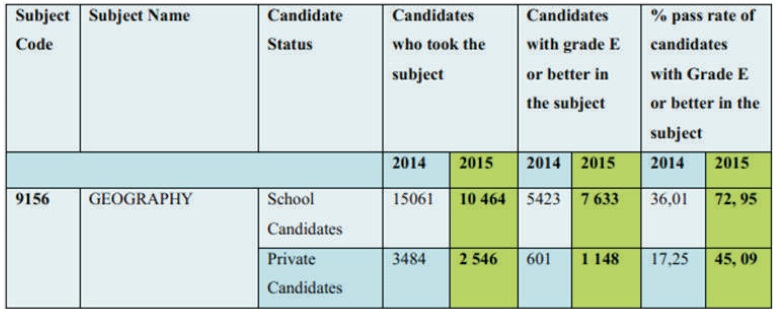
Figure 2. November 2014 and 2015 Advanced Level Geography Pass Rates for School and Private Candidates (Source: ZIMSEC, 2016)
Research studies revealed that ICT plays an important role in changing the face of learning in education, ICT is user friendly in providing new methods of teaching, which inculcates geographic knowledge in learners. Computers and technological devices are yielding desired results in the education sector of Zimbabwe. Studies by Aristovnik (2012) indicates that ICT integration in education in countries like Belgium, Finland, Norway, and Korea is very effective and efficient in producing desired outcomes in the education sectors of these countries. Aristovnik's (2012) research was supported by studies from Olaore (2014) who insisted that incorporating ICT in education provides ample benefits in educational outcomes because ICT helps in designing and developing learning materials, electronic teaching materials can be saved and retrieved for future use and ICT facilitates independent study and individual instruction specifically on distance learning. This was also confirmed by Hassel (2002) and Maguire (1989) that ICT provide safe and non-threatening environment for learning and help learners to meet their individual unique needs and abilities during learning. Studies by Lim (2007) indicates that technology is very crucial as it inquire and provoke learners to higher order thinking when ICT is combined with suitable and best educational instructional methodologies at their level. If ICT integration in geography lesson is perceived in this standpoint, teachers are at the forefront of success and failure of students due to technology integration into teaching and learning. Studies by Keengwe, Onchwari, and Wachira (2008) reveal that technology integration is a difficult task that needs teacher's motivation, understanding, perception, and beliefs in educational technology integration into teaching and learning. Studies from Hew and Brush (2007) reveal that if teachers like technology, integration into classroom and thought that it is beneficial to include technology integration into teaching and learning will be much easier. Many studies acknowledge that teachers are most important players in technology integration into teaching and learning. Failure and success of learners depend on teacher's use of technology in teaching and learning.
Despite the importance of ICT integration in education identified above, studies reveal that technology integration in education is affected by other factors (Hew & Brush, 2007; Keengwe et al., 2008). Studies reveal that technology integration into classroom is affected by lack of equipment and lack of technical support. Hew and Brush (2007) identified 123 barriers in technology integration into learning and grouped them into six categories which are; resources, knowledge and skills, institutions, attitudes and beliefs, assessment, and subject culture. Basically, Hew and Brush (2007) identified these factors mainly basing on the role of the teacher and few external factors, which affect technology integration into teaching and learning. Studies by Demirci (2009) identified that technology integration into classroom is not an easy task, especially when looking to Geography and incorporation of Geographic Information System into the curriculum. This is because GIS was specifically designed for professional spatial analysis of data rather than for educational purposes at secondary school. The indication from literature review is that technology integration is basing on teachers, though other external variables may intervene in integration. Teachers must be motivated to integrate ICT in teaching and learning. The assumption of the present study is that technology integration is very crucial in the development of education particularly geography, which need to be updated by current and modern stance in the environment. Geography teachers should accept technology in daily instructions so that learners benefit more from technology integration in teaching and learning.
Geography is the subject which study earth and the world environment, as the subject of the earth and environment, to study fully and deeply in its subject matter there is need to move hand in gloves with technology. The growth of technology changes earth and world environments greatly, therefore geographers should be more acquainted in the use of computers for the study of earth. This means ICT and computer technology should be maximally integrated in geography school curriculum, where instructional approaches are being undertaken in whatever circumstances. With increasing changes in global world, technology mastery should be embraced in geography to solve problems that arise. Teachers should integrate ICT in teaching and learning, therefore, teacher's ICT acceptance is very important in determining technology integration in geography education. This research is underpinned by Technology Acceptance Model (TAM), which was propounded by Davis, Bagozzi, and Warshaw (1989). According to Davis et al (1989), technology acceptance is based on three factors which are perceived usefulness, perceived ease of use, and behavioural intentions.
The TAM assumes that perceived usefulness and perceived ease of use directly affect teacher's behavioural intentions to use and integrate computer into teaching and learning as shown in Figure 3. Finally, behavioural intentions are the factors, which actually determine the user to use technology. A study from Yi and Hwang (2003) confirms that there is a close relationship between behavioural intentions and actual use of technology. The theory assumes that behavioural intentions of geography teachers to use ICT in teaching and learning is affected by their attitudes, which are developed from perceived use and ease of use. Despite, the importance of ICT in Geography lessons, Zimbabwean secondary schools are still far from ICT integration into teaching and learning. Studies from Bereiter and Scardamalia (2006), Lim and Khine (2006) reveal that even when technology is seen as the prime transformer in teaching and learning, its use in teaching and learning remains trivial and negligible. That is teachers do not use technology effectively for the purpose of teaching and learning. Studies by Bayhan, Olgun, and Yelland (2002) reveal that majority of teachers shun to use computers in teaching and learning for the purpose of lack of self-confidence and professional development at work. Therefore, this paper seeks to investigate whether the use of ICT in geography lesson is underpinned by TAM of other external variables.
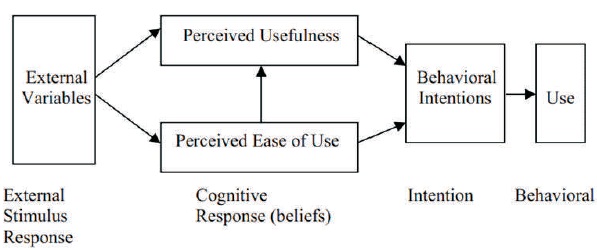
Figure 3. Technology Acceptance Model (Davis et al., 1989)
The study aimed at assessing the integration of Information and Communication technology in Geography at Jameson High and Munyaradzi High Schools in Kadoma. The first aim of the study was to assess learners' exposure to ICT and technological devices in teaching and learning geography. Secondly, the positive contribution of ICT integration in geography education at two high schools in Kadoma. Lastly, the paper aimed at establishing teachers' attitudes and competencies towards the use of ICT as instructional media in teaching and learning of geography. The study employed qualitative methodology in which observations, interviews, and questionnaires (open and closed) were used to gather data in the field. The study focused on teachers, students, and administration in gathering data concerning ICT integration in teaching geography.
The study was located in Kadoma urban of Mashonaland West province as shown on the map given in Figure 4.
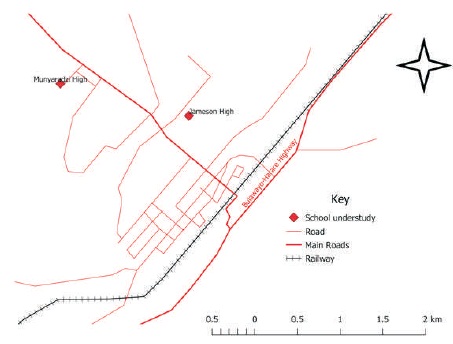
Figure 4. Map showing Location of Jameson and Munyaradzi High Schools in Kadoma
Results revealed that majority of students confirmed that they do not own technological devices like cell-phones, tablets, iPad, and iPhone. This is so because the Ministry of Primary and Secondary Education policy do not allow learners to bring their own devices at school. Learners are also restricted to access computers at school computer laboratories due to scarcity of school computers particularly at Munyaradzi High School. The statement was confirmed by both teachers and learners who asserts that 'Computers at this school are fewer to support instructional media in geography… they are restricted to be used only in computer lessons. Computers should be more enough to be used in geography room not to share computers in computer lab with computers lesson as it create clashes during learning'. However, the study revealed that learners at Jameson High school are exposed to ICT during geography lessons better than those at Munyaradzi High School. Learners' exposure to ICT plays a crucial role in shaping learner's interest and understanding of geographic concepts. Learners' to ICT broaden their understanding and experiences in complicated geographic concepts. Studies by British Educational Communication Technology Agency [BECTA] (2004) reveal that pupils' understanding of specific geographic topics such as erosion and agriculture can be enhanced by use of simulations and other multimedia resources in learning. BECTA (2004) notes that the use of ICT in learning geography enhance pupils' reasoning ability, decision making, skills inquiry, and problem-solving skills that may arise in the arena of geography. Learner's exposure to ICT is of paramount importance to learners through concepts like GIS and remote sensing topics in geography. These topics (GIS and Remote Sensing) are computer based topics, which require a pure grippe of computers and ICT during learning. The use of Quantum Geographic Information System (QGIS) during learning is vital integration of ICT in geography teaching. One cannot learn GIS without manipulation of both hardware and software of computers; hence integration of ICT in geography classroom is compulsory.
ICT is changing the face and nature of geography continually, geography as a subject is now technology embracing subject. This means geography now cannot be taught and successfully learnt without utilization of computers and ICT kits. Introduction of Geographic Information System, Remote Sensing, and Research techniques into geography secondary curriculum maximize the use of computers in softwares like QGIS, DIVAGIS, SPSS, and other computer software programmes, which support understanding of geographic concepts. These topics bring in new teaching methods into the discipline of geography which is switching from traditional teaching (use of chalkboard, textbooks, newspaper and chalks) into traditional methods of teaching which cuddles the use of computer, videos, DVDs, and TVs in teaching and learning.
Prior to the analysis of the contribution of ICT integration in geography, percentage pass rates for Ordinary and Advanced level geography results must be analysed for both schools (Munyaradzi and Jameson High School) (Figures 5 and 6).
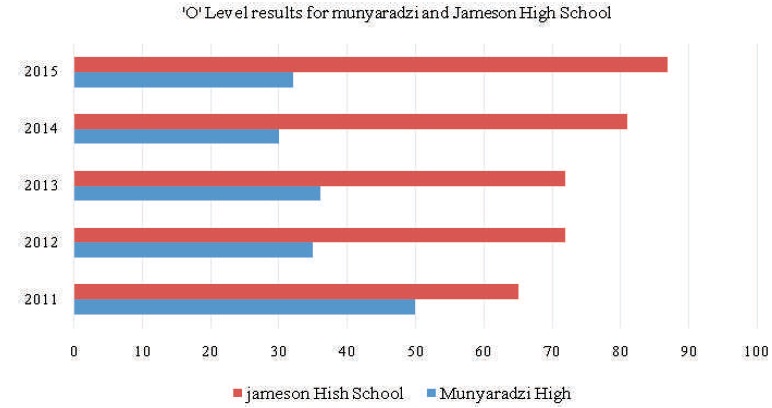
Figure 5. Ordinary Level Results Geography Analysis for Munyaradzi and Jameson High School in Advanced Level Results Analysis for Geography

Figure 6. Advanced Level Geography Results Analysis for Munyaradzi and Jameson High Schools in Kadoma from 2011 to 2015
Teachers from Jameson High school's responses reveal that learner's exposure to Wi-Fi connections at school enabled them to access electronic educational materials and this is responsible for high percentage pass rates and grades at this school for both 'O' and 'A' levels. The pass rate for both Schools is depicted on graphs in Figure 6, Jameson High school pass rate ranges from 65% to 87% and 90.1% to 95.5% for ordinary and advanced level, respectively. The findings above reveal that learners at Jameson high were exposed to ICT during geography lesson than learners at Munyaradzi High school as revealed in the above assessment.
In support of the above, the study established that learners are highly motivated when ICT is integrated in the lesson because students are exposed to rich sources of information than traditional modes of teaching. Respondents reveal that exposure to ICT tools like computers and accessibility to WI-FI develop learner's research skills, which develop their reading and observation skills in geography. This raises their understanding of concepts in geography curriculum packages. This was confirmed in the study by Hassell (2002) who insist that ICT provide safe and non-threatening environment for learning and help learners to meet their individual unique needs and abilities during learning. This was seconded by Maguire (1999) who reasoned that computers can quickly manipulate data and present in a whole different ways, which improve efficiency and understanding in geographic concepts in an interactive way.
Majority of respondents reveal that ICT integration in geography enhances skills in geographic enquiry to students and teachers and expand their understanding of environment and spatial phenomenon in geography. This is enhanced through their exposure to world people's images, world environment and places through access to Wi-Fi, computers social media softwares like Facebook, WhatsApp, and Twitter. Studies by Delen and Bulut (2011) concurs with this study by insisting that ICT contribute positively to learning of science and mathematics. Studies by Ikelegbe (2006) cited in Okeh and Opone (2007) reveal that there are many advantages of incorporating ICT in education. This is because ICT helps to develop and design teaching and learning materials, such as maps, pictures, and videos that can be captured lively in the field. They postulate that ICT in form of Wi-Fi help teachers to access electronic teaching materials like e-books, journals, videos, and pictures that can be downloaded and saved in computers for future use. This creates easy access and analysis of data during learning as revealed by Maguire (1999) and Hassell (2002).
Teachers at both schools (Munyaradzi and Jameson High School) established that ICT plays a major role in teaching and Learning of geography particularly in topics like volcanicity, rocks, weathering, and climatology, which are abstract concepts in geography. Respondents reveal that through experience, these abstract concepts became simple and understandable by learners through video simulations. This was supported in studies by BECTA (2004) who states that geographic concepts like agriculture and erosion can best be understood by video simulations. The study resonates with the studies from Obondo, Too, and Nabwire (2013) who argues that use of video during teaching and learning is effective in enhancing students' achievement in learning topics like landforms, river processes, and rainfall formation and patterns in geography. The study further reveal that learners' exposure to ICT devices like mobile phones, iPhones, iPads, laptops, computers, and GPS devices raise morale of learners and motivate learners in geography lesson. This helps learners' understanding and enhances geography education standards in secondary schools at both ordinary and advanced level. This was shown by leaners' motivation and higher level of percentage pass rates at Jameson High school, which uses computers in learning. Pass rate at Jameson High was outstanding in the past 5 years as compared to that of Munyaradzi High school. This is because students at Jameson High school are exposed to computers than those of Munyaradzi High school.
Teacher's attitude towards technology can be a major problem in integrating ICT into teaching and learning of geography in secondary schools. Attitude is a specific feeling that indicates whether a person likes or dislikes something. In this case, teacher's attitudes of the use of ICT in geography lesson is shown by their acceptancy and frequency uses of ICT in teaching geography. This study reveals that at Munyaradzi High School, there was no ICT materials integrated in the teaching of geography as indicated in responses of both teachers and learning. Teacher's responses towards shunning ICT integration in teaching and learning of geography was accentuated by power-cuts and electricity shortage. The use of computers, projectors, TVs, DVDs, and other multimedia is by no means it can be used without electricity. This means electricity is the major barrier to the use of ICT into teaching and learning of Geography as indicated by one of the respondents who insisted that
'I was frustrated by integrating ICT in teaching and learning, especially electrical devices. At one time when I was prepared to teach using a laptop and projector there was a power cut and generator backups were not switched on in time’
This indicates that the use of ICT in schools is trodden down by power cuts and electricity shortages. This helps create and develop the negative attitude towards ICT integration at Munyaradzi High School as was indicated by teachers and administration. The study revealed that besides frustrations from power cuts, other factors which develop teacher's negative attitude towards ICT integration into geography learning include unwillingness to change from traditional methods of teaching, lack of exposure to ICT, and some teachers have never used computers before. However, shortage of computers at Munyaradzi High School is one of the major contributing factors for the development of negative attitude towards ICT integration in geography lessons. Studies by Ang'ondi (2013) confirm that use of ICT in geography lesson is to increase teachers' burden in already burdened load. The results also confirm that lack of commitment by administration at Munyaradzi High school was responsible for the development of negative attitude of teachers. Munyaradzi High school revealed that there are fewer computers to integrate into geography lessons and there are very fewer ICT devices like projectors to use into teaching and learning. Respondents revealed that administration is slow to show interest in providing generator backups during power cuts and strict rules set by administration. 'Sometimes computer laboratory rooms are kept locked to reduce theft cases'. This concurs with studies by Ang'ondi (2013) who reasoned that administration is to a larger extent developing negative attitude of teacher towards incorporating ICT in teaching and learning, ICT rooms are kept locked and accuse teachers to have vandalised computers at school. Lack of administration commitment to ICT integration in geography lesson in schools studied led teachers to resign towards the use of ICT in teaching geography. Teachers at Munyaradzi High School showed that they have turned back to traditional methods of teaching as there is no support on the use of ICT in Geography from the administration. 'The administration is lacking commitment for teachers to integrate ICT in teaching and learning. Sometimes we want to conduct our lessons using computers, unfortunately, computer room is found to be locked as they safeguard computers against theft'. Studies from Kula (2010) stress that management should support teachers in the use of ICT in learning because any contrary to this will automatically disqualify teachers from using ICT and develop negative attitudes towards ICT integration into teaching and learning.
However, results from this study reveal that teachers at Jameson High school integrate ICT particularly computers, overhead projectors, DVDs, and TVs into geography teaching and learning. Participant observation, interviews, and data from questionnaires established that teachers use videos and pictures from overhead projectors and laptops. These simulations raise learners' interest towards geography learning. Teachers at Jameson High indicate that the use of ICT in geography lesson raise learner's capabilities, knowledge, and learners are very attentive throughout the lessons. This was confirmed by studies from Wong and Ng (2005) and Walford (1997) that students accept the use of computers in geography lesson and showed enthusiasm, appreciation, and readiness to use computers in learning. Kinuthia (2009) and Wabuyele (2006) indicate that when students are given the chance to use computers in geography and effectively utilise technology for effective learning, teachers at Jameson High showed positive attitude towards ICT integration into teaching and learning of geography than those at Munyaradzi High. This was backed up by studies from Osodo, Indoshi, and Ongati (2010) who reveal that 82% of teacher's attitude was favorable towards the use of ICT in geography lesson. It was revealed that teachers developed positive attitude towards the use of technology in teaching geography. Studies by Sang, Valcke, van Braak, and Tondeur (2010); Osodo et al. (2010); and Teyfur (2009) reveal that teachers show willingness to embrace ICT in teaching Geography. Teachers used computers to unpack abstract concepts in geography as such educational standards are being continually increased in geography due to use of ICT. ICT help to enhance the comprehension of abstract topics in the curriculum. The present study revealed that teachers at Jameson High showed a positive attitude towards integration of ICT, which was depicted by their frequencies in the use of ICT in teaching geography. This has improved the educational standards of learning at this school as indicated by learners' participation during learning. Though some teachers at Munyaradzi High school show negative attitudes towards the use of ICT in teaching and learning, an overview of teacher's responses showed a favourable attitude towards the use of ICT in teaching and learning as it motivates and develops learner's needs towards geography learning.
Results of the current study reveal that learners' exposure to ICT and other technological device is very low at Munyaradzi High school, however, learners at Jameson High indicates that their exposure to ICT device is better due to laptop accessibility and access to computer laboratory. It was revealed that the Ministry of Primary and Secondary Education policy did not allow learners to bring in mobile phones, iPads, iPods, iPhones, and other cellphone related devices at schools. This was the most impediment factor, which limited learner's exposure to ICT gadgets at school. The study also reveals that ICT integration in geography learning is changing the face of geography learning positively. Results revealed that both Ordinary level and Advanced level geography results at Jameson High School, were constantly high due to technology integration at the school. Due to technology integration at Jameson High, school's results surpass that of Munyaradzi High school, which failed to integrate technology in geography lesson. Finally, the study identified that the overall teacher's attitude towards technology integration was generally high though some teachers at Munyaradzi High school depict a negative attitude towards technology integration due to lack of self-confidence, lack of administration commitment, strict laboratory rules, and lack of professional development in the field of ICT integration in teaching and learning of geography. The study revealed that technology integration into teaching and learning yield positive results to learners and it raise educational standards in geography.
Based on evidence from this study, ICT integration in geography lesson plays a crucial role in shaping geography and produce positive outcomes in educational outcomes, therefore it is recommended that education system must take ICT integration in geography seriously so that national pass rate will rise. It was revealed that computers at Munyaradzi High school are generally low in student/computer ratio, there must be alternative sources to fund for computer laboratory improvement so as to increase learners' exposure to ICT devices. Lastly, administration must reduce teacher frustrations by removing barriers to technology integration into geography lessons, generators must be powered in time to supplement electricity shortage and computer laboratories must be open and be accessible so that teachers access and use computer laboratory whenever geography instructions are to be undertaken. Access to resources, quality of software and hardware, such as QGIS, Thuban, DivaDIS, Google Maps, Illiwis, ease of use, incentives to change, support, collegiality in the school, and commitment to professional learning are among other factors influencing teachers' decisions to use new technologies in the classroom (Mumtaz, 2000). The need is more important, given the centrality of GIS in Geography teaching and other disciplines. GIS is a broad set of software programs designed to store, retrieve, manipulate, analyze, and display geographical data-information concerning people, places, and the environment (Firtzpatrick & Maguire, 2000). The technology has been introduced recently in Zimbabwe in an updated curriculum, which is current in use from 2015-2022, making a huge and imperative development of teachers at all levels.