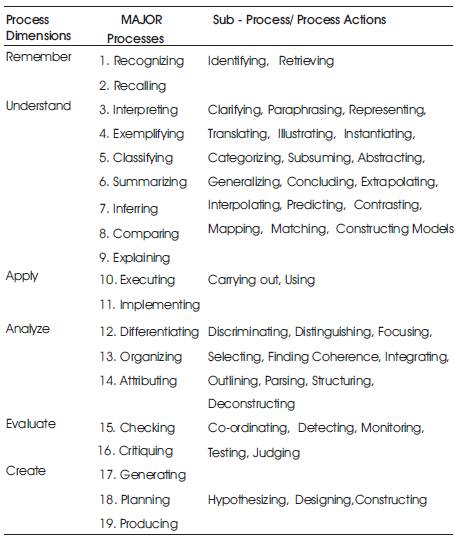
Table 1. Process Dimensions and Processes as per Revised Blooms Taxonomy
Transaction methods and approaches of value education have to change from lecturing to process based methods according to the development of constructivist approach. The process based methods provide creative interpretation and active participation from student side. Teachers have to organize suitable activities to transact values through process based teaching. This paper deals with the ideas of preparing Educational objectives and organizing student centered or process based classes on value education in accordance with the Process Dimensions proposed in Revised Blooms Taxonomy (RBT). RBT suggests Remember, Understand, Apply, Analyze, Evaluate and Create as the process dimensions. Teachers can organize the objectives of value education classes according to these process dimensions. It will promote effective transaction of values in modern methods.
Value education entitles high consideration in the present scenario of education. Like all other divisions of education, value education is placed with a lot of changes in planning, practice and evaluation. The pedagogical approaches based on constructivist methodology are the vital spark in the present education system in India. Value education also cannot abstain from this invasion of pedagogical changes. In light of the far-reaching shifts in the definition of objectives of value education for the contemporary society, certain changes must be done that are necessary in planning and practice of the same.
India is an accumulation of human beings with wide ranging differences in language, culture, beliefs, practices, religions, dress codes and ethnicities. Spirit of co-existence should prevail in this plural society in all walks of life. Goel & Goel (2005)marked that tolerance must be a major value in a plural democratic culture like India. School education must develop social values and personal values in children right from the beginning. The social atrocities that occur in India day by day create distrust on efficacy of Indian education to develop pupils with desirable values. To overcome this distrust, Education should impose the development of values more effectively.
There have been enough indications for social virtues and vices that can be highlighted by education. Attainment of values and practice of virtues must be the aim of schooling. Proper setting of instructional objectives in the value education classes will support attainment of these aims. The Educational aims should have to be framed in accordance with the curriculum, method of teaching and transaction strategies. Such a framing is essential to make the objectives of value education fruitful.
According to Bloom (1956), the instructional objectives are settled in three major domains: Cognitive domain, Affective domain and Psycho-motor domain. Each domain has different levels. For example, according to Bloom, cognitive domain has the levels such as knowledge, comprehension, application, analysis, synthesis and evaluation. The instructional objectives may be placed in any one of these levels. Achievements of objectives in any one of these six levels determine the effective accomplishment of both of them in affective and psycho-motor domains.
Mostly, all value education patterns in the present curriculum are prepared objectives according to the suggestions on instructional objectives as per Bloom's Taxonomy. In these circumstances, a change in the ways of transaction of value education content is necessary in the new modus operandi according to the objective settling of Revised Blooms Taxonomy (RBT). Setting objectives according to RBT is essential to promote learners' competency of value acquisition and value potential. This approach will be an innovative approach in the value education programs at school level.
Anderson and Krathwohl (2001) identified six process dimensions and named them in RBT as Remember, Understand, Apply, Analyze, Evaluate and Create. The cognitive process dimensions represent a continuum of increasing cognitive complexity from lower order thinking skills to higher order thinking skills. The thinking skill starts from the lower order, which is Remember and reaches at the higher order that is Create. Anderson and Krathwohl (2001) proposed nineteen specific cognitive processes that further clarify the scope of the six categories.
Details of those process dimensions are furnished in Table 1. The process dimension indicates the possible cognitive processes that are to be taken place in human cognition during the learning process formally and informally.
Table 1. Process Dimensions and Processes as per Revised Blooms Taxonomy
The processes listed in Table 1 represent the acquisition of a particular skill by the learner if the learning process is perfect. For example, in the process dimension 'Remember', a learner can recognize or recall or identify or retrieve a concept and information by undergoing accurate learning process. In the same way, learner will be able to judge the received information in the process dimension 'Evaluate'. The outcome of these setting is that a teacher can frame learning objectives in accordance with process that may take place in corresponding process dimension.
NCERT has suggested certain objectives that are to be achieved by children through education. NCERT (National Council of Educational Research and Training) has put forwarded 83 values as the compulsory attainable values (Maheswari, 2002). The National Curriculum Framework - NCF (2005) echoes the vision of integrating values in every aspect of schooling, seeking guidance from the constitutional vision of India as a secular, egalitarian and pluralistic society, founded on the values of social justice and equality.
The inculcation of values among students would be possible by teachers. To a teacher, better plan to inculcate values is making use of the constructivist approach. Students themselves can identify and work on values. Teacher, here, functions only as facilitator for value development among students. The processes suggested in RBT effectively support teacher in this attempt. Hence, it is becoming significant the utilization of prescribed processes of the process dimensions as per Revised Blooms Taxonomy (RBT) in implementing value education.
Maheswari (2002) refers that the major attainable objectives of value education in India are:
All these objectives are to be achieved through the effective transaction of the content of value education. Achievement of them takes place through proper design and practice of classes based on process oriented method, philosophically supported by Revised Blooms Taxonomy. In other words, the process dimensions of RBT can make use to coordinate the teaching and learning activities in order to achieve values by the students.
The inculcation of values at school stage itself needs an hour daily. It is suggested by several experts that, value inculcation is better effective, while it is incorporated with regular teaching. While setting instructional or learning objective, the teacher can purposively frame one or more objectives from value education too in each lesson.
The scope of framing the objectives of value education in each process dimensions are described below with example.
The process dimension 'remember' refers to lower level cognitive functions. Under this dimension the main processes are Recognizing, Recalling, Identifying, and Retrieving.
According to Nanda (1997), any individual has a minimum level of retrievable attachment with social values, personal values and any other type of values. The attachment with mother, father or other family members and peer group etc. are giving the basement of values. Teacher can plan and implement that type of activities during the lesson which helps individual learner to recall those moments and feelings of attachments. This needs no particular subject session, but any subject teacher can include it in her class itself.
In this process dimension, value education objectives can be set in such a way that makes the individual able to recall the values, or recall the experience that shared values, recognize the affection shared by mother, father, siblings or family members. Retrieving all those experiences, situations, words, and even a minor incident will promote value development and will potentially make the individual able to identify her/his position in the value perception. Collectively remembering the life experiences or memories associated with value development will function as a platform for further value acquisition of the individual.
Teacher can frame objectives at this process dimension that suitable to retrieve value embodied experiences. By that, individual becomes able to recognize or retrieve values or qualities she/he experienced. Child also can able to recognize values from the information received. The activity may be an experience sharing session, story telling, and life experience based extempore speech or exploring the experiences.
Interpreting, Exemplifying, Classifying, Summarizing, Inferring, Comparing and Explaining are the major processes in this dimension.
Teacher has to arrange that type of activities which may provide opportunities to students to interpret or exemplify the acquired knowledge. The activities should lead students to all those processes mentioned. In classroom, teacher can arrange activities that lead students to interpret the acquired values, find out examples for value acquisition, classifying the values like social values, personal values, terminal values, and so on. Certain activities can be planned by teacher that helps students to infer, compare and explain the value related occasions, experiences and knowledge.
Activities like experience sharing, discussions based on personal experiences with values embodied situations, illustrating the life experiences or reading experiences that cling the mind on certain value embodied life situations, making stories, finding the virtues from stories, placing the proverbs through discussions and etc. can be suggested by teacher to accommodate these processes. Carefully planned processes bounded on value will effectively help the children to understand values.
Executing and Implementing are the processes in this dimension. These are along with the application level. Teacher should provide opportunities to children to make use and implement the values they acquired. That may be a real life situation. School atmosphere itself can make use for these purposes. Keeping premises clean, observing queue at various counters, interpreting others with respect, observing silence for a whole period, and etc. can be informally implemented as activities to inculcate values in this dimension. The observation and evaluation from teachers side will encourage students to practice values at the situations.
Differentiating, Organizing and Attributing are the major processes in the ‘Analyze’ dimension. Certain activities like categorizing incidents, stories, experiences and so on showing the basis of the values imbibed in them, giving a script and conducting discussion to distinguish values explained in them, activities of organizing content for value embodied stories through discussion, making pictures and posters on value contents, conducting open forum for discussing the value related matters etc. can be conducted by teacher to achieve objectives in this process dimension. Conducting such activities will help students to make use of their value potential in any social circumstances.
Major processes of this dimension are Checking and Critiquing. Teacher has to arrange activities that will take the students' attention to judge the situations, make their own appraisal, detecting the right and wrong, monitoring and judging their own activities and words and so on. Teacher can conduct some of the following activities to set objectives in the ‘Evaluate’ process dimension such as,
(i) Ask them to write one or two dilemma experiences from their own family or school life. Make the group of students and arrange discussions. The group should monitor the role of individual student in the situation and judge the performance. A positive way of criticism or advice should be followed in this activity.
(ii) Give reports, news, photos, pictures, cartoons or paintings related with public issues and make student groups to discuss the issue. Let them derive their own judgment on the issue and suggest solutions.
(iii) Conduct dyadic discussions or conversations on individually hunted issues and suggest coming out with judgment and solutions.
Processes of this dimension are Generating, Planning and Producing. This is the high level dimension of processes. Individual is supposed to manifest all the abilities he has and all the abilities he acquired in this level.
Teacher has to give certain individual activities that should support individual to creatively frame something. The individual may do artistically performance, painting, story writing and etc., depending upon her/his abilities. Students can transform the acquired knowledge to any creative version, if proper guidance and opportunities have been received. It is the duty of the teacher to organize such opportunities. It will make the student able to design value oriented situation, accommodate accurate values on any situation and generalize the values she/he acquires.
New standards, new curriculum, new techniques, new policies and new methods, everything are introduced in the education sector afresh. It seems that, the state of education continues to be bewildered, a large puzzled system that is constantly seeking reform in the application of innovative programme that supposedly will enhance and accelerate the learners' growth (Amruth, 2009). The whole of school education sectors in India are discussing the necessities of strengthening the practice of value education. Students are to be developed with high volume of value potential. The components of education including teaching and learning should cope with the expected changes. In this context, resetting of the objectives of value education according to the prevailing system and practice is irreproachable.
Values can be taught as a fact (NCERT, 2005). The present teaching learning system is process-based. Separate 'lecture and advice' oriented value education classes are unnecessary in the integrated approach. Teachers of any subject can plan transaction of values in the classroom by transacting them through the methods designed in accordance with the processes suggested in the Revised Bloom’s Taxonomy. The power of modern methods of transaction based on processes can be better realized by achieving a happy integration of utility and value, integration of body and mind, emotions and ideas, individual and society and the world at large.
Inferences of the RBT in setting objectives of Value Education are very relevant and inventive. It is principally suitable for the integrated approach of value education. Planning, teaching and evaluation of the implementation of values can be revised to process based by this way. The setting of value education objectives according to the process dimensions of RBT can be made easily and effectively by the teachers of any subject. Independency of teachers in setting objectives that are suitable for their lesson plan of teaching topic will inspire the aims of implementing value education at large.
Most of the research studies carried out in the field of value education revealed the following Goel & Goel (2005):
The above said points are the factors that hinder the implementation of value education. So, the method of instruction must be changed. Students can never remain passive listeners of 'lectures' or 'talks' on values. Such methods of teaching create ver y low level of development. Hence the system of value education should be changed and must follow the method of transaction of values differently.
The teacher is expected to function as a facilitator and inculcator for acquisition of values and transformer of inner being in constructivist approach of teaching (Prasad & Vijayalatha, 2010). The learning processes suggested in the process dimensions help the teacher to organize activities according to the learning atmosphere and content. Teacher can plan activities focusing on student effort to acquire values. Students can effectively catch values, organize them, apply in life situation, and create value embodied life situations, if the teacher planning is according to the exact ways of process dimensions described in RBT.
Present education scenario in our country demands such a system of value education that strengthens solidarity among people of different religions and cultures to live together with respect and tolerance. The acquisition of these qualities would be more effective if the transaction through process-oriented method is implemented. Students do not remain as passive listeners of lectures on values, but they themselves work on values through various activities and accommodate them with cause and effect, if the objectives of value education are designed and suitable activities are implemented according to the process dimensions of RBT.