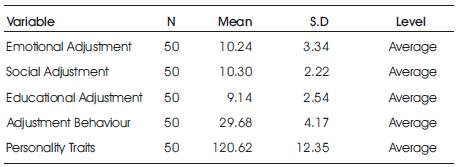
Table 1. the Mean, Standard Deviation Values of the Entire Sample of Adjustment Behaviour and its Dimensions, and Personality Traits of Adolescent Students with Visual Impairment
The student in adolescent stage faces many problems, and it is more complicated for the students with visual impairment. They need somebody to solve problems in order to avoid tensions and conflicts. Adjustment and personality traits are two important attributes that shape the students into the proper human being. Therefore, this a study aims to investigate the adjustment behaviour and its dimensions of visually impared adolescent students in relation to personality traits. A normative methodology and survey technique has been adopted to a sample of fifty visually impaired students randomly selected from six schools in Namakkal, Salem, Erode, Thiruvannamalai, and Cuddalore districts of Tamil Nadu. The descriptive analysis shows that the level of adjustment behaviour and its dimensions and personality traits were averaged for the whole sample. The differential analysis showed that independent variables onset of blindness, achievement, and birth order did not have a significant influence on the adjustment behaviour. Onset of blindness and achievement has no significant influence, while birth order has a significant influence on the personality traits. The correlation analysis shows that adjustment behaviour has a positive significant relationship with personality traits whereas adjustment dimensions have no significant relationship with respect to personality traits. The stepwise multiple regression analysis shows that birth order is the best predictor that has significiant on the influence adjustment behavior. Therefore, the average adjustment behaviour and personality traits of adolescent students with visual impairment need guidance and counseling that is very mandatory to provide a moral support for them to excel in their life.
Education is an essential element for the transformation of an educand as “good human being" even though they are different from individual skills and abilities or as an educand with different challenges. It is a constant and ongoing process designed in such a way to develop the required knowledge, psychological and sociological attributes that are very necessary to enable individuals to cope effectively with their environment and essential for achieving success in one's life. This potential instrument that can be given to educand through formal and non-formal educational agencies must inculcate normal psychological and socialogical developments apart from their transformation and an important means of national development. But when compared to normal educand, the educative process for the differently challenged should be highly challenges even establishing a lot of special, integrated, inclusive and main streaming school setups depending upon the nature of the percentage of the challenges. Studying about the psychological and sociological attributes of the special educand can help them to plan, establish and develop suitable strategies to overcome and alleviate their immediate problems, thereby understanding their common needs.
Normal adjustment is a type of relationship between an individual and his environment. If this relationship is in accordance with to established norms, the particular relationship is considered as normal adjustment. A child who obey his parents, who is not unduly stubborn; who studies regularly and has neat habit is considered as well adjusted in terms of emotional and social (Satish & Gill, 2014). Such children have a balanced relationship with the environment and society. Abnormal adjustment is a problem behaviour that means maladjustment. Maladjustment takes place when the relationship between an individual and his environment is deviated from standards or norms. A delinquent child adjusts with his environment very cleverly. But, he is a maladjusted child when he is violates certain moral codes. With reference to school education, the types of adjustment vary with educational, emotional and social well being of the individual (Aminabhavi, 1996).
Visual impairment is defined in terms of visual acuity, field of vision, and visual efficiency. Visual acuity or ability of the eye to see distant objects clearly at a distance of 200 feets. When vision of a person is so handicapped or impaired that to see the object within 20 feets. In or near it, he/she is considered as legally blind. The children are partially sighted whose visual acuity does not exceed 20/70. Visual impairment is a condition in which a student's vision is deficient to such a degree that it significantly affects his school functioning. Another description could be used to classify an individual as blind. If the visual field is severely limited, that person may be considered as blind even if visual acuity is better than 20/200. This visual field limitation is often called tunnel vision. If the visual field is does not greater than 20 degrees in width, the individual can still be classified as being blind eventhough visual acuity is not within typical range of blindness. The visual field is a measure of the peripheral vision of the eyes of a person.
The visual field of a person refers to the peripheral vision or what a person can see on the sides when the vision is focused on the center of the eyes. Visual efficiency refers to the extent to which a person can make the best and greatest use of the vision, which is available to him or her. In other words, visual efficiency is a measure of how well available vision is used to perform daily activities. Visual acuity and visual field are the measures of visual efficiency. The movement of the eyes also affects the visual efficiency. For greater visual efficiency, it is important that the eyes move with the objects. The way the brain interprets, the vision signal is a factor affecting visual efficiency.
In the case of visual impairment students, adjustment related problem can be seen easily and is more pronounced when there is a lack support from environment (Gill, 2014). It may be related to either self or with peer group or both. More adjustment problem leads to adjustment disorder. It occurs when a visual impairment student is unable to adjust or coping with a particular stressor, such as major life skills and life event. Common characteristics of adjustment disorder include the symptoms of loneliness, mild depression, anxiety, and traumatic stress or a combination of these. There are certain stressors that are more common in visual impairment student, which can affect the level of adjustment due to poor socio economic status, difficulties in learning daily living and basic skills, family conflict, parental separation, school problems or changing schools, less peer members and death or illness or trauma in the family (Gorme et al., 2014).
Personality is the sum of all the biological innate dispositions, impulses, tendencies, appetites and instincts of the individual and the dispositions and tendencies acquired by experience. Personality Traits, in which “Personality” can be defined as a dynamic and organized set of characteristics possessed by a person that uniquely influence his or her cognitions, motivations, and behaviors in various situations. Traits are the mean to understand and predict behavior of the individual. We often level the individuals in terms of traits. For example, he/she are sincere, honest, lazy, hard- working, rational, or logical and so on. Traits theory grew out of the attempts of individuals on such characteristics. It represents a systematic effort to identify and measure the common personality characteristics or traits which underline and determine individual behavior. Trait is a mode of behavior.
Pradhan (2011) studied on adjustment and anxiety in 400 visually handicapped male and female adolescents from Bhim Bhoi School for Blind, Bhubaneswar, and found that there was no significant influence of sex on visually handicapped adolescents' with respect to adjustment. Rajkonwar et al. (2014) investigated a study of adjustment, level of aspiration, self-concept and academic achievement of 400 visually handicapped school children of Assam and reported that the adjustment of visually handicapped boys and girls were found similar on overall adjustment traits of high school students with visual impairment differs significantly with respect to living place, medium of instruction, type of school, educational qualification of parents, and income.
Rani (2010) explored the relationship between academic anxiety and academic achievement of 282 visually impaired students from different visual schools in Delhi, and revealed that academic anxiety of visually impaired students was positively and significantly correlated with their academic achievements. Gill (2014) investigated the educational, social and emotional adjustment of boys and girls of visual handicapped students from special schools in Faridabad, and found that there was no significant difference between the educational, social and emotional adjustments of special school students belonging to boys and girls.
From the above referred studies, it has been shown that no studies were conducted on the adjustment behaviour of students with visual impairment in relation to their personality traits. Hence the investigator was felt that the present study could provide the information needed to fill the research gap for teachers and parents to understand the importance of adjustment behaviour of students with visual impairment in relation to their personality traits, which helps teachers, and other stakeholders of special school to develop appropriate strategies to improve the adjustment behaviour and personality traits of students with visual impairment.
Adjustment and personality traits are the two important psychological aspects influence the personalities of individuals' especially adolescent students with visual impairment. The personality traits play an eminent role in student life to know the social changes mode of every individual to adapt various behaviours. Adolescents are experiencing a various strong cognitive and physical changes, hence proper guidance at this crucial phase of life is important for enhancing their positive self-concept, enriching their knowledge and skills in decision-making, conflict resolution and management of emotions.
The statement of the present problem aims to investigate the adjustment behaviour and its dimensions of adolescent students with visual impairment in relation their personality traits in selected districts of Tamil Nadu.
Normative methodology and survey technique (Krishnan & Premalatha, 2012) has been adopted. Population for the present study is the adolescent students with visual impairment from six selected schools in Namakkal, Salem, Erode, Thiruvannamalai. and Cuddalore districts of Tamilnadu. The sample selected from the total population was 50. The sample was selected according to the principle of simple random sampling technique.
Adjustment behaviour inventory (Sinha & Singh, 2005) and Personality traits inventory (Sathiyagirirajan, 2008) can be modified, validated and used to measure the adjustment behaviour of the adolescent students with visual impairment in the Tamil Nadu context. Adjustment behaviour inventory consisted of sixty statements with yes or no options on three dimensions social, emotional and educational behaviour. Out of the sixty statements, six statements (3, 10, 15, 22, 44, & 53) are modified with respect to the adolescent students with visual impairment. The Personality rating scale consisted of fourtyeight statements with a five point rating scale based on Likert's type. Items with odd numbered questions are positive in nature whereas even numbers represents negative. In the case of personality rating scale, item numbers 3, 8, 12, 21, 23, 27, 32, 37, 41, & 47 are modified for the students with visual impairment level. Apart from pilot study, the reliability of the both tools were established by test-re - test method. The correlation was worked out between the scores of two-tests. The correlation co-efficient was found to be 0.78 in the case of adjustment behaviour and 0.81 in the case of personality traits, and it shows high reliability of the tool. Apart from the face validity arrived from the jury/expert opinion, the internal validity was established against both tools. The internal validity of the Sinha and Singh's Adjustment behaviour inventory of adolescent students with visual impairment was found to be 0.641 and Sathiyagirirajan's Personality inventory was 0.781.
After getting discussion with the subject experts and jury opinion, both the level of adjustment behaviour and personality traits score were segregated into high, average and low level based on the M±1 (Mean±1x Standard Deviation) distribution properties of the normal probability curve which contributes 68.26 percentages of area in its total distribution. Those students who scored above M+1 considered interpreting as having low adjustment behaviour and high personality traits, those students who scored between M+1 to M-1 considered to interpret as having average adjustment behaviour and personality traits, and those students who scored below M-1 considered interpreting as having high adjustment behaviour and low personality traits.
The main variables of this study are adjustment beahviour and its dimensions, and Personality traits. The dependent variable of the study is adjustment behaviour and its dimensions. The independent of the variables of the study are personality traits, degree of visual impairment, onset of blindness, achievement, and birth order.
The descriptive analyses like mean and standard deviation provide valuable information about the nature of a particular group of individuals (John, 1978). The differential analyses like t-test and F-test were used to make inferences (John, 1978) between groups with reference to selected variables. The simple correlation statistical analysis reveals that the relationship between independent and dependent variables. A linear stepwise multiple regression locates the exact predictor (independent) variable that influences the dependent variable (Garrett, 1962) to a maximum extent for suitable interpretation.
The mean, and standard values of adjustment behaviour and its dimensions, and personality traits of adolescent students with visual impairment are given in Table 1.
Table 1. the Mean, Standard Deviation Values of the Entire Sample of Adjustment Behaviour and its Dimensions, and Personality Traits of Adolescent Students with Visual Impairment
In the case of adjustment behaviour, the mean score (Mean=29.68) indicates that the overall behaviour of the adolescent students with visual impairment is found as average. With regard to sub-dimensions, the adolescent students with visual impairment have high educational adjustment (Mean=9.14) when compared to emotional (Mean=10.24) and social adjustment (Mean=10.30) scores. In the case of personality traits, the overall means score (Mean=120.62) indicates that the adolescent students with visual impairment have average personality traits.
The mean scores, t-test, and F-test values of adjustment behaviour and its dimensions, and personality traits of adolescent students with visual impairment for the select sub-sample are given in Tables 2, 3, 4, 5, 6, and 7.
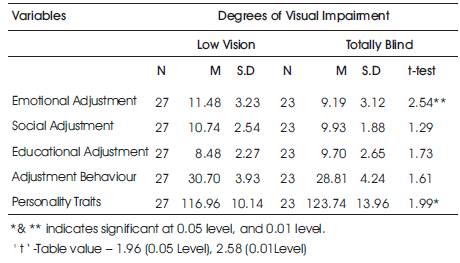
Table 2. The Mean Scores and t-test Statistic of Adjustment Behaviour (AB) and its Dimensions, and Personality Traits (PT) of Adolescent Students with Visual Impairment with Respect to Degrees of Visual Impairment
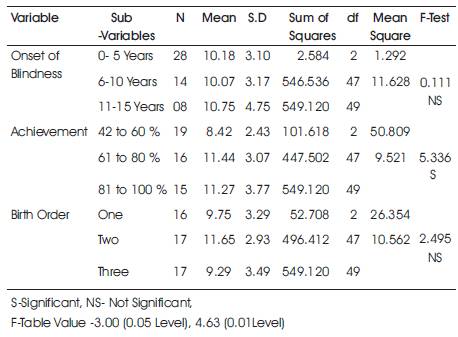
Table 3. F-Test Statistic of Emotional Adjustment Behaviour of Adolescent Students with Visual Impairment with Respect to Select Sub-Sample
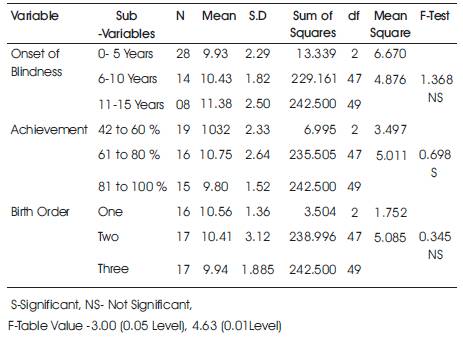
Table 4. F-Test Statistic of Social Adjustment Behaviour of Adolescent Students with Visual Impairment with Respect to Select Sub-Sample
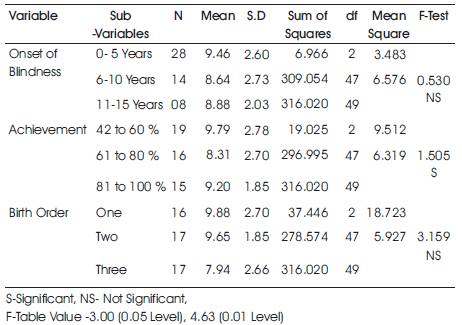
Table 5. F-Test Statistic of Educational Adjustment Behaviour of Adolescent Students with Visual Impairment with Respect to Select Sub-Sample
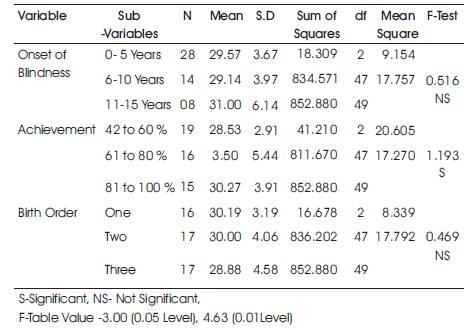
Table 6. F-Test Statistic of Adjustment Behaviour in Total of Adolescent Students with Visual Impairment with Respect to Select Sub-Sample
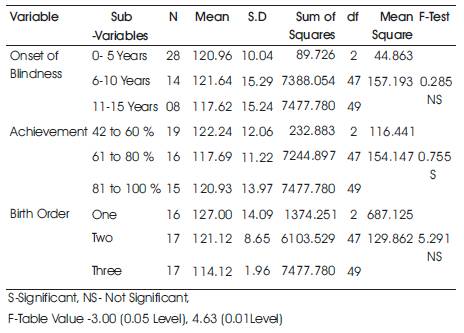
Table 7. F-Test statistic of Personality Traits of Adolescent Students with Visual Impairment with Respect to Select Sub-Sample
From Table 2, it is evident that the calculated t-value 2.54 is greater than tabulated t-value 1.96. Therefore the null hypothesis is rejected and alternative hypothesis is retained. It is significant at 0.05 levels in the case of emotional adjustment behaviour of adolescent students with visual impairment with respect to their degree of visual impairment. Therefore degree of visual impairment influences the emotional adjustment behaviour. From Table 2, it is also evident that the calculated t-value 1.99 is greater than tabulated t-value 1.96 and it is significant at 0.05 levels in the case of personality traits of adolescent students with respect to their degree of visual impairment. Therefore degree of visual impairment influences the personality traits too. It is well known that, with regard to degree of visual impairment, it has significant influence on the emotional adjustment behaviour and personality traits of adolescent students with visual impairment and has no significant influence over the social adjustment, educational adjustment, and adjustment behaviour in total based on the t-values.
From Table 3, it is evident that the calculated F-value 5.336 is greater than tabulated F-value 4.63 and it is significant at 0.01 levels in the case of emotional adjustment behaviour of adolescent students with respect to their achievement. Therefore the framed null hypothesis is rejected and its alternative hypothesis is retained. Therefore, it is interpreted that achievement has significant influence on the emotional adjustment whereas onset of blindness and birth order has no significant influence on the emotional adjustment behaviour.
From Table 4, it is evident that the calculated F-values 1.368, 0.698, and 0.345 are lesser than tabulated F-value 3.00 and no significant at 0.05 levels in the case of social adjustment behaviour of visually impaired adolescent students with respect to their achievement. Therefore, it has been concluded that onset of blindness, achievement, and birth order do not have significant influence on the social adjustment behaviour of adolescent students with visual impairment.
From Table 5, it is evident that the calculated F-value 3.159 is greater than tabulated F-value 3.00 and is significant at 0.05 levels in the case of educational adjustment behaviour of adolescent students with respect to their birth order. The framed null hypothesis is rejected and the alternative hypothesis is retained. It has been concluded that birth order has significant influence whereas onset of blindness and achievement has no significant influence on the educational adjustment behaviour of adolescent students. From the mean values, it has been concluded that the adolescent students whose birth order as first has more educational adjustment beahviour than second and third birth order.
From Table 6, it is evident that the calculated F-values 0.516, 1.193, and 0.469 are lesser than tabulated F-value 3.00 and it is very least significant at 0.05 levels in the case of total adjustment behaviour of adolescent students with respect to their achievement. Therefore, the framed null hypotheses are retained in all cases. Onset of blindness, achievement, and birth order has no influence on the adjustment behaviour of adolescent students with visual impairment. The adolescent students whose birth order as first has more adjustment behaviour than second and third birth order.
From Table 7, it is evident that the calculated F-values 5.291 are greater than tabulated value 4.63 and it is significant at 0.01 levels in the case of personality traits of visual impaired adolescent students with respect to their birth order. Therefore, the framed null hypothesis is retained. Birth order has significant influence on the personality traits of adolescent students with visual impairment. The adolescent students whose birth order as first has more personality traits than second and third birth order. But in the other two cases, onset of blindness and achievement has no influence on the personality traits of adolescent students with visual impairment.
In order to find out the significance relationship between the scores of adjustment behaviour and personality traits of adolescent students with visual impairment, Person correlation 'r' was applied and the results are presented in Table 8.
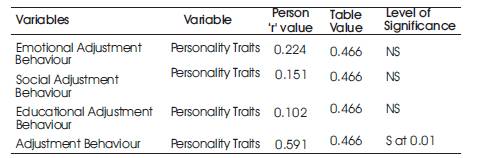
Table 8. Correlation r-value of Adjustment Behaviour and its Dimensions, and Personality Traits of Adolescent Students with Visual Impairment
The r-value is found to be 0.591 and it is greater than the table r-value 0.466. It is significant at 0.01 levels. Hence, null hypothesis is rejected and research hypothesis is accepted. To sum up, there exists positive and significant relationship between adjustment behaviour and personality traits of adolescent students with visual impairment. From Table 8, that adjustment behaviour in total has positive significant relationship with personality traits of adolescent students whereas adjustment behaviour dimensions has no relationship with respect to personality traits.
The multiple regression analysis has been applied to find out the significant influence of independent variables on the adjustment behaviour of adolescent students with visual Impairment and the results are presented in Tables 9, 10, and 11.
Table 9 shows the R square value, which is found to be 0.183. It is evident that only 18.3 % of the total variance in adjustment behaviour is attributed by the independent variable such as birth order of adolescent students with visual impairment.
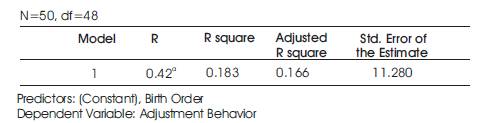
Table 9. Model Summary for Influence of Independent Variables on Adjustment Behaviour of Adolescent Students with Visual Impairment
It is evident from the Table 10, the F value is found to be 10.774, which is significant at 0.01 levels. It indicates that there is a significant contribution of birth order on dependant variable adjustment behaviour.
It is evident from Table 10 that, the F value is found to be 10.774, which is significant at 0.01 levels. It indicates that there is a significant contribution of birth order on dependant variable adjustment behaviour.
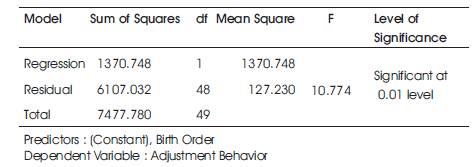
Table 10. ANOVA for Contribution of Birth Order on Adjustment Behaviour of Adolescent Students with Visual Impairment
Table 11 shows that the ' t ' value for birth order. It reveals that the variable birth order (t = 3.282, significant at 0.05 level) is significantly contributed to the dependent variable adjustment behaviour. To sum up, the following conclusion has been reached in respect to the hypothesis. Birth order influences the adjustment behaviour of adolescent students with visual impairment.

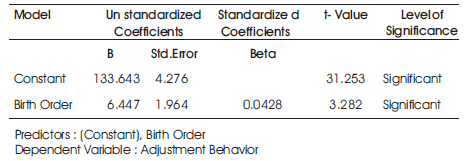
Table 11. Relationship Between Birth Order on Adjustment Behaviour of Adolescent Students with Visual Impairment
Birth order is the best predictor that has significant influence on the adjustment behavior of adolescent students with visual impairment
An attempt has been made to investigate the adjustment behaviour of adolescent students with visual impairment in relation to personality traits. In the present study, it was found that adolescent students with visual impairment have average adjustment behaviour and personality traits. The present finding that the overall level of adjustment behaviour of adolescent students with visual impairment was average in consonance with the finding of the study of Rajkonwar et al. (2014) whom investigated a study of adjustment behaviour, level of aspiration, self-concept and academic achievement of visually handicapped school children of Assam and reported that the adjustment of visually handicapped students was found similar on overall adjustment.
Another finding reveals that adjustment behaviur in total has positive significant relationship with personality traits of adolescent students. Further multiple regression analysis located that 18.3% of birth orders has significant influence on the adjustment behaviour. The adolescent students whose birth order as first has more adjustment beahviour in total than second and third birth order. Especially, the adolescent students whose birth order as first has more educational adjustment beahviour than second and third birth order. Therefore, it has been concluded that more and more in-depth research should be conducted over birth order. Further it helps us to plan and develop strategies for improving the overall adjustment behaviour and personality traits of adolescent students with visual impairment.
The alarming complexity of modern society, can lead to variety of complicated problems such as conflicts, frustration, unhealthy rivalry etc., which resulted in value crisis and serious maladjustment among adolescents. In such a complex society, adolescents have to face many problems in life for a better adjustment in a social structure. There must be a compulsorily need of individual guidance and counseling services for adolescent students with visual impairment with birth order as second and three to improve their overall adjustment behaviour (Sood & Sastri 2016). At present scenario, due to over globalization, universalisation and privatization, the world is highly competitive in nature. In order to cope with high competitiveness and achievement, the students with visual impairment especially adolescents at secondary and higher secondary stage face uncountable problems and we need to take more effort into bringing them to improve their adjustment behaviour and personality traits as enjoyed by the normal students. Therefore, the significance of guidance and counselling program among the adolescent students with visual impairment is a need of the hour for the present scenario.
The adolescents need somebody to help in the solution of problems and thus avoid tensions and conflicts. Even for the normal students, the need of guidance and counselling in modern times has increased because of the multiplicity of problems they face in the various domains of life. Now we are successful in establishing mainstreaming, inclusive, integrated, and special education institutional setups for the educand depending upon the vulnerability of the special challenges required by them. In these circumstances, it is essential and strengthen the formal educational school agencies (Advani, 2005). To help and guide the youth especially adolescent students with visual impairment to worthwhile channels through the introduction of guidance and counselling as a compulsory one, thereby to bring a confidence to self evaluate their level of adjustment behaviour and personality traits in order to further improvement to the expected level.