
Table 1. Magnetic Parameters of Sm/Zr Substituted Mg-Mn Bulk Ferrites

Table 2. Magnetic Parameters of Sm/Zr Substituted Mg-Mn Nano Ferrites
For all the concentrations of samarium and zirconium, the saturation magnetization is found to be higher for nano ferrites relative to bulk size materials; which can be understood on the basis of core shell model (Kodama, 1999). This explains the finite size effects of the nanoparticles that lead to canting on non-collinear system of spins on their surface modifying the magnetization. Decrease of saturation magnetization at higher values of samarium may be due to the weak exchange interactions of Fe3+ - Fe2+ ions. Significantly observed that at lower values of x, i.e., up to x=0.20, the obtained saturation magnetization values are higher for samarium substituted materials when compared with zirconium substituted materials while converse is true at higher values of x. The substitution of samarium ions at the expense of Fe3+ ions related to the octahedral sites which decreases the exchange interactions of magnetic ions present in the octahedral sub lattices, consequentially magnetization decreases (Kodama et al., 1999). Samarium substituted Mg-Mn bulk ferrites coercivity values vary from 150.24 to 159.62 G while for nano ferrites it vary from 146.51 to 149.35 G (x=0.50). These values are much greater than that reported for rare earth-substituted Mg-Mn ferrite materials synthesized by other methods (Panda et al., 2003; Rezlescu et al., 2004). In the multi domain regime, the coercivity is inversely proportional to the grain size. Larger grain size makes the domain walls motion easier, thereby the coercivity decreases unlike the present materials. Those have lower grain sizes causing to increase coercivity as a function of samarium content. For zirconium substituted Mg-Mn bulk ferrites, coercivity values vary from 149.63 to 150.24 G while for nano ferrites it varies from 146.51 to 159.33 G. Coercivity is maximum at higher zirconium concentrations for both bulk and nano Mg-Mn ferrites. Low coercivity infers the material as soft in nature and also to consider it as demagnetized substance(s). Larger coercivity indicates that the magnetization is not wiped out by stray external fields and it can withstand for mechanical ill treatment besides temperature changes, which counts the large hysteresis (Cullity & Graham, 2009; Herzer et al., 2013).
As shown in the Table 1, the observed retentivity (Mr) increases continuously as a function of x from 4.213 to 6.573 emu/gm and 4.213 to 6.357 emu/gm for samarium and zirconium substituted Mg-Mn bulk ferrites respectively. Though the retentivity found to increase initially for samarium substituted Mg-Mn nano ferrites, unlike bulk samarium ferrites it decreases at higher values of 'x'. On the other hand, in the case of nano particles zirconium substituted Mg-Mn ferrites, the retentivity values continuously increase from 4.463 to 9.924 emu/gm similar to its corresponding bulk ferrites. The obtained retentivity values are relatively higher for the samarium substituted bulk Mg-Mn ferrites when compared with its nano materials while reverse or converse is true for zirconium substituted Mg-Mn ferrites as displayed in the Tables 1 and 2. Retentivity is higher for soft materials when compared with their corresponding hard materials (Kumar et al., 2006). Samarium has been promoted to hard nature and zirconium moved towards soft nature of the materials. The values of remnant ratio (R=M /M ) are in the range 0.3390 to r s 0.6913 for samarium and 0.3390 to 0.4438 for zirconium substituted ferrites. The remnant ratio values lie in the range 0.3063 to 0.3339 for samarium while 0.3063 to 0.5234 for zirconium substituted Mg-Mn nano ferrites. It is an indication of decrease in anisotropy of the crystal lattice. The material reads low hysteresis loss and low heating effect (Karche et al., 1997). The Magneton number (nB) values are in the range 17.879 - 30.587 emu/gm for samarium substituted and 17.879 - 20.564 emu/gm for zirconium substituted Mg-Mn bulk ferrites respectively. Nano ferrites show some improvement relative to their respective bulk ferrites indicating the impact of particle size having the values in the range 18.059 emu/gm to 30.478 emu/gm for samarium substituted and 20.612 to 27.221 for zirconium substituted nano ferrites. The value of magneton number increases by the substituted foreign cations due to the enhanced exchange of interaction energy and relatively higher orbital contribution of ions (Panda et al., 2003; Rezlescu et al., 2000; Shalendra, et al., 2007).
Theoretical values as shown in Table 1 and 2 of magneton numbers have close agreement with the experimental values showing consistency of the investigations. The variation of weight loss and temperature of Sm in bulk ferrites is shown in Figure 1. The obtained present initial permeability (μ) values are smaller relative to earlier i reported value (μ =34) for Mg-Mn ferrites (Rezlescu et al., i 2000). The Curie temperature (Tc) of un-substituted Mg-Mn nano ferrite value 753 K (480.2 0C) has fair agreement with the earlier reported value of Mg-Mn ferrite (Tc =753 K) (Sharma et al., 2013). The substitution of samarium ions seems to enhance the linkage between A and B sub lattices with the rise of samarium concentration. Theexpected strong exchange interaction Fe3+A « F3+B e as a function of x due to movement of more number of Fe ions from B to A sites indicates rise of Curie temperature. On the other hand, substitution of zirconium with simultaneous dilution of Fe3+ and Mn has been believed to weaken the magnetic linkage between two sub lattices causing decrease of Curie temperature (Kishan et al., 1984). The decrease of A-B magnetic interactions due to foreign cations occupancy of A and B sites decreases the overlap of orbital's, which in turn weakened the exchange interaction (Shin, 1964). The substitution of diamagnetic zirconium ion results its additions either on A-site or B-site causes to weaken the A-A interaction lowering the Curie temperature (Niihara et al., 1991; Phanjoubam et al., 1997; Sivakumar et al., 2010). In certain studies reduction of particle size from bulk to nano is indicating enhancement of Curie temperature for all the materials (Bhise et al., 1991).
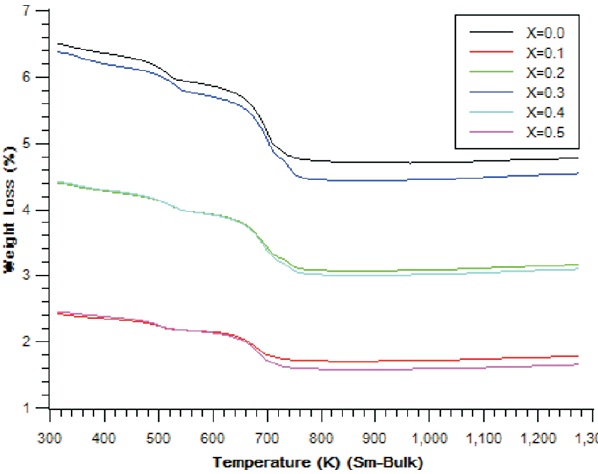
Figure 1. Variation of Weight Loss (%) with Temperature (K) (Sm-Bulk)
3. Variation of Magnetization with Temperature
Figure 2 shows one (Zr-Bulk) of the zero field cooled (ZFC) and field cooled (FC=30 Oe) curves of Sm3+/Zr 4+ substituted Mg-Mn ferrites. Table 3 shows the temperature characteristics for both bulk and nano state of the specimen for varying concentrations. Specimens in both the cases (ZFC and FC) heated at zero and 30 field state from the temperature 30 to 300 K and cooled from 300 to 30 K to measure corresponding magnetization (M). It is observed that the saturation magnetization drops slowly as a function of temperature.
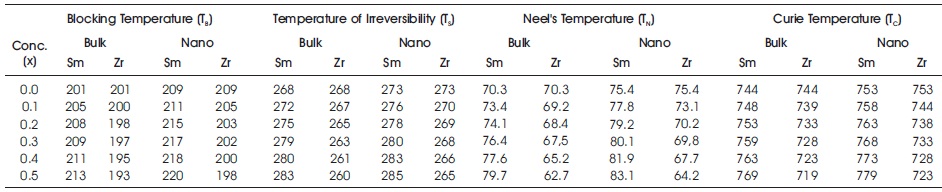
Table 3. Sm3+/Zr 4+ Substituted Mg-Mn Bulk/Nano Ferrites Blocking Temperature, Temperature of Irreversibility, Neel's Temperature and Curie temperature (in K)
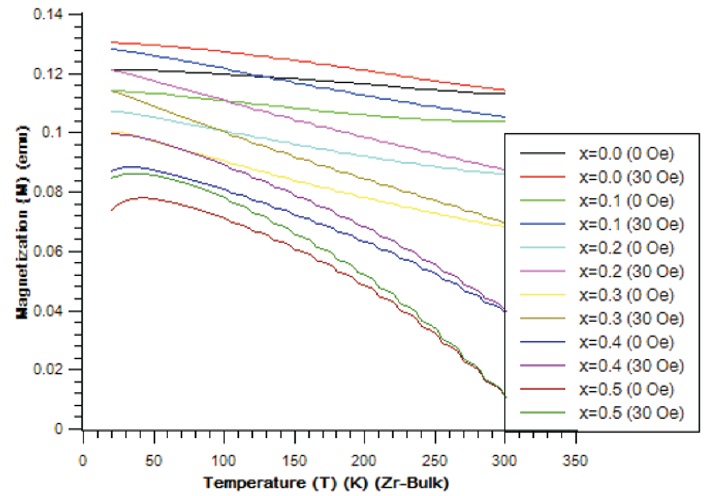
Figure 2. Variation of Magnetization with Temperature at FC and ZFC (Zr-Bulk)
The formation of ZFC and FC curves separately is due to the competition between thermal and magnetic exchange energies, which causes disordered behaviour of spins in ZFC resulting in a lower magnetic moment than that of FC where applied external magnetic field suppress the thermal energy. The ZFC and FC curves begin to separate at the temperature of irreversibility (Ts). At a specific critical temperature termed as blocking temperature (TB), magnetization reaches to a maximum of blocking value. This indicates that the magnetic moment of each particle is blocked along its easy magnetization axis at its blocking temperature.
In the present study, the obtained maximum value of ZFC curve related to the un-substituted or basic ferrite is shown at (ZFC magnetization exhibits a broad maximum) TM = 201 K having good agreement with the results reported by earlier studies (Batoo et al., 2010). Magnetization in ZFC decreases significantly below TM due to activation of paramagnetic and ferrimagnetic transition state. In ZFC the deterioration of magnetization has been observed the observed magnetization decreases monotonically with the increasing temperature in the obtained ZFC curves (Alamolhoda et al., 2016). The blocking temperature depends on magnetic interactions such as dipole-dipole interactions between the particles and exchange interactions between surface spins and core spins of the nanoparticles. Stronger dipole interactions cause an increase in blocking temperature. Further decrease of magnetic anisotropy and weakening of dipolar interactions are responsible for the reduction of blocking temperature, as it depends on the effective magnetization anisotropy.
Plots of inverse magnetic susceptibility as a function of temperature at ZFC and FC are drawn to obtain values of Neel's temperature (TM). Its value of un-substituted Mg-Mn N ferrite (75.4 K) shows close agreement with the reported pure or un-substituted Mg-Mn nano sized ferrite value (75 K) (Markandeya et al., 2016). The Neel's temperature of samarium substituted Mg-Mn ferrites found to increase in the range 70 to 79 K and 75 to 83 K for bulk and nano materials respectively. On the other hand, decrease of Neel's temperature has been observed for zirconium substituted Mg-Mn ferrites in the range 70 to 62 K and 75 to 64 K for bulk and nano materials respectively. The effect of foreign cations on anti-ferrimagnetic nature, which improves the trend of anti-alignment of spins, can be explained by increasing Neel's temperature for samarium substituted Mg-Mn ferrite materials, while the converse nature can be explained by using high valence cation zirconium substitution. The reported rise in Neel's temperature values for nano size materials compared to bulk size can be attributed to a better knowledge of particle size in terms of greater strength of anti-aligned spins.
4. Multiferroic Behaviour
Curie temperature values of ferroelectric phase differ from ferro or ferrimagnetic phase Curie temperature values. Therefore, dielectric constant (ɛ') is also measured as a function of temperature at a frequency of 100 Hz, that has been reported elsewhere (Praveen & Rao, 2019). The observed ɛ' increases with the increase of temperature (T). In the low temperature region (-150 to 100 OC), dielectric constant increases to a maximum value, reflecting a peak at around 50 OC; further reaches to minimum around 85 to 95 OC for samarium substituted ferrites. From this temperature (T), dielectric constant has been again found to increase showing a small kink around 200 OC. For nano sized ferrites of Sm3+ substitution, the region (near 200 OC) found to exhibit a small peak that showed a slope change around 85 - 95 OC. Zr4+ substituted nano ferrites also exhibited a peak near 200 OC for x=0.4 and 0.5 only while it is absent for other values of x, but a change in the slope at low temperature region is visualized. The appearance of a peak in the plots of temperature versus log ɛ' substantiates the presence of electrical phase change besides occurrences of magnetic phase by which the materials are classified as multiferroic magnetic materials. The change of curves slope for log ɛ' versus temperature (T) can be attributed to the extrinsic and intrinsic behaviour of the semiconducting ferrites. From the above results, Sm3+/Zr 4+ substituted Mg-Mn ferrites have both ferroelectric and ferromagnetic nature and these are considered as multiferroic materials (Shalendra, et al., 2007).
Conclusions
- The obtained saturation magnetization is found to be higher in nano ferrite materials when compared with bulk particle size ferrite materials. The substitution of samarium strongly influenced the magnetization of ferrites relative to zirconium substitution.
- Retentivity (Mr) value is higher for zirconium substituted Mg-Mn nano materials when compared to bulk materials. Remnant ratio are in the range 0.3390 to 0.6913 for samarium and 0.3390 to 0.4438 for zirconium substituted Mg-Mn bulk ferrite indicating increase of its value with the rise of 'x' values.
- Remnant ratio value increases from 0.3065 to 0.3329 and from 0.3065 to 0.5234 for samarium and zirconium nano ferrites respectively.
- The substitution of samarium on Mg-Mn bulk/nano ferrite shows the increase of Curie temperature because of increase in thermal energy hardness. Substitution of zirconium with simultaneous dilution of Fe3+ and Mn2+ is believed to weaken the magnetic linkage between two sub lattices causing decrease of Curie temperature.
- The Neel temperature of samarium substituted Mg-Mn ferrites found to increase in the range 70 to 79 K and 75 to 83 K for bulk and nano materials respectively. On the other hand, decrease of Neel temperature has been observed for zirconium substituted Mg-Mn ferrites in the range 70 to 62 K and 75 to 64 K for bulk and nano materials respectively.
- The change of curves slope for log ɛ' versus temperature can be attributed to the extrinsic and intrinsic behaviour of the semiconducting ferrites. The appearance of a peak in the plots of temperature versus log ɛ' substantiates the presence of electrical phase change besides occurrences of magnetic phase where the materials are classified as multiferroic magnetic materials.