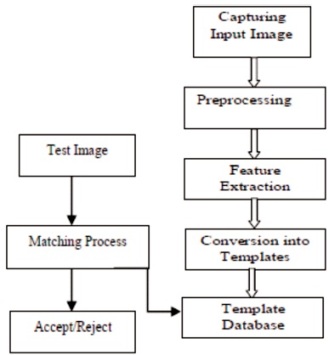
Figure 1. Training and Testing Process
Biometrics is the physiological and behavioural characteristics of a person, such as their face, ear, finger print, thumb, voice, signature, and so on. Generally, a person's fingerprints are used for authentication, and their face is used for identification, although this is a difficult task because people use masks to cheat and commit fraud. In this paper, we investigate multimodal biometrics using two modalities, the foot and the iris, to find the best results and improve the biometric system's quality.
Biometric technology is very useful for identifying and verifying people based on their physiological and behavioural characteristics. When verifying the person, compare the test image with the stored image and if they are identical, take the decision that the person is authenticate else the person could be an impostor or fake.
It is a one to many mapping method that matches the test image with the stored database and determines whether or not the individual is known. Some of the biometrics methods used to identify people are listed in the following passages:
Face Biometrics: Face identification is the process that uses digital images to recognize and authenticate an individual.
Ear Biometrics: The ear bio-metric uses ear attributes or traits to compare. This is a constant and unchanging state.
Fingerprint Biometrics: Fingerprints have been the most widely used biometrics for identifying people over the last few decades. Earlier, ink was used to create a print of the finger and thumb illustration on paper. Nowadays, electronic fingerprint scanners are used to capture and verify fingerprints.
Hand Geometry Biometrics: People are also perfect candidates for using this new biometric because they are unable to alter lines of palm print over the course of their lives.
Voice Biometrics: Voice biometric can be categorized under observable traits based on the fact that everyone has a distinctive voice, tone, and way of speaking.
Signature Biometrics: A person's writing style can be calculated by the process of creating a signature. All of these factors go into a signature: how firmly a person presses the pen, how heavy the pen is, and whether or not the individual keeps the pen at an angle.
For all the above mentioned biometric methods, the following processes are followed for practical application. Of the two steps in the process, first one is training process and second is testing process.
Training Process:
Testing Process: It is similar to training process, except it is performed at the matching level. Figure 1 depicts the training and testing processes.
Figure 1. Training and Testing Process
Unibiometric system has many challenges such as:
Multimodal biometrics gives the opportunity to take more than two biometrics traits, combine them that overcome the limitations of unimodal biometric system and find the optimal results. In this paper, we have worked on multimodal biometric system using two biometrics, foot and iris. Footprints are standardised, and the iris, as a composite layer structure, is distinctive and does not change with the individual's age.
Many researchers have given their contribution in this field. According to Ross and Jain (2003), biometrics is becoming more widely used in a range of locations, including banks, institutes, and airports, via various biometric devices.
Multimodal biometrics is preferred in authentication based image processing applications. Barde et al. (2014) introduced a multi modal system working on physiological and demography information for identification of person.
Ross and Jain (2004) proposed a multimodal biometric system for individual identification, which improved the system's accuracy.
Abate et al. (2007) developed a hybrid system based on the face and ears. This system employs the Iterated Function principle, which compresses and indexes images.
Barde and Zadgaonkar (2015) and Barde (2018) developed a multimodal biometric system that combines face and foot modalities using a PCA classifier for the face and a wavelet transformer for the foot, which are then merged after normalisation to produce a compatible score and a decision.
Barde et al. (2014) proposed a multimodal biometric system that uses PCA, Eigen image, and hamming distance classifier for feature extraction, and the sum rule method for fusion to calculate matching score.
Bigun et al. (2005) discussed the benefits of identifying people using several biometric characteristics, including high accuracy and robustness.
The current paper is a multimodel biometrics system which combines iris and footprint.
This work is surrounded by iris recognition, which relates to the coloured part of the eye that is encapsulated by the pupil called the iris. Iris photos are taken with the highest quality cameras available, and each person's iris is unique. To compute patterns, a large number of procedures are needed. Bits are used to carry out the operation, which is then saved as a blueprint. The distance between the test image and the template is measured using the Hamming distance process. When the difference between the test and training images is zero, the test and training images are identical. In other case, we can assume that the images are distinct.
Due to their use in person identification, footprints are receiving a lot of attention these days. It is simple to obtain information about the characteristics of a footprint using Furrier's cutting tool, and Haar. Each person has their own unique footprint, making it easier to capture a full-length photograph and eliminating the need for a special capture requirement. You will need to crop and resize the captured foot screenshot once you have it. Figure 2 shows how an image captured with a high-quality camera is viewed as an image, while an RGB image converted to grayscale with resizing is viewed as a database of data.
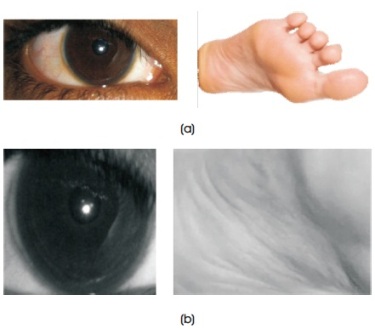
Figure 2. Image Prepressing (a) Image Captured by Camera (b) Image Resized and Converted into Gray Scale
For iris model databases that have noise masking functionality, the Hamming distance method is used. The distance between two iris templates is calculated in binary format, and if the distance is small, the iris are identical; otherwise, the iris are not compatible, demonstrating that hamming distance is an efficient and reliable method for iris recognition.
The iris recognition process has been completed after three stages.
The image-recall mapping technique, which uses the image-conversion approach, is used to create the sequential modified Haar wavelet. The wavelet coefficients were represented in decimal form, with each Haar value requiring eight bytes for storage.
An eye image is fed into the device, and the iris template, which is a set of bits represented in mathematical form, is created as an output of the iris region. The segmentation and normalisation of the image are shown in Figure 3.
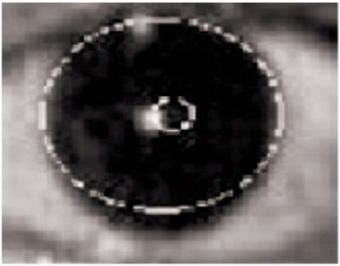
Figure 3. Segmented and Normalized Image
Since the middle portion of the foot picture has more strength, it is used for the procedure. This captured region is divided into 4 x 4 rows and columns, and a sequential modified Harr transform is applied. The result is shown in Figure 4. To measure the precision, the MHE is compared at various stages of decomposition. After that, the minimum MHE is estimated and saved in the database by combining them. Finally, the MHE of the test image is compared to the database prototype to determine whether the image is real or not.
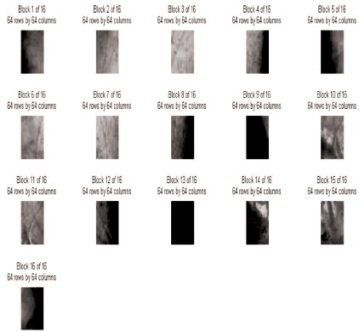
Figure 4. Foot Image Divided into 4 x 4 Blocks
Genuine score, imposter score, and threshold value for iris and foot images are shown in Table 1.
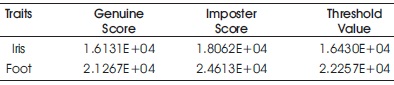
Table 1. Genuine Score, Imposter Score and Threshold Value For Traits
Iris and foot biometrics were checked separately, and the False Accept Rate (FAR) and False Reject Rate (FRR) are shown in Table 2. For the Iris and foot modalities, an algorithm has been used to generate distinction scores.

Table 2. FAR and FRR for Traits
Table 3 shows the weights for both modalities. The Min-Max normalization technique has been used to transform all dissimilar data into similar data, as shown in Table 4.
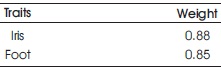
Table 3. Weight for All Modalities
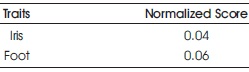
Table 4. Normalized Score
The weight value of the iris and foot after the fusion of two traits is shown in Table 5. The results of the iris and foot combination are shown in Table 6.

Table 5. Weight for Each Trait in Fusion of Two Traits

Table 6. Score After Fusion
Iris and foot biometric traits were used as the multimodal biometric method. Hamming distance and sequential modified Haar transformation classifier approaches were used to measure the weight of each biometric trait. Following normalisation, the data has been merged. The sum rule fusion applies to all possible combinations of modalities, with the highest matching score of 0.296 obtained when two modalities, the iris and the foot, were combined.