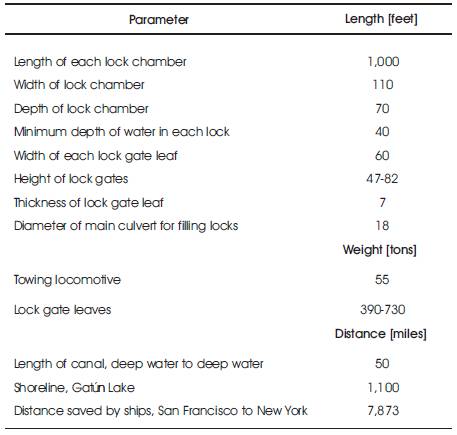
Table 1. Technical Specifications of the Panama Canal [3].
As an answer to a possible future situation of unchecked global climatic change involving global warming, we discuss a mitigating geoengineering project that would lead to a more stable climate for the Earth; achieved by restoring the previous stable condition in the Earth's climate where the ancient equatorial ocean current circulated freely across the Central American Land Bridge.
Such a large scale civil engineering project would involve the conventional and nuclear excavation of a sea-level canal through several possible routes. We present the historical perspective of the Panama Canal and discuss the costs involved, previous studies of a sea-level canal across the Isthmus of Panama and its foreseen environmental consequences.
Other proposed approaches of carbon management and sequestration such as iron and iron sulfate seeding of the oceans and Earth shading are compared to the excavation approach; which appears to offer lower cost, scalable technology and is free of possible ecological unintended consequences.
Before the last three million years, the Earth's climate enjoyed a steady state mild temperate climatic condition situation with the ocean currents rotating around the globe and evenly distributing the absorbed solar radiation from the water to the land masses. In the past, whenever there has been a return to ice-age conditions, this was preceded by a rise in the concentration greenhouse gases such as CO2 or CH4 , followed by a sudden drop [1].
For the past three million years, the CO2 levels in the atmosphere have been low. However, tectonic Earth movements caused the Central American Land Bridge to develop, blocking the flow of ocean currents from the Atlantic Ocean to the Pacific Ocean that had stabilized the Earth's climate for millions of years. This land bridge forced the ocean currents into a north-south flow. It may have caused a die-off of forests, and a CO2 level decrease. The diverted oceans currents lead to a more variable climate, with dramatic differences between the seasons. The temperate forests reaching into the Arctic were replaced by a taiga or sub arctic forests characterized by pine trees. Winters became longer and the north and south ice caps formed. The recurrent periods of glaciation and thawing in the last three million years, and the rising of the Central American Land Bridge may have forced the Earth's climate into a long cycle involving long ice ages followed by short warm periods. Every glaciation period has been accompanied with large species extinctions [1].
A geoengineering project worth investigation that would lead to a more stable climate for the Earth, would be to restore the previous stable condition in the Earth's climate where the ancient global equatorial ocean current circulated freely across the Central American Land Bridge.
The Isthmus of Panama is a land bridge arched between the North and South American continents. With 12 distinct ecosystems between mountains, rainforests, cloud forests and beaches, it is home to a large biodiversity. In the 16th century, Spanish mariners thought of a shortcut waterway through the Isthmus of Panama. Mariner Balboa conceived the notion in 1513, but the daunting idea was forgotten. French financier Ferdinand de Lesseps, 367 years later tried to build a sea level canal like the Suez Canal between the Mediterranean and the Red Sea. Disease, scandal, rain, corruption and the jungle claimed the lives of 16,000-20,000 workers, and the effort was discontinued [2].
By 1900, the USA devoted the engineering resources to take on the challenge. President Theodore Roosevelt committed to the project, signed a treaty with Panama, and the project started with a 35,000 persons work force.
Construction started in 1904 creating one of the world's largest artificial lakes: Lake Gatún, as well as an 8 miles winding channel called the Gaillard Cut. Six massive locks were built to raise or lower the giant sea-going vessels to a height of 85 feet. More than 52 million gallons of fresh water are used for each ship which transits the Panama Canal. Technical Specifications are given in Table 1.
Table 1. Technical Specifications of the Panama Canal [3].
Completed in 1914, the Panama Canal cost over $336 million and 5,600 lives lost to tropical diseases such as o yellow fever, temperatures reaching 130 F, and accidents. It has saved every ship passing through it a 7,872 miles trip around South America. Each ship takes a 51 miles journey through an intricate system of gates, locks, and drains, including dredged approach channels at each end (Figure 1). A single trip through the canal requires million of gallons of water, and busy days can see up to 40 trips. For the water it needs, the canal depends on one of the world's biggest artificial lakes: Gatún Lake. For its water supply, Gatún Lake depends on the health of the surrounding rain forest [3].
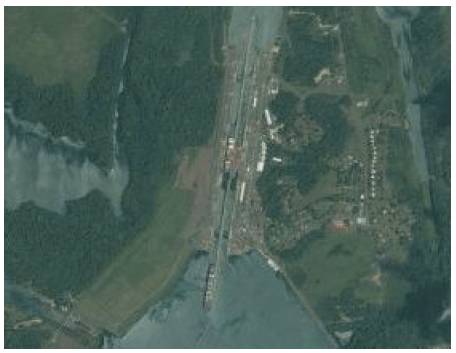
Figure 1. Panama Canal locks. Source: Microsoft Bing NASA image.
The Panama Canal consists of artificially created lakes, channels, and a series of locks that raise and lower ships through the mountainous terrain of central Panama. Built by the USA from 1904 to 1914, the Panama Canal posed major engineering challenges, such as damming a major river and digging a channel through a mountain ridge. It was the largest and most complex geoengineering project of this kind ever undertaken by that time, employing tens of thousands of workers.
The Panama Canal system is composed of three major locks, one on the Atlantic side: the Gatún locks, and two on the Pacific side: the Pedro Miguel and Miraflores locks. The Gailard cut represents the line of continental divide. To supply this system of locks a large amount of water is required, a goal fulfilled by the artificially created Gatún Lake. Running parallel to the canal is the Panama Canal Railway designed to absorb the extra shipping traffic generated by ships too large to use the facilities.
The canal cuts through the central and most populated region of Panama, and it has been a point of dispute between the governments of Panama and the USA through most of its existence. Under a 1903 treaty, the USA controlled both the waterway and a large section of the surrounding land, known as the Panama Canal Zone, considered as a USA territory [2].
The people of Panama resented this arrangement and argued that their country was unfairly denied the benefits accruing from the canal. Eventually, demonstrations and international pressure led the USA to negotiate two new treaties, which were signed in 1977 and took effect in 1979. The treaties recognized Panama's ultimate ownership of the canal and all the surrounding lands.
More than half of the former Canal Zone came under Panamanian control shortly after the treaties were ratified. Control of the canal was turned over to Panama on December 31, 1999. In December of 1989, the USA invaded Panama, ostensibly in order to capture its President Manuel Noriega and held him in a Florida prison serving a 40 year sentence for alleged drug trafficking.
Article XII of the Panama Canal Treaty provides for a joint study of “the feasibility of a sea-level canal in the Republic of Panama.” In 1981 Panama formally suggested beginning such a study. After some discussion, a Preparative Committee on the Panama Canal Alternatives Study was established in 1982, and Japan was invited to join the USA and Panama on this committee. The committee's final report called for the creation of a formal Commission for the Study of Alternatives to the Panama Canal, which was set up in 1986. Although there was a general perception that the costs of such a canal would outweigh benefits, the commission is continued studying the problem without further action [3].
The French financier Ferdinand de Lesseps attempted digging a canal at sea level around 1884, in the same way as the Suez Canal between the Mediterranean Sea and the Red Sea. Even though he succeeded with the Suez Canal Company, he ended his life bankrupt and confined in jail for fraud following the failure of his Panama Canal Company. The present Panama Canal was started in 1904 and finished in 1914 using the labor of a ½ million men.
After debating on the most appropriate place for the canal, the USA Congress authorized President Theodore Roosevelt to purchase the French assets and take over the Panama project. Panama, where the isthmus was located, was then part of Colombia. Negotiators from both countries agreed upon terms, but Colombia rejected the treaty, holding out for more financial payments. Angered, President Roosevelt stopped negotiations and found another way to get the isthmus. He supported the Panamanian revolutionaries in their fight for independence from Colombia. An American fleet was dispatched to both sides of the isthmus, blocking its sea approaches. Colombian forces were forced into a land approach through the dense Darien Jungle, and were forced to turn back. Panama achieved its independence. The USA acquired the lease to build the Panama Canal on very favorable terms with the newly independent country.
The Panama Canal is a major maritime route slashing 8,000 miles off the shipping distance between the east and west coasts of the American continent [2] (Figure 2).
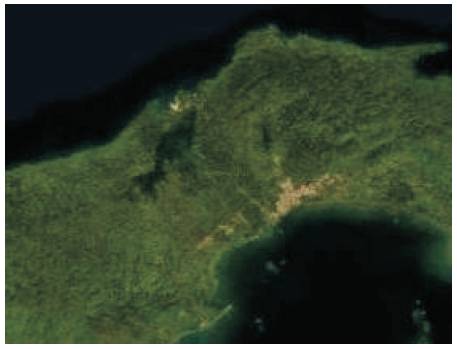
Figure 2. The Panama Canal extends from Panama City on the Pacific Ocean to the south across Lake Gatún to the Atlantic Ocean to the North. Microsoft Bing NASA image.
The Panama Canal, however, does not slice through the mountainous backbone of Panama. It is constructed as a series of locks interconnecting artificial lakes constructed by damming rivers in the mountains, and feeding the canal through gravity. About 52 million gallons of fresh water are flushed into the sea every time a ship passes through the canal. Since about a couple of decades ago, scientists are noticing that Panama's climate is slowly becoming drier, possibly caused by the clearing of the forests along the canal's watershed: 2/3 of the forests in the hills have been cut out. Silting and mudslides in 1970 and 1984 are affecting the one-way traffic of ships. Modern super tankers and large bulk carriers are too large to go through the canal. A time may come to consider the possibility of a new sea level canal of the order of a mile or more in width in the isthmus area to restore the ancient equatorial ocean current.
Control of the canal changed hands from the USA to Panama on December 31, 1999 [3].
An alternate sea level canal through Panama or northern Columbia, restoring the old ocean currents intercepted by Central American Land Bridge, may become an international global geoengineering project.
Five different Trans-Isthmian routes (Figure 3) and the relative costs for conventional and nuclear excavation for a sea level canal are possible as shown in Table 2. The cost figures include the operating facilities.
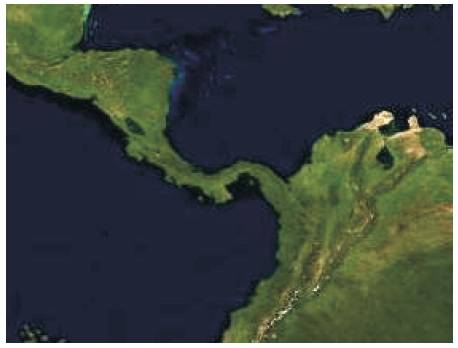
Figure 3. Location of Trans-Ithsmian possible routes. Microsoft Bing NASA image.
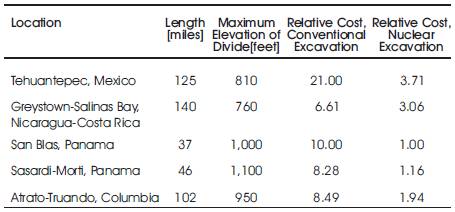
Table 2. Relative costs of conventional and nuclear excavation for different Trans-Isthmian routes for a sea level canal across the Central American Isthmus [8] .
Some previous studies considered canals that were 600 feet wide and 60 feet deep, and canals which were 1,000 feet wide and 280 feet deep. A sea level canal construction would require the use of massive amounts of energy carving hills and mountain ranges [8]. Peaceful clean thermonuclear cratering devices releasing megatons equivalent of TNT may be an economical means of achieving such an ambitious project as shown in Figure 4. As an example, Nicaragua could be an alternate sea level canal route, where a 140 miles sea level canal would connect the Pacific to the volcanic Lake Nicaragua, to the San Juan River. In all cases important environmental considerations will have to be addressed. Economical benefits must be allocated by the international community to the populations that would accept the undertaking of such projects in their territory.
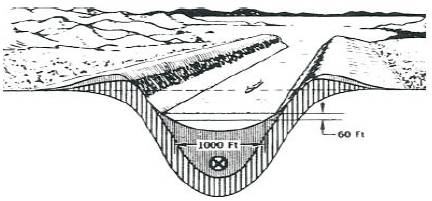
Figure 4: Peaceful clean thermonuclear cratering devices releasing megatons equivalent of TNT can excavate a sea level canal using nuclear civil engineering methodologies. Source: Project Plowshare, Lawrence Livermore National Laboratory, LLNL, University of California [8].
Several basic strategies have been proposed to reduce carbon emissions into the environment [4]:
This should include the different sectors of carbon usage, including electrical utilities, transportation, industrial, residential, or commercial.
Considering the transportation sector, by applying new knowledge in combustion chemistry, non thermal plasmas, and catalytic processes to the piston engine, one can reduce carbon emissions. The most viable technology for reducing the carbon dioxide emissions of light vehicles is the use of the Diesel Engine, most probably in hybrid drive train configurations. Using light weight materials, improved aerodynamics and lower rolling resistance and after-treatment technologies, diesel engine cars can reach the 70-mile per gallon efficiency level. After-treatment technologies include catalytic converters that reduce pollution from the released hydrocarbons, oxides of nitrogen, carbon monoxide, and particulates. The new Homogeneous Charge Compression Ignition engine does not produce significant amounts of nitrogen oxides, and can replace the Diesel engine, if a control mechanism can be found for it. Careful choices of oxygenated and reformulated fuels such as cellulosic ethanol, sugar and other agricultural crops, avoiding the history of Methyl Tertiary Butyl Ethylene, MTBE contamination of water supplies in the USA can be considered.
Soil tillage and the decay of plant residues release through microbial action significant amounts of carbon to the atmosphere. One simple application is in soil stabilization and carbon sequestration. This is the natural process by which the USA's prairies were formed.
Carbon credit programs for farmers who would adopt notill and other conservation tillage approaches such as strip-till in farming could enhance carbon sequestration in crops residue. The surface of no-till fields has higher amounts of crop residue, carbon, and microbial and fungal activity that can use much of the Nitrogen from applied fertilizer. Thus adoption of these practices may result in a larger level of use of fertilizers. A question arises about how farmers can maintain long term production levels if their fields become covered with a thick layer of crop residue on the surface.
The commercial application of carbon credits started in October of 1999. A consortium of Canadian utilities paid the state of Iowa's farmers in the USA $3-15 dollars per acre to adopt the no-till conservation strategy, replace commercial fertilizer with animal manure, and plant trees in an effort to obtain credit from the Canadian government for reduction of carbon emissions.
About 100 Iowa farmers were the first to be paid to practice no-till or minimum till farming to lower carbon emissions. As part of an agreement with utility companies, the IGF Insurance Company of DesMoines in collaboration with CQuest Ltd. of West DesMoines, Iowa, contacted its policy holders and other potential clients to ask if they would like to participate in the program. A modest 1.3 million tons of carbon credits for 2,000 and up to 6 million tons by 2,012 were contracted. The price paid is $0.50 to $2.50 per ton of carbon credits. Farmers should be able to deliver 4-5 tons of carbon credits per acre depending on their farming practices. This amounts to $10 to $15 per acre. USA farmers alone could sequester 300 million of carbon emissions annually.
Tillage is the enemy of carbon sequestering, so that the major method of carbon sequestration is through no-till and minimum-till farming. The difficulty is the need to maintain the soil's productivity. Research need to determine the optimum practices and locations and the carbon sequestering capacity of different soils.
Additional credits for sequestration are obtained through the saving of tractor fuel that otherwise would be used for tillage. A negative effect is the need to use more hydrocarbons for extra herbicides and fertilizers needed to maintain the soil's productivity.
Using livestock manure as fertilizer instead of commercial nitrogen fertilizer as anhydrous ammonia, NH 3 manufacture by natural gas would add more credits. If manure is injected into the soil instead of being stored in lagoons, less methane gas is released leading to further credits. Waterways, buffer strips and other conservation measures will also earn farmers carbon credits.
Some fuels contain less carbon than coal, such as natural gas and hydrogen from dissociated water. Methods to manufacture low carbon fuels can be pursued such as methanol from natural gas, ethanol from agricultural crops such as sugar cane, liquefied natural gas, and hydrogen gas as an energy carrier from renewable energy sources. Trending toward hydrogenation and decarbonization will accelerate. Electricity production can be considered from sources that contain no carbon such as wind energy, solar energy, fission energy for the immediate future, and fusion energy for the long term [5].
In the Proceedings of the USA National Academy of Science in 2006, the agro ecologist Johan Six and other researchers at the University of California, Davis, Northern Arizona University and Wageningen University in the Netherlands defy the thoughts that the rise in the concentration of carbon dioxide would help plants fix more of it.
This challenges recent assessments and model projections from the Intergovernmental Panel on Climate Change which anticipated increases in soil carbon with rising carbon dioxide levels.
The new findings are that plants cannot keep up with increasing levels of carbon dioxide unless some essential nutrients such as potassium, phosphorus and molybdenum are added as fertilizers. In addition, the rising levels of carbon dioxide do not speed up the process of nitrogen fixation. Soils are limited in their impact on global warming because of their dependence on nitrogen and other nutrients. For soils to lock away more carbon dioxide as carbon, there has to be much more nitrogen than is normally available in most ecosystems.
Various plants such as legumes can pump nitrogen from the atmosphere into the soil by the process of nitrogen fixation. The process cannot keep up with increasing levels of carbon dioxide unless other essential nutrients are added.
Plants do play a role in mitigating global warming in that they store about half the carbon dioxide emitted into the atmosphere, temporarily until they decay, in land or marine ecosystems. However, the soils of unmanaged ecosystems have a limited and reduced capacity to clean up the excess carbon dioxide in the atmosphere.
This suggests that the ability of plants to counteract global warming by removing carbon dioxide from the atmosphere and storing it as carbon in the soil is limited. Future carbon storage by land ecosystems may be smaller than previously thought and is not a solution to global warming. Reducing the reliance on fossil fuels is more effective than expecting natural ecosystems to absorb the increasing levels of carbon dioxide.
Several approaches to carbon sequestration have been proposed and some of them are seriously being studied and even tried and tested.
In 2007, the USA National Aeronautics and Space Administration, NASA reported that satellite data showed that ocean plant life is shrinking, and that a 6-9 percent loss in plankton production has occurred since the 1980s. Some regions, like the equator, have experienced a 50 percent drop. This can result in an imbalance in the oceans ecosystems [6].
By seeding the plankton deficient areas of the oceans with micron size iron dust particles in the form of ground iron ore as a catalyst, photo plankton growth can be stimulated leading to algal blooms that last 2-3 months. Through the process of photosynthesis it would fix atmospheric CO2 . About 50 percent of these algae would constitute food for sea life, the rest dies, bleaches and sinks down. Due to the increased pressure from the column of water above it, as it reaches a depth of 1,000 feet it should be trapped for decades, at 1,500 feet, for centuries, and at 3,000 feet for millennia.
It is not yet known how much CO2 is ingested by the plankton per ton of seeded iron. Side effects of the process include the depletion of oxygen in the water by the algal bloom, the overproduction of nitrogen and of carbonic acid, and the ocean currents could carry the dead plankton back to the surface where it would release the trapped CO2 .
Every ton of sequestered carbon corresponds to three tons of CO2 . Countries that signed the Kyoto Protocol such as Japan and Canada are already trading carbon credits. In the USA, which did not sign the protocol, the states of Texas and California set up a certification process for carbon credits trading.
The ocean that surrounds the Antarctic continent is full of nutrients such as nitrogen. The only element lacking for plankton to be able to bloom there is iron. Wind was the only proven source of iron in the Southern Ocean, blowing much needed iron oxide and other metal oxides from the dusty deserts of the southern continents. The quantities moved by this method are minuscule.
Another powerful mechanism has been operating under the waves for millions of years: icebergs fertilize the ocean around the South Pole with microscopic particles containing iron. Algae are then able to bloom, and they in turn absorb the greenhouse gas carbon dioxide from the Earth's atmosphere via photosynthesis. Some of the algae then sink to the ocean floor. This helps to slow down global warming. Icebergs dump around 120,000 tons of iron into the Southern Ocean, causing 2.6 billion tons of CO2 to be removed from the atmosphere. This massive amount corresponds to the greenhouse gases emitted from power plant smokestacks, home chimneys and automobile exhaust pipes in India and Japan combined.
The Earth itself seems to be using this self healing negative feedback process, although it is by no means sufficient to halt global warming. The effect is expected to increase in the coming decades, as more and more ice breaks off from ice sheets due to rising temperatures. This is happening especially along the Antarctic Peninsula, which has seen a rapid temperature increase of 2.5 degrees Celsius or 4.5 degrees Fahrenheit in the last 50 years. For every percentage point increase in the amount of ice that breaks off, an additional 26 million tons of CO2 is removed from the atmosphere [4].
Ice is moving out from the interior of the Antarctic continent faster than ever before, grinding across the rocky bedrock and releasing iron oxides such as schwertmannite. Iron from these minerals then allows algae in the ocean to bloom in greater quantities.
This naturally occurring iron fertilization process does not come close to tapping the nutrient rich but iron poor Southern Ocean's full potential to act as a CO2 sink. The iron-deficient area covers 50 million square kilometers or 20 million square miles. If this entire expanse were to be artificially fertilized with several million tons of iron oxide, the ocean could remove three and a half gigatons of carbon dioxide from the atmosphere. This amounts to an eighth of the yearly emissions created by burning oil, gas and coal.
Among scientists and environmental entrepreneurs, a plan has long been in the works to fertilize the ocean around Antarctica with iron sulfate, using large tankers. The scheme is controversial since environmentalists fear such geoengineering could knock the ecosystem out of balance. American oceanographer Mary Silver even predicts possible large-scale proliferation of toxic algae. For this reason, the UN Convention on Biological Diversity in May 2008 called for a moratorium on such plans, at least until further scientific results become available [6].
A particular species of algae that grows along the coast is of interest. Spores of this species are enclosed by a silicon dioxide shell, and they also incorporate carbon dioxide into their organic inner parts. When the spores then sink through the water, even fish can hardly digest them. Then the greenhouse gas is sure to be out of the Earth's atmosphere for several hundred years.
An authority at the United Nations should oversee future iron fertilization projects undertaken to save the climate. This matter cannot be left in the hands of industry, allowing companies simply to buy their way out of other climate related obligations with a tanker full of iron sulfate.
If global climatic change results in runaway warming; directly shading the Earth from solar radiation could be considered as an alternative. Ken Caldeira at the Carnegie Institution in the USA proposes seeding the stratosphere with millions of tons of reflective particles such as sulfates. Since they would fall back to Earth, the process would have to be continually delivered [7].
The use of sulfates as heat reflectors is confirmed from the observations from volcanic eruptions. The eruption of Mount Pinatubo in the Philippines in 1991 launched into the stratosphere about 10 million tons of sulfur resulting in a dimming haze around the Earth that dropped the average global temperature by about one degree Fahrenheit. The effect lasted over a one year period.
A similar suggestion is advanced by Roger Angel from the University of Arizona in launching thin silicon nitride discs that are two feet in diameter and weighing less than one gram into space between the sun and the Earth. Their number would reach into the trillions and the deployment would take decades and cost trillions of dollars.
The current consensus is that global warming caused by increased CO2 emissions, and other greenhouse gases such as methane, will warm the Earth's atmosphere by about 5-6 degrees Fahrenheit in the next century. The climate data from the 1930s could be used as a predictor of the future effects. However, the heat waves of the 1930s did not last for long, and temperatures returned to the average levels. This may not be the case in the future, since it would take 50 to 100 years for some greenhouse gases to be dissipated in the atmosphere, or be absorbed by the ocean waters or biomass [6].
Once injected in the atmosphere, it would be impossible to significantly decrease the CO2 concentration by other than the natural means. If the concentration would double then quadruple to the 600 ppm level, decreasing it by 100 ppm would be a monumental task. In principle, this would require 1,000 chemical plants, with air intake speed of 30 km/hr, each 100 m high and 1 km long, to operate for 30 years, to recycle 1/6 th of the atmosphere.
Adjustments to the new reality are already occurring. Increased rainfall, longer growing seasons, warmer winters and higher dew points in the summer are already being observed in the American plains. Plant disease pressures have increased in many areas due to increased moisture and higher dew points, which requires different variety selection and disease management strategies. Farmers are already responding with more pattern tile drainage, split applications of fertilizer to reduce the risk of leaching and runoff losses during downpours. The earlier arrival of spring weather has shifted events such as egg laying, the end of hibernation and flower blooming ahead about five days per decade for temperature zones species [6].
Unintended consequences and side effects could be met from the geoengineering projects such as an effect on the ozone layer from Earth shading. It may come to be realized that weaning ourselves from fossil fuels is the cheapest alternative. If this is not realized on a timely basis, in the case of a global warming emergency what appears presently too costly may be perceived in the future as a necessity.
Humanity has one to two decades or so at hand to study and try to solve the problem before the consequences would become irreversible. The future course of action should be based on a comparison of the risks and benefits of different energy sources, but it appears that enhancement of fossil fuels usage should not be encouraged, unless compelling reasons arise. New agricultural tillage and forestry management practices would have to be developed.
If the possibility of severe weather events becomes more of a probability, geoengineering projects restoring more stable climatic states, such as the restoration of the ancient equatorial current across the Central American Land Bridge using conventional excavation or nuclear civil engineering methods, may provide a mitigating and beneficial sustainable climatic change.