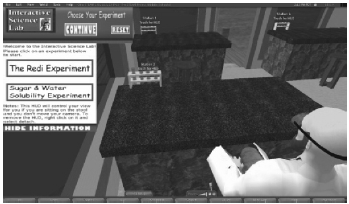
Figure 1. Heads Up Display (HUD) which displays needed information for the student engaging in the Interactive Science Lab
This paper presents the development of a 3-D virtual environment in Second Life for the delivery of standards-based science content for middle school students in the rural Appalachian region of Southeast Ohio. A mixed method approach in which quantitative results of improved student learning and qualitative observations of implementation within middle school classrooms are provided. The Interactive Science Lab Game found in the Teen Grid of Second Life has been used for the past year to improve the understanding of genetics (Fruit Fly Experiment) and Gallery Walk was used to improve the learning of science in grades 6 to 8. Participant teacher reactions and concerns in the use of 3-D simulations in middle school will be addressed.
As schools continue to question effectiveness and assess student learning for the 21st Century, educators in K-12 are realizing that today's digital natives are not the students they have had in the past. These digital natives bring to the classroom a wide variety of technology expectations, skills and knowledge. The speed at which they accept new technologies will not be slowed and as students, they are evolving and changing at a rapid pace. Today's students take the internet for granted, blog, multitask throughout their day, use cell phones to map their lives, are experts in sending instant message and play video games in a worldwide arena of players (Prensky, 2005). And while schools have attempted to integrate technology into the classroom, effective integration has proven to be a difficult problem due to budget constraints, teachers' lack of familiarity with technology, and technology staff support. Schools not utilizing technology in teaching and learning are creating a larger gap between informal learning via multimedia technologies (computers, gaming, television, internet) that occurs in the home and formal classroom learning, which relies primarily on text in the school (Downs, 1997).
Away from school on the home front, video games have established themselves as one of the most popular and profitable mediums of entertainment today. Children as well as adults have turned video games into an industry as in 2006 it has generated a profit of more than 12.5 billion dollars in the US alone, a 19% increase from 2005 sales (Sinclair, 2007). The success of this industry has left educators wondering if video games can be adapted to serve educational needs while retaining the elements that engage audiences with immersive and interactive experiences.
Len Annetta (2007) suggests that students are eager to pursue new information in virtual learning environments supported through the use of video games. These students eagerly return home from school and embark on the development of skills which help them to connect, manipulate, and evaluate information in virtual worlds. Games in our classrooms provide a new opportunity to explore how students learn through a learner-centered environment. Digital games whether delivered on DVD, CD or online are very learner-centered, they offer a challenge to the user, often require cooperation or collaboration with other students, engage the learner in content and promote problem-solving opportunities (Gros, 2007)
”Today's games developed on games engines can be played on personal computers, on games consoles, on handheld devices, on mobile phones and using mixed interfaces, e.g. augmented reality and mobile devices, and can be created without the use of programming languages” but rather software editing kits (de Freitas, 2007, p.7) These games and their software are seen as interactive in nature allowing for greater flexibility in their support of large and small community interactions. These game-based technologies bring to the educator a greater potential for unique learning environments in which diverse delivery offers immersive engaging learning which is not only effective but relevant to the learner (de Freitas, 2007).
Online games, once unheard due to internet access and bandwidth issues are widely used. “Online games include simple text-based games as well as games that involve complex graphics and virtual worlds that are used by large numbers of players simultaneously. Broadband access to internet resources has made massively multiplayer online role play games (MMORPs), massively multiplayer online real-time strategy games (MMORTS) and massively multiplayer online first-person shooter games (MMOFPS) very popular. In addition the wider usage of Flash and Java has allowed gaming websites to use streaming video, audio, and introduce greater user interactivity” (de Freitas, 2007).
Simulation and exploration created by a game provides students with a unique method to experience a topic which is often unrealizable in the classroom. Leach and Scott stress the importance of experience in learning, which is necessary to encourage “conscience reflection and thought” (2003, p. 100). Virtual environments are quite useful in helping the students and participants in visualizing phenomena that is abstract and impossible to observe because humans are either too large or too small (Yair, Mintz, & Litvak, 2001). Adding a gaming element to this experience promotes the goals of educators by creating a motivation to learn. When students are in charge, and in control of the decisions made on all levels of the virtual world, they are free to explore and experiment (Tekaat-Davey, 2006). While most agree that games can motivate, engage and hold the attention levels of students, there are still questions concerning whether learning is actually taking place and is this an effective instruction. Those beginning to research the use of games in K-12 schools are also questioning whether the pedagogical models presently in use are appropriate in the digital medium used for game development. Perhaps there is the need to examine a new pedagogical model.
Second Life (SL) is three-dimensional open source software in which the users of the software are able to change and create the different aspects of the virtual world. Conceived by Philip Rosedale in 2002, it is completely “imagined, created, and owned by its resident” (Rymaszewski, M., Au, W., Wallace, M., Winters, C., Ondrejka, C., & Batsone-Cunningham, B., 2007, p. 6). Each part of the SL environment is user generated through programming different functions into the environment. Second Life is divided into two different grids: the Second Life Grid which is for students of 18 years old and older and the Teen Grid which is designed for students aged 13 to 17 years (Rymaskewski, et. al., 2007). Each grid is composed of a group of islands which may be purchased by individual users for specific uses if desired, however, many people work, play and communicate in Second Life with ever purchasing items, land or building on SL sites. Second Life users teleport to move among the different islands found in Second Life. While the general Second Life grid is free, private islands can be purchased and maintained for a fee. The purchase of a private island allows the user to set parameters for who and when different groups may visit, the “rules” for participating in activities on the island and purchasers act as the regulators of the use of the island. Users on a private island have specific logins and passwords and are immediately teleported to the private island upon login to Second Life.
Second Life (http://www.secondlife.com ) provides a portal by which users can login with a password to the site and create a personal avatar which represents the SL user. In this 3-D world avatars are the means by which to engage in the world. The avatar acts as the player's character or persona and interacts by communicating with other avatars. Avatars may be customized by changing their size, shape, hair, skin, tone, clothing, etc. The avatar also has the ability to fly, walk, and communicate by speaking using a microphone attached to the user's computer. Another interesting feature is the ability to teleport to other locations within the Second Life environment. Almost all of the objects built in SL are created from geometric shapes called prims. A prim can be shaped in a variety of ways, using given qualities or characteristics and textures to give them a surface. Prims can be linked together to create larger objects, programmed to follow a script, many of which are built into the software or found within the software library online (Rymaskewski, et. al., 2007).
In this research project, a private island on the SL Teen Grid was purchased and used to provide security from adult users that might “wonder” into the spaces during class time. Secure logins and passwords were generated and remained with the teacher to be passed out when the middle school students were ready to interact with the Interactive Science Lab and Gallery Walk. The private island allowed the engineering graduate students to provide some area for student work and some areas on the island for continued development which could not be visited by the students. The private island also helped to alleviate some of the fears of principals, teachers and parents concerning the use of a virtual environment readily available to persons on the Internet.
Development in Second Life does not require that the user be a programmer. Many of the objects and scripts used in SL for designing learning spaces can be found free on the internet and plugged into the software which is free to download from the homepage of Second Life. The short learning curve for programming in SL creates a window in which educators can intuitively build learning environments for their students.
The Interactive Science Lab and Gallery Walk were designed to provide middle school students an opportunity to explore and interact virtually in a hands-on manner with concepts typically taught in Ohio middle school science. Many of the schools within the middle school level in Ohio have limited science labs equipped with laboratory equipment and resources appropriate for many experiments which should be taught within the curriculum specified by the state. Most middle school science classrooms are typically like any other classroom in the school building. By using a virtual lab, students have the opportunity to use bunsen burners, proper goggles, safety equipment such as emergency eyewash and shower as well as gas and water for use in the experiments. While these may seem trivial to many, the virtual environment provides a means for students to experience the use of a science lab without the expense and safety issues that abound in these schools. The Interactive Science Lab presently provides a foundation for the exploration of the scientific method, water solubility exercises, the Redi experiment and a study of the genetic traits of the fruit fly. The Gallery Walk contains an interactive environment for students to share research on a wide variety of concepts and to use research from previous students to expand their own understanding of a science concept. At present, the Gallery Walk contains research on marine animals and habitats of the world.
When students are teleported to the Interactive Science Lab, they first are asked to put on their goggles and then to sit at a location in the lab. Through the use of a “heads up display” (HUD), students select the experiment to be conducted and the needed equipments appear on the lab countertop. The HUD not only allows students to select from a menu of experiments but is used to provide educational content to support the experiment, instructions, questions, and quizzes to be completed as the experiment progresses. (Figure 1). The HUD provides an area on which the student may focus for information and helps to keep the students from distractions which may be found in the virtual world. Pictures of the Interactive Science Lab (Figure 2) and the Fruit Fly Experiment (Figure 3) are both taken from the student's perspective while working in Second Life.
Figure 1. Heads Up Display (HUD) which displays needed information for the student engaging in the Interactive Science Lab
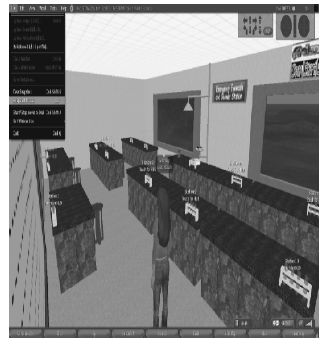
Figure 2. Interactive Science Lab
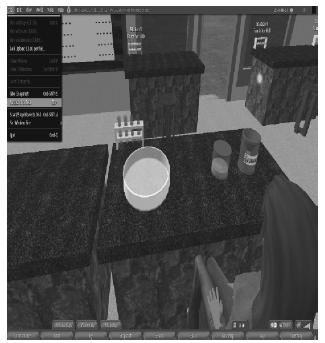
Figure 3. Fruit Fly Experiment within the Interactive Science Lab
When entering the Gallery Walk (Figure 4) students are placed within a variety of habitats in which research content is available to read and observe. Students may move from habitat to habitat and collect data on habitats, share their own data and content or build more content within the “poster” area to share with students from other schools entering the Gallery Walk. All of the content within the Gallery Walk has been student generated with the engineering graduate student only helping to correctly load student content within Second Life.
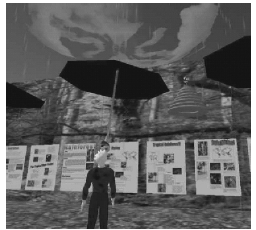
Figure 4. Entry to the Gallery Walk
The National Science Foundation GK-12 Grant (Science and Technology Enrichment for Appalachian Middleschoolers – STEAM) supporting this research will continue through March of 2009. More “games” will be ready to share with students over the next year with a Mystery Objects Game under construction which helps students to make scientific inferences and observations as well as a game which allows the student to race in space while examining stars, novas, and other space science content. As each game is completed, middle school teachers along with a higher education faculty member in instructional technology and science education design wrap-around lessons to support the use of the virtual games.The following URL
(http://vital.cs.ohiou.Edu/ softwarereleases.html) can be used to gain access to Flash-based games which were created for this grant and to obtain access to the Second Life site when field testing is complete:
The following research hypotheses were used to guide the study of the use of the virtual world of Second Life-Teen Grid in the middle school classrooms.
This research used a quasi-experimental approach in which mixed methods involving a quantitative investigation of the implementation of science content games to determine their value to learning science and qualitative investigation of the context surrounding the implementation was examined. The qualitative examination aimed to explore, describe, and understand the nature of the virtual environment (Second Life) and focused “on descriptions of how people experience and how they perceive their experiences of the phenomenon under study” (Glesne, 1999, p.7). The quantitative examination used the t-test to examine the means between the pretest and post test given by the classroom teacher. Data collection included the use of 1) a Student Satisfaction Survey, 2) classroom observations using an established observational instrument, 3) an examination of test means, and 4) principal, teacher and parent reflections or comments.
Development of the Interactive Science Lab and Gallery Walk in Second Life took place along two parallel paths during 2007, year 1: 1) computer science graduate students in the College of Engineering and the faculty instructional designer investigated the National Science Standards for K-12 schools and aligned the middle school content typically taught with the standards; and 2) as the game was developed in the Second Life –Teen Grid environment, middle school teachers and students were asked to examine, play, and critique the Interactive Science Lab and Gallery Walk.
During 2008, Year 2, an iterative cycle was used in which the game was changed to meet the critique of the audience and to match national standards for science instruction as the teachers, parent, and students identified issues within the game play. During this time period, extensive observational notes, student and teacher comments and development team critiques were maintained to document the design process. Two teachers were recruited to use the Interactive Science Lab and Gallery Walk in their classrooms and to conduct a quasi-experimental model in which learning outcomes for the game content were compared by 1) students who played the games only, 2) students who played the game within curriculum and 3) students who did not play the games.
The engineering graduate students who created the games were assigned to the two schools to determine the viability of the school to actually play the game on the school computers, help with teacher preparation to work in the virtual environment of Second Life, and to gather data on software glitches that occurred as students worked in the Interactive Science Lab. By placing the engineering graduate students in the classrooms as game play occurred, the builder of the game gained immediate feedback from the teacher and student as well as information on the hardware concerns.
Data collection for an examination of the means involved the use of assessments aligned to the Ohio Science Achievement Test and teacher designed tests (item analysis: Cronbach Alpha 0.69 for lowest, 0.83 for highest value for pre and post test questions and found to be satisfactory) which were used across all participating schools. Levene's test of normalcy was examined and was found to be satisfactory. Classroom observations of teachers and students during a typical science lesson and on the days in which the Interactive Science Lab was embedded in the lesson were collected over a 6 month period. Ongoing during this period were, interviews with principals, parents and teachers to gain insight into the “climate” of schools allowing the use of virtual environments.
Overwhelmingly, the students were engaged and motivated by the use of the Interactive Science Lab in the classroom. On days in which the Interactive Science Lab was to be part of the class, students would by-pass going to their classroom and arrive at the computer lab. When instructed to go to their science classroom first, student often tried to negotiate staying in the lab to begin and thereby obtaining more time to work in the Interactive Science Lab. Student[A2] noted, “It wastes time to go to science, can't I stay here and start? I know how to get the computer going. I can just play till everyone else gets here.”
Satisfaction surveys were given to students to obtain information concerning the “game play” and comments on whether the game was appealing, easy to play, reading level was appropriate, and/or if the student actually understood what concept the game was presenting. The range of scores was from 1 to 4 with 1 being the lowest (Completely Disagree) and 4 (Completely Agree) being the highest score possible for any one question. Table 1 demonstrates the high values given by students to the games concerning their satisfaction of two Second Life presented. Comments from the Satisfaction survey typically fell into the following categories: 1) do not understand how to play, 2) the text is hard to read, or 3) can we play these more often. Text color contrast and readability were continuing problems as most of the schools did not have the newer flat screen monitors and this created some difficulties with reading on the screen.
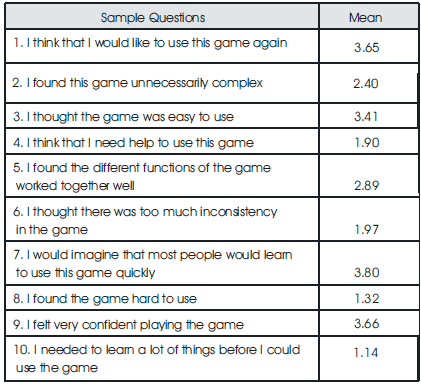
Table 1. Selected Satisfaction Survey Questions (Limitation of Space only allow a sample.) 1 = Completely Disagree, 2 = Disagree, 3 = Agree 4 = Completely Agree (n = 88)
The following statement from Teacher[4] was typical of teacher viewpoints in the engagement of the Interactive Science Lab, “The students keep asking when will they play the games and see the fellows [engineering graduate students]. It means the students are very interested in the project but sometimes it is annoying when the students ask too many times every day.”
Common comments from teachers included, “The students would do this every day if I would go to the lab.”; “I was skeptical in the use of computers in helping my students learn science – now I am convinced. The students love this and it is like what they do at home on their Nintendo” and “I think these games really had a difference when I taught genetics – on paper, they never figured out the Punnett Squares but on the computes for two minutes and they have got it!”
Many parents commented on the fact that their middleschooler was describing the games at home and wanted to have access to the games beyond the school day. One parent stated, “We do not have internet access and so I had to drive her to the library. She played for about an hour and a half and I finally had to tell her we needed to go home. She has never asked to go anywhere to do schoolwork – and this was science! These must be really good!”
Principals approached the use of Second Life with caution. Their main concern was the liability of having unexpected intruders into the school’s virtual world. The use of the private island dispelled some of these fears but it wasn't until the principals saw the enthusiasm of the students that they became more interested. In particular one principal visited the classroom every time the students interfaced with the virtual world. As the work on the Interactive Science Lab progressed, so did his enthusiasm. He stated, “These are very difficult concepts that students must know. I am so amazed at how well they respond to the games. This enthusiasm hopefully will translate to learning.”
Most principals were concerned about student behavior in Second Life and the fact that students can “hold hands”, “undress” or “chat online”. It was interesting to note that students did not purposefully undress. In the one instance in which a female student lost clothing and was queried, the student replied, “Oh, Dr. X, these are only dolls! It is not me undressing, it is the doll – and it was an accident. I was trying to wear this shirt and lost this one.” On the issue of chatting and other personal contact, the schools added language to the Acceptable Use Policy (AUP) to inform parents and students of the acceptable and unacceptable practices expected when online or in virtual worlds.
Because these digital natives are so used to chatting, a system was established in which all chats were recorded within Second Life and then emailed to the teacher at the end of each class period in which students were logged into Second Life. While these chats were originally collected to determine if students were using the chat appropriately, examination of the chats indicated that students were engaged in the game and were actually asking each other for help in solving the problem presented in each game. The collaboration between students was a pleasant outcome of the game and the ability to chat with others in the classroom without disturbing others.
Concerning the use of the Interactive Science Lab and Gallery Walk in improving student learning, Tables 2 and 3 provide some insight to the gains in means through the use of the statistical t-test procedure which was used to examine the means. The Interactive Science Lab contains three sub-levels of games: 1) Redi Experiment, 2) Water Solubility Testing, and 3) Fruit Fly Genetics. The data presented is from the Fruit Fly Genetics which was part of the fall semester curriculum. The Redi Experiment and Water Solubility Testing are still in the testing stages at schools with data expected for March 2008 as results from the curriculum based testing is complete. Gallery Walk data is also presented.
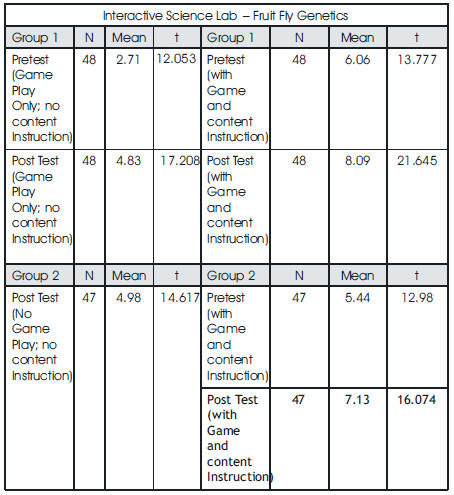
Table 2. Results of Interactive Science Lab Fruit Fly Genetics
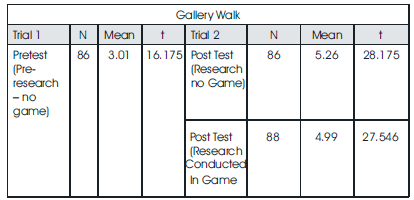
Table 3. Results of Gallery Walk
For the Interactive Science Lab – Fruit Fly Genetics, students were divided into 2 groups within classrooms. The placement within a group was purely random although it is considered a convenient sample due to the nature of working in a classroom setting within schools. No action was taken to balance the groups by achievement levels. Before the content was taught within the science curriculum, Group 1 took the pretest, played the game, and took the post test. Group 2 only took the post test but was allowed to play the game with Group 1 after completing the post test. When the content was taught within the curriculum all students took the pre test, were taught the content by the teacher and then took the post test (data retains Group information). Comparisons were made between the three treatments and are found in the Table 2 (Interactive Science Lab – Fruit Fly Genetics).
As was anticipated, students engaged in classrooms in which the Interactive Science Lab Game – Fruit Fly Genetics was embedded within the science curriculum obtained the highest gains, with students playing only the game had the second highest gains from pretest to post test. Group 2 students not exposed to the game had only a post test score, which was higher than expected level, but still lower than their post test with content instruction and the game. The combination of teacher instruction and the game significantly increased the post test knowledge. Student enthusiasm for the use of the Interactive Science Lab was overwhelming with student comments ranging from, “can we just use this to do science” to “the first time through the genetics – I got it! I did not understand when I did this on paper, now I see how it works.” Teacher comments included, “the students are so much more alert when they know we are going to use the game. They come to class excited and anticipating what they will see in the site.” A second teacher commented, “They work on games at home so much that this seems like a natural fit for them. One parent state that she had to take her daughter to the library to be sure to play the games as her daughter was that much enthusiastic about them.”
The Gallery Walk is designed to provide opportunities for students to learn to conduct research. As shown in Fig 3, the Gallery Walk contains exhibits which provide science content, data, observations and inferences concerning marine animals or world habitats. Data for the Gallery Walk is found in Table 3. In this particular case, Trial1 students took the pretest without having conducted any research. Trial 2 students contained 2 situations: One group took the post test after having conducted research in books, online and from the library. The second group took the post test after having conducted the research while in the Gallery Walk. Those students having conducted research from print materials and the internet scored only slightly better than students who used only the Gallery Walk. The slight difference may have been due to the excitement of exploring the virtual world of marine animals and given the small difference, the Gallery Walk holds promise in providing an immersive research environment.
As educators, we are just beginning to establish that games in the virtual 3-D world can provide learning environments in which students “try out” science and learn to develop critical thinking skills and methods by which hypotheses can be evaluated in a safe and open environment. The outcomes for the research are only in the infancy stage. As each virtual environment within Second Life is examined and field tested, new insights are gained into the development of the game, how digital natives in the classroom interact, and how we as digital immigrants have different perceptions of what is fun and what is learning, than do our students. Much of what has been learned has pointed to the fact that these environments are so new that students become so excited exploring the environments and forget to concentrate on the tasks at hand. As more virtual worlds become available and classrooms begin to see the value of immersive worlds, the opportunities to change pedagogical strategies increase allowing educators to create very specialized instruction which targets the needs of the individual student.
While this research provides only a beginning, the attitudes of principals, teachers and students have changed within the 2 years of this project. Principals are now asking about Second Life and social networking environments when 2 years ago, this was unheard of in these rural schools. Teachers having observed their peer teachers with students working in Second Life are asking to join the project and to play the games with their students. Finally, parents are asking when these will be available online for “home play” so that learning can continue after the school doors close. This informal learning will be an area of continued study as the games are released to the public. This research provides interesting insights into the total process of designing and implementing virtual environments in rural middle schools in Southeast Ohio, USA.
For those who are presently working in the development of games within virtual environments, all observation instruments, and student satisfaction data collection sheets may be shared by contacting the author of this article. The pretests and post tests for each game that has been developed may be found at the website noted earlier.
This material is based upon work supported by the National Science Foundation under Grant No. 0538588. Any opinions, f indings, and conclus ions, or recommendations expressed in this material are those of the authors and do not necessarily reflect the views of the National Science Foundation.