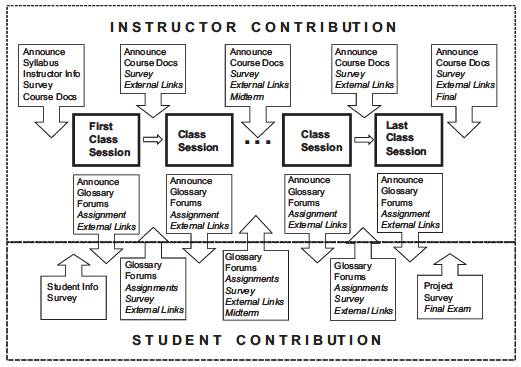
Figure 1: LDS Tool Overlay
There is a number of proprietary and open source Learning Delivery Systems (LDSs) available for the use of Instructors today. Though each have their own protocols, they all still sharing an overlapping and common tool set. This article provides a case study describing how to apply some of the common tools found in LDSs in the delivery of course in an executive level, international program that is taught in the students' non-native language. Designed for the practitioner, the article describes how an Instructor can apply these tools for maximum benefit to executive level students for whom language issues may be an impediment for their maximum learning. The article also lays out a schedule for the Instructor to assist them in the integration of the tools before, during, and after the delivery of the course.
Executive education is the learning solution of choice for busy executives who are climbing their career ladder. By its very nature, executive education must be accessible and convenient for professionals who are not only busy building their careers, but often engaged in managing many other commitments. Thus a unique set of challenges are awaiting beyond those full-time learners. It has become common that many local institutions are becoming partners with international higher education institutions, as a result of this many executive programs are now being delivered in the executive learner's non-native language. This creates additional challenges for the executive education learner. For these reasons, executive education lends itself to a hybrid delivery - that is, a combination of in-class learning supplemented with an asynchronous learning component delivered through application of technology. Learning Delivery Systems (LDSs) is one of the main technologies developed to provide this asynchronous learning component.
While there are a number of learning delivery systems on the market today, most share some of common tools. This article is not about comparing the current LDSs on the market today, but it discusses more about how to use standard modules found in most LDSs to co-create a transformational learning experience for professionals enrolled in an executive education program. The list discussed in this article is not comprehensive. It is, however, a good starting list for the beginner or intermediate designer of an executive education course. Following the guidelines for using tool presented in this case, can save hours of course design that you, as an Instructor, can refocus on working with your learners. The LDS tools presented in this article will be: announcements; online syllabus; glossary; instructor information; tasks; surveys; assignments; discussion forums; groups; course documents; external links; tests, and; drop boxes.
This methodology was designed specifically for a six week, executive education course that was conducted once in a week. The student population were Taiwanese and the course was delivered in English. Recognizing that there are specific start-up and closing elements, the methodology is equally applicable to courses of either shorter or longer duration - the application of the tools in the middle of the course can be replicated for number of weeks. Figure 1 illustrates the overlay of the tools mentioned above on the course time line.
Figure 1: LDS Tool Overlay
The case study presented here advocates integrating the LDS into course delivery in three distinct phases: course start-up; ongoing course delivery, and; course closing.
The LDS will only be successful if the executive learner sees the value that can be added in their course. Some of the learners may know this already, but some executive learners may not have been in a classroom for many years. For these learners, it is difficult to understand the purpose and power of an LDS. They may also be intimidated by the use of technology in their learning experience. Hence, the Instructor needs to reach out to the learners via an email to ensure the introduction of LDS as a key course before the course begins. This initial email contact should address the following points:
This initial contact helps to set the stage for how the LDS can be used throughout the course and begins to manage the executive learner's expectations, and draws the interest of executive learner towards the course before the course begins. Achieving these goals early are important for executive courses, since executive courses by their nature have to cover a wider information in a shorter duration than a traditional masters level course will. Figure 2 is a sample welcome letter that an Instructor can send out to a learner before the start of a course.
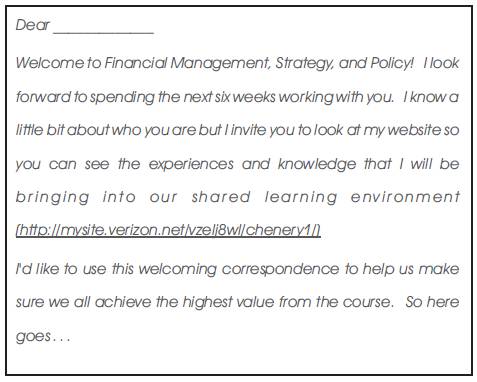
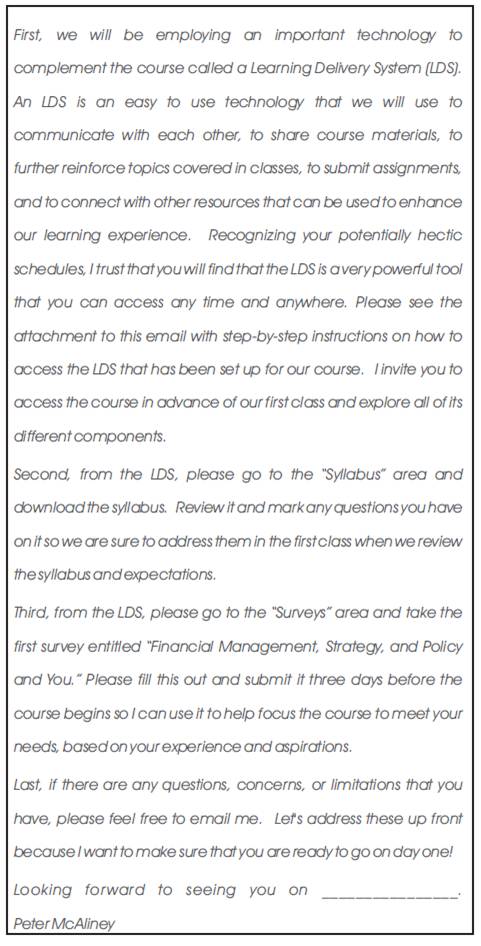
Figure 2. Sample Student Welcome Letter
This welcome letter should also be the first announcement that is shown to the executive learner when they arrive at the LDS module corresponding to the course.
From a practical perspective, this initial contact will introduce the learner directly to some of the LDS tools (e.g., announcements, syllabus, Instructor info, surveys) and indirectly to others through your invitation to review the entire LDS course module (e.g., the glossary, tasks, assignments, discussion forums, groups, external links, tests, and; drop boxes).
During the fist session of the class, the instructor should review the LDS with the executive learner. In this first class the instructor has to explain to the executive learners how he/she has planned to use the LDS, and the instructor has to be careful in gauging the level of the executive learners in this first session. So the instructor do not spend too much or too little time on the LDS, but encourage learners to work together reviewing the LDS, pairing those who are more familiar with the LDS with those who are less familiar.
If students have laptops with internet access, an in class exercise can be conducted with using the LDS. A group survey, starting to add definitions to the course glossary, answering a question in a discussion forum, and visiting an external link are all relevant exercises that can be assigned to executive learners in the first class to ensure that they are comfortable with using the LDS. As an Instructor, you would want to make sure that at the end of the first class, all of the executive learners have developed at least a familiarity of the specific LDS that will be used to complement the course.
For an Instructor, the most powerful communication tool that can be used for disposal is the “Announcements” tool. Announcements serve two purposes for an Instructor:
As Figure 1 indicates, by the first session, the executive learner would have been introduced to all of the tools in the LDS. If an internet connection is available, they will also have had the opportunity to work as a group navigating through the LDS. Accomplishing the above, assures that the course will get in to a strong start and the LDS will start to be internalized as an integral part of the executive course delivery.
During the delivery of the course, the instructor will be employing different tools within the LDS. As Figure 1 illustrates, before each class session, the instructor should have to assure that the executive learners are being provided with “Announcements” and the learners would be raftered to the specific “Course Documents” that will be employed in the upcoming class session. Instructors may also use “Surveys” and refer them to “External Links” to help them prepare for the class session. If tests are to be administered, you may also assign “Tests” for them to complete.
As mentioned above, after each class session, the instructor can use the “Announcements” to reiterate topics covered in the class, identify additional areas for learners to visit (through “External Links”), and reinforce the homework assigned in the class in the “Assignments.”. Some of these assignments will probably bring them to “Discussion Forums” and the “Glossary.” One of the areas open for exploration is integrating podcasts and blogs into the “External Links” in the LDS.
It is essential for an instructor to set a schedule for updating the LDS for the pre-class and post-class supplements. This gives time to pull everything together and also provides you the time for the necessary reflection required to make sure that your communication in the session is a successful one.
Posting too frequently to the LDS has the tendency to burn the executive learner out and runs the risk of them avoiding the LDS altogether. For the pre-class supplement, usually do it at least one full day before the class. This gives the executive learner the time to complete assignments from the prior session and prepare for the upcoming session. It also gives them time to print out any new materials in advance if they need, so that they can read them during commuting hours or in the free time during their work.
As indicated above, one of the powerful advantages that an LDS provides for executive learners, especially, those who were learning the course in their non-native language is the ability to review the class materials after the class so they can catch up the substance. A useful technique the author employed is to assign specific topics to learners to find articles in their native tongue and place them in the “Drop Box.” It can be send to them directly either by post or providing their location via “External Links.” Not only do executive learners appreciate this sensitivity to their national culture, but it also helps to increase community in the class section. It helps the executive learners to build their networks outside of the class setting. After all, one of the benefits an executive learner expects from an executive level course is the ability to increase their professional network.
The “Glossary” tool is a powerful way that the executive learners use to build a shared vocabulary around the course topic. One of the requests for learners when adding to the glossary is not only to provide a definition for the term, but also to relate any personal experiences that they may have had around the specific term or find a reference through a web search that cites a specific example of how the term may have unfolded in a specific business setting. Whatever the course topic might be, a true understanding of the term or concept required in the glossary addition must be augmented with a practical application, so that the executive learner can better apply the concept in their career. An important outcome of executive learning needs to be relevant for the executive learner.
An executive level course usually does not end on the last class. In some cases, a final can be required to be submitted after the last class session. Here, the “Test” tool would be employed. More often, projects or group projects will extend up after the last day of class. To continue to be benefited from the LDS, the course module must be able to facilitate the completion of the executive learners' group projects. This becomes particularly important especially when the team members are in different cities (or even countries).
A standard tool in an LDS is the “Group” tool, whereby a special private area is assigned to facilitate group work. This tool can be used by the group to email each other and establish threaded conversations, and they would also be able to exchange documents that they can work on together. This is extremely important to help them with version control and managing a project throughout its completion. Additionally, the “Group” tool enables the instructor to contribute to the group project.
The author usually leaves the LDS course module open even after the group project has been turned in and would encourage learners to bookmark any links that they might have found helpful and copy any “Course Documents,” threaded discussions, or really any of the material that the group co-created as a learning community in the course.
An LDS is a powerful complementary technology in executive education. While there are many proprietary and open source LDSs available today, many of them share a common tool set. However, like any craft, it is important to know how to use them. This article presented a number of these common tools - announcements, online syllabus, glossary, instructor information, tasks, surveys, assignments, discussion forums, groups, course documents, external links, tests, and drop boxes and showed how an Instructor can integrate them into a six week executive education course. The methodology presented here advocates integrating the LDS into course delivery for three distinct phases: course start-up; ongoing course delivery, and; course closing. Hence, this methodology can be extended to courses longer or shorter in duration.