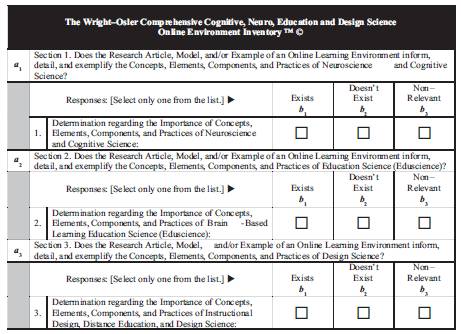
Figure 1. The Research Instrument
The purpose of this research investigation was to look at the factors that lead to isolation, lack of student inspiration and motivation, lack of student engagement and lack of student retention in the asynchronous online learning environment. The study further delves into how the use of cognitive and neuroscience research can inform the design of an interactive user interface model to address the aforementioned factors. The instrument used in this study was researcher designed “Tri–Squared Test Inventive Investigative Instrument” ( Osler, 2012). The data was analyzed using the novel Tri–Squared Meta–Analysis methodology. The results yielded significant differences in the Tri–Squared Meta–Analysis regarding the research literature as it relates to the overall use of cognitive science, neuroscience, and the science of design to increase the overall effectiveness of distance education in terms of course design based upon neuroscientific graphic user interface concepts and principles. This illustrates that there is a clear lack of relevant research regarding the use of cognitive science, neuroscience, and the science of design to truly create effective and engaging distance education online courses
Learning in an online environment has garnered both positive and negative feedback from students who participate and experience this method of teaching and learning. The fact that the distance education and online learning market is consistently growing is a testament that this option for lower and higher educational services is becoming a standard source for educational opportunities ( Allen & Seaman, 2010; O'Toole & Keating, 2011 ; Reiser, 2001; Hu & Potte, 2012). In fact, online course offerings are increasing at a faster rate than traditional course offerings, with online higher education courses nearly tripling between 1995 and 2003 ( Beck, 2010 as cited in Crawford-Ferre & Wiest, 2012). However, the online learning environment and the ability to engage and retain students have not been perfected yet, especially in the asynchronous learning environment. This means that there is much that we can still learn about how to improve online learning and the design of online learning environments.
At the rate of speed that technology is advancing, anyone beginning a course of online study today is likely to find a greatly changed landscape even by the time they complete their education ( Searls, 2012). Although best practices in online learning are at the forefront of distance education research, the effects of the initial introduction to online learning environments have not been researched as thoroughly. This study explores the design of online learning environments and the role that cognitive and neuroscience research can play to inform the design of these online environments and address some of the challenges such as, motivation, engagement and retention that many of these environments present. There is great potential in the field of education for tapping the research findings on the functional workings of the brain and how this knowledge can be used in designing effective instructional approaches to learning ( Kumar & Yap, 2010 ).
People learn best in their pleasure zone, between panic and boredom ( Feidakis & Daradoumis, 2013). Introduction to an online learning environment can sometimes produce in some first time students the extremes of both panic and boredom. Finding and fulfilling that pleasure zone within the minds of learners can be indeed a significant challenge that requires the practice of both science and pedagogy. There are many models and theories that provide a basis for understanding how humans think and ultimately learn ( Mahan & Stein, 2014). Research is now showing that a learning environment can influence a developing brain ( Hardiman, Rinne, Gregory, & Yarmolinskaya, 2012 ) and the physical, social, cultural and psychological factors of a learning environment have an impact on student learning (Hu & Potter, 2012). Don Tapscott, 2009 as cited in Sprenger, 2010, discussed how according to cognitive and neuroscience research, Net Geners absorb information differently than any other generation. When they scan a website or go online, their approach is more visual ( Sprenger, 2010). Understanding the science of how the brain encodes and retrieves information from the environment at the moment of learning can be a major consideration in the design of online learning environments. In the book, “Brain Rules”, John Medina (2008) provides the example of creating a “Spanish Room” for teaching bilingualism in a household. John Medina notes that this room should be designated for Spanish speaking only and that all the artifacts and pictures should be of the Hispanic culture. By creating this type of environment, it allows for the encoding of the learning goals to become more elaborate and leads directly to retention and retrieval when the environmental cues are later encountered ( Medina, 2008, pg. 117).
Additionally, new research in the field of Neurobiology is now showing how environment creates changes in both the brain and the body at the cellular level ( Briggs, 2013; Mahan& Stein, 2014). Cognitive Science have revealed that the human brain physically changes when it learns, and that after practicing certain skills it becomes increasingly easier to continue learning and improving those skills. Enriched living and learning environments are the key to optimal brain development ( Restak, 2011, pg. 1). Knowledge of this direct link between the brain, the environment and learning, and the impact and influence that these can have on student motivation, engagement and retention can help to inform the design of online learning environments. The standardized virtual or online learning environments now available in many higher education institutions give little room for imagination and innovation (Greener, 2010). Many of these environments have a sterile look and feel and the initial introduction into these online environments creates an emotional and cognitive disconnect for the learner even before the learning process begins. In order for optimal learning to take place in these environments, a student must first get past the fear and anxiety of approaching a new learning environment that is not as familiar as the traditional classroom setting and this often requires the student to use a new set of skills ( Sprenger, 2010).
Russo (2012) labeled this net generation as iStudents. He noted that these iStudents entering college today have different characteristics from the preceding generations and not only do these college students behave and communicate differently, they actually think differently due to the use of technology. Research in neuroscience is showing that the brains of even older adult users of technology are showing the same patterns of the net generation and that as little as five hours on the Internet changes the way our brains work. Research in Neuroplasticity, which is the process in which your brain's neural synapses and pathways are altered as an effect of environmental, behavioral and neural changes is showing how the brain is constantly changing as it is exposed to new information. Current research also suggests that the more you challenge your brain by learning new things; the better off your brain will be ( Sprenger, 2010). This research Investigation carefully looked at the online learning environment from a cognitive and neuroscience perspective to see how that information can be used to create motivating and engaging online environments that can lead to a more interactive learner experience and as a result, achieve greater student retention.
The Optimal Learning Interface© (OLI) Model developed by the researcher and introduced in this paper is an example of how this understanding of how the brain works can be used to design and develop online learning tools that can enhance student motivation, engagement, retention and ultimately learning. The Optimal Learning Interface© (OLI) Model is designed to optimize learning through the use of an interactive user interface.
According to Moore (1989) as cited in Abdous (2013), in the online learning environment, you have three dimensions of learner interactions (learner-to-content, learner-to-teacher, and learner-to-learner). A fourth dimension (learner-tointerface interaction) was introduced by Hillman, Willis, and Gunawardena (1994) as cited in Abdous (2013). The interface used by most LMS's (learning Management Systems) or CMS's (course Management Systems) do not engage or inspire the user's interest in the courses that are presented ( Abdous, 2013). It is only once you are in the course that you will know whether or not the course is engaging. This is like going to a website that has no appeal. It may have all the information that you want and need but because the first impression of the home page you received evoked a negative emotion, you ended up not even looking at the rest of the website pages. This is how the brain works! In brain science this is called as and “approach-avoidance” state. The amygdala, a small almond-shaped object that is part of the limbic system plays a central role in remembering whether something should be approached or avoided ( Rock, 2008). All sensory inputs, external and visceral, must pass through the emotional limbic brain before being redistributed to the cortex for analysis, after which they return to the limbic system for a determination of whether the transformed, multi-sensory input is salient or not (Cytownic, 1994, as cited in Picard, 1997; as cited in Feidakis & Daradoumis, 2013). Interests, anticipation, curiosity, and excitement all produce an approach state and is usually associated with positive feeling and emotions while negative feelings and emotions are associated with the avoidance state and students will disengage instead of engage ( Rock, 2008). This novel approach to the virtual world of distance education and online learning addresses just one small component of the online learning environment. The initial learner-to-interface interaction experience is what the Optimal Learning Interface© (OLI) Model addresses. The goal of this study is to address the challenge of student motivation, engagement and retention in the online learning environment using cognitive and neuroscience research to inform the design and development of this model.
The theoretical framework for this research comes from the disciplines of Cognitive Science, Neuroscience and Design Science. The researcher, having a background in both cognitive science and online instructional design, uses learning theories and models from both disciplines as the bases for presenting this framework. Cognitive science is the interdisciplinary study of intelligent systems, both human and artificial ( UNCC-CSP, 2014). Several disciplines comprise the field of Cognitive Science, including Artificial Intelligence, Linguistics, Anthropology, Psychology, Neuroscience, Philosophy, and Education. ( Cognitive Science Society, 2014 ). Cognitive science aims to understand the processes and representations that are the basis for intelligent actions. Research questions center on cognition, memory, problem solving, vision, and their computational embodiment ( UNCC-CSP, 2014). Paul Thagard, Ph.D. (2007) notes that cognitive science has unifying theoretical ideas, but the authors appreciate the diversity of outlooks and methods that researchers in different fields bring to the study of mind and intelligence.
Neuroscience, also known as Neural Science, is the study of how the nervous system develops, its structure, and what it does. Neuroscientists focus on the brain and its impact on behavior and cognitive functions ( Nordqvist, 2012). Neuroscience research spans from molecules, through cells and pathways, all the way up to complex human behavior. Neuroscience integrates Physics, Chemistry, and Biology, with studies of Anatomy, Physiology, and Behavior including Human Emotional and cognitive functions. ( UNSW Medicine, 2012). Theoretical neuroscience is the attempt to develop Mathematical and Computational theories and models of the structures and processes of the brains of humans and other animals. ( Thagard, 2007). Neuroscience encompasses approaches ranging from molecular and cellular studies to human psychophysics and psychology. Theoretical neuroscience encourages cross-talk among these sub-disciplines by constructing compact representations of what has been learned, building bridges between different levels of description, and identifying unifying concepts and principles ( Abbott & Dayan, 2001 ). Basically, theoretical neuroscientists are interested in understanding the computational and mathematical principles behind brain function ( Centre for Theoretical Neuroscience [CTN], 2014).
Design Science is a problem solving approach which entails a rigorous, systematic study of the deliberate ordering of the components in our Universe ( Buckminster Fuller Institute [BFI], 2014). The use of design science in the constructing of online learning environments entails incorporating elements and principles that are fundamental to design. R. Buckminster Fuller, a proponent of design science, in his book, Cosmography (1992) (as cited by the Buckminster Fuller Institute [BFI], 2014) states, “The function of what I call design science is to solve problems by introducing into the environment new artifacts, the availability of which will induce their spontaneous employment by humans and thus, coincidentally, cause humans to abandon their previous problem-producing behaviors and devices”. Design science research is a rapidly evolving field that uses design research methods that are aligned with both cognition and education. In the field of Education, design science research when defined as learning through building, describes how curricula and learning programs are designed and empirically evaluated ( Vaishnavi & Kuechler, 2004 ). According to Mukopadhyay (2001) as cited in CEMCA 2014, 'Instructional Science provides the theoretical construct to the process of instruction'. 'Instructional Technology is the applied aspect of Instructional Science based on Instructional Design. Instructional Design is a discipline of study and has evolved over the last forty years as a science.
The literature is limited in the use of these three frameworks in regards to the design of online learning environments in distance education. The longstanding history of interdisciplinary research within the broad field of neuroscience creates an ideal basis from which to grow a science of education that draws on research from neuroscience, cognitive psychology and other learning sciences ( Ansari & Coch, 2006). This research purports that by understanding and incorporating the theoretical principles of these three disciplines, researchers can better inform the design of online learning environments that will address the issues of appeal, engagement and functionality within these learning environments.
Brain-based learning refers to teaching methods, lesson designs, and school programs that are based on the latest scientific research about how the brain learns, including such factors as cognitive development how students learn differently as they age, grow, and mature socially, emotionally, and cognitively. Research in related fields such as social neuroscience, psycho-immunology, behavioral genetics, psychobiology, cognitive science, neuroscience and physiology also play a role ( Jensen, 2000 ). Brain-based learning is motivated by the general belief that learning can be accelerated and improved if educators base how and what they teach on the science of learning, rather than on past educational practices, established conventions, or assumptions about the learning process. Neuroeducation or Educational Neuroscience seeks to link an understanding of brain processes with classroom instruction and experiences ( Wolfe, 2010). Neuroeducation seeks to analyze the biological changes that take place in the brain as new information is processed through learning. An important goal of neuroeducation is to translate relevant research findings from the neuro and cognitive sciences and help educators interpret and apply these findings in the classroom ( Hardiman, et al., 2012).
The conceptual framework of neuroeducation and brainbased learning has yet to be fully realized since research in both fields of study are still emerging and evolving. There is still much to learn, however, about how instructors and course designers can create the most effective, highly interactive, online social learning communities ( Boling, Hough, Krinsky, Saleem, & Stevens, 2012). Applying brain research to instructional design can result in the practice of brain-compatible instruction instead of brain-antagonistic instruction (Stevens & Goldberg, 2001 as cited in Kumar & Yap, 2010). This Educational climate provides an excellent opportunity for Educational researchers and instructional designers to put forth new approaches to teaching and learning. This is what makes this novel approach to distance education and online learning relevant research.
The purpose of this study is to look at the factors that lead to isolation, lack of student inspiration and motivation, lack of student engagement and lack of student retention in the asynchronous online learning environment and how using cognitive and neuroscience research can inform the design of an interactive user interface model to address these factors. The researchers, use design principles from instructional design science, educational and learning science, learning theories, neuroeducation, cognition and neuroscience, presents a model called, “The Optimal Learning Interface© Model” for use within the online asynchronous learning environment to enhance student motivation, engagement, retention and learning. Webbased learning environments can serve as motivational, instructional, modeling, feedback, and assessment tools ( Wijekumar, 2005). These environments also can impact the cognitive and social behaviors of students (Wallace 2001 as cited in Wijekumar, 2005).
The researchers as a proponents of Distance Education methodologies chose to conduct this study for the purpose of improving online education and in doing so improving education as a whole; the goal is to help educators, teachers, instructors, and professors to enhance the field of online education through the use of cognitive and neuroscience research and neuroeducation for the future students and learners. This will also help to modernize online instruction and establish it as a meaningful discipline for 21st Century students.
This study specifically addressed deficits in the research literature pertaining to the design of online learning environments that actively use cognitive science, neuroscience, and the science of design to aid in the overall efficacy of distance education via the Tri–Squared Meta–Analysis statistical metric.
The research investigation had the following trichotomous limitations: (1) The study was limited by the exact number of research articles that are available on the subject matter; (2) The study was further limited by the outcome parameters as designated by the researcher's Tri–Squared Test Meta–Analytical Inventive Investigative Instrument; and (3) The study was conducted with information extracted from available databases.
The research investigation had the trichotomous delimitations: (1) The first delimitation will be that the research study will analyze research findings that the researcher determines as valid after detailed and careful scrutiny; (2) Data collection will be completed via the researcher based on the use of the Mathematical Law of Trichotomy; and (3) Data derived for the study will be analyzed using the innovative and novel Tri–Squared Test statistic.
The mixed methods qualitative/quantitative comparative obser vational Tri–Squared Meta–Analysis of the Trichotomous Categorical and Outcome Variables in this study yielded a trifold set of in–depth research-based questions regarding the design and creation of online learning environments. The questions are used to gather data via the researcher designed “Inventive Investigative Instrument” as relevant items that pertain to the art, design, and deployment of online learning in distance education settings. Thus, the following Research Questions are applicable to this research investigation:
R1: Does the Research Literature in terms of an Article, a Model, and/or Example of an Online Learning Environment inform, detail, and exemplify the Concepts, Elements, Components, and Practices of Neuroscience and Cognitive Science?
R2: Does the Research Literature in terms of an Article, a Model, and/or Example of an Online Learning Environment inform, detail, and exemplify the Concepts, Elements, Components, and Practices of Education Science (Eduscience)?
R3: Does the Research Literature in terms of an Article, a Model, and/or Example of an Online Learning Environment inform, detail, and exemplify the Concepts, Elements, Components, and Practices of Design Science?
The following hypotheses were used in the study
H0: There are no significant differences in the research literature as it relates to the use of cognitive science, neuroscience, and the science of design to increase the overall effectiveness of distance education course design.
H1: There will be significant differences in the research literature as it relates to the use of cognitive science, neuroscience, and the science of design to increase the overall effectiveness of distance education course design.
As a result of the aforementioned Research Hypotheses structure, the subsequent Mathematical Hypotheses have the following Tri–Squared Test equation for Tri–Squared Meta–Analysis: [Tri2 = Tsum [(Trix –Triy )2 : Triy ] ( Osler, 2012) due to the use of the Tri–Squared statistic as the detailed Trichotomous–Squared Meta–Analysis data analysis measurement. Thus, the Mathematical Hypotheses are written as follows:
H0: Tri2 = 0
H1: Tri2 ≠ 0
The sample data for the research investigation consisted of 70 research articles. A rigorous and exhaustive trichotomous selection process of over 125 research articles related to the research topics “Neuroscience and Distance Education and/or Online Learning” took place to determine which articles would be included in the sample based on content and the specific research procedures that follow. The procedures in this process are described in detail in the section that follows. There were three primary basic steps to the selection of the research: (1) Identification; (2) Selection; and lastly (3) Abstraction was described in the following sections.
The first step in the process of published research identification was to find all of the pertinent articles on the research topic. Important sources of information for this research analysis included the following database search engines: (1,) ProQuest; (2,) EbscHost; (3,) ERIC; (4,) Google Scholar; and (5,) University of Phoenix Online Database. In addition to the affirmation, there are other sources of literature that were important to the researcher such as: (1,) Refereed Journal Publications; (2,) Specialized reports and studies from pre-eminent research Foundations; (3,) Dissertations and theses - there are national indexes of dissertations at university libraries; (4,) Industry studies; (5,) Non-indexed studies; (6,) Texts and books related to the topic; and (7,) Videotaped lectures on and from industry leaders (in Distance Education).
Once the researcher had assembled a large number of studies, the selection process began. There are variety of possible inclusion (also called eligibility) criteria: (1,) Whether the study include enough information on and under the following sub-headings – Neuroscience, Cognitive Science, Online learning, Asynchronous and Synchronous Online Learning, Distance Education, Online Course Design, Instructional design for Distance Learning, and a number of micro-sub topics related to Distance Education and Learning; (2,) The study design (in terms of the application of effective online course design); and (3,) The study setting (K–12, Higher Education, and/or Industry Professional Development).
After selecting the appropriate group of studies, the researcher had to abstract the relevant data from each study. There are many sources of potential error in data abstraction. For example: the article may be wrong due to typographical or copyediting errors; (1) Table and sources of data could be misinterpreted; and lastly (2) Errors could occur during the data entry or abstraction process.
The steps in the data analysis research procedures for the Trichotomous Squared Meta–Analysis conducted in this study included the following: (1) Data were gathered from existing resources: Refered Journals, Reports, and Research Articles; (2) Data will be analyzed via the Trichotomous Squared Test ( Osler, 2012); (3) An Effect Size was determined based upon nTri = 70; (4) Data will be categorized according to nTri= 70 (at alpha level = 0.05) and placed into specified Trichotomous Categorical Variables; (5,) A Standard 3 × 3 Tri–Squared Table is presented according to qualitative outcomes based upon an in–depth observational analysis of existing research publications on the research topic as relevant data; (6) Data was analyzed trichotomously according to the researcher designed “Inventive Investigative Instrument” created under the direction and guidance of the thesis advisor and determined from the Trichotomous Categorical Variables which were derived from the Research Questions under investigation; and (7) The Tri–SquaredTest was used to test the mathematical hypotheses and determine the level of significance of the research findings.
Tri–Square or Tri–Squared comprehensively stands for “The Total Transformative Trichotomous–Squared Test” (or more simply “Trichotomy–Squared”). The Total Transformative Trichotomous–Squared Test provides a methodology for the transformation of the outcomes from qualitative research into measurable quantitative values that are used to test the validity of hypotheses. It is based on the mathematical “Law of Trichotomy ”. In terms of mathematics, Apostol in his book on calculus defined “The Law of Tricohotomy” as: Every real number is negative, 0, or positive. The law is sometimes stated as “For arbitrary real numbers “a” and “b”, exactly one of the relations: (1) a < b; (2) a = b; and (3) a > b, holds ( Apostol, 1967).
It is important to note that in mathematics, the law of trichotomy is most commonly the statement that for any (real) numbers x and y, exactly one of the following relations holds. Until the end of the 19th century the law of trichotomy was tacitly assumed true without having been thoroughly examined ( Singh, 1997). A proof was sought by Logicians and the law was indeed proved to be true. If applied to cardinal numbers, the law of trichotomy is equivalent to the axiom of choice. More generally, a binary relation R on X is trichotomous if for all x and y in X exactly one of xRy, yRx or x = y holds ( Osler, 2013b ). If such a relation is also transitive it is a strict total order; this is a special case of a strict weak order. For example, in the case of three elements the relation R given by: (1) aRb; (2) aRc; and (3) bRc is a strict total order;while the relation “R” given by the cyclic “aRb, bRc, cRa is a “non–transitive trichotomous relation”. In the definition of an ordered integral domain or ordered field, the law of trichotomy is usually taken as more foundational than the law of total order, with y = 0, where 0 is the zero of the integral domain or field. In set theory, trichotomy is most commonly defined as a property that a binary relation “<” has when all its members “< x,y >
The foundational idea of a “Trichotomy” has a detailed long history that is based in discussions surrounding higher cognition, general thought, and descriptions of intellect. Philosopher Immanuel Kant adapted the Thomistic acts of intellect in his trichotomy of higher cognition: (a) Understanding; (b) Judgment; and (c) Reason (which he correlated with his adaptation in the soul's capacities as): (a) Cognitive Faculties; (b) Feeling of Pleasure or Displeasure; and © Faculty of Desire ( Kant, 2007).
The Total Transformative Trichotomous–Squared Test provides a methodology for the transformation of the outcomes from qualitative research into measurable quantitative values that are used to test the validity of hypotheses ( Osler, 2012). The advantage of this research procedure is that it is a comprehensive holistic testing methodology that is designed to be static way of holistically measuring categorical variables directly applicable to educational and social behavioral environments where the established methods of pure experimental designs are easily violated. The unchanging base of the Tri–Squared Test is the 3 × 3 Table based on Trichotomous Categorical Variables and Trichotomous Outcome Variables. The emphasis the three distinctive variables provide a thorough rigorous robustness to the test that yields enough outcomes to determine if differences truly exist in the environment in which the research takes place ( Osler, 2013a ).
Tri–Squared is grounded in the combination of the application of the two mathematical pioneers and research the author's research in the basic two dimensional foundational approaches that ground further explorations into a three dimensional Instructional Design. The aforementioned research includes the original dissertation of optical pioneer Ernst Abbe who derived the distribution that would later become known as the chi square distribution and the original research of mathematician Auguste Bravais who pioneered the initial mathematical formula for correlation in his research on observational errors. The Tri–Squared research procedure uses an innovative series of mathematical formulae that do the following as a comprehensive whole: (1,) Convert qualitative data into quantitative data; (2,) Analyze inputted trichotomous qualitative outcomes; (3,) Transform inputted trichotomous qualitative outcomes into outputted quantitative outcomes; and (4,) Create a standalone distribution for the analysis’s possible outcomes and to establish an effective researchs effect size and sample size with an associated alpha level to test the validity of an established research hypothesis.
The process of designing instruments for the purposes of assessment and evaluation is called “Psychometrics”. Psychometrics is broadly defined as the science of psychological assessment ( Rust & Golombok, 1989). The Tri–Squared Test pioneered by the author, factors into the research design a unique event–based “Inventive Investigative Instrument”. This is the core of the Trichotomous-Squared Test. The entire procedure is grounded in the qualitative outcomes that are inputted as Trichotomous Categorical Variables based on the Inventive Investigative Instrument ( Osler, 2013c ). Osler (2012) initially defined the Tri–Squared mathematical formula in the imanager’s Journal on Mathematics Article entitled, “Trichotomy–Squared – A novel mixed methods test and research procedure designed to analyze, transform, and compare qualitative and quantitative data for education scientists who are administrators, practitioners, teachers, and technologists” as follows: Tri2 = Tsum [(Trix – Triy )2 : Triy ] (Osler, 2012).
The following sections will be included in this chapter: (a) selection of participants, (b) selection of the instrument, (c) data collection and (d) data analysis.
The instrument used in this study was researcher designed “Inventive Investigative Instrument” ( Osler, 2012) created under the direction and guidance of the thesis advisor. The Research investigator determined from the Trichotomous Categorical Variables which were derived from the Research Questions under investigation and instrument was shaped and developed according to them. The research instrument is presented in Figure 1.
Figure 1. The Research Instrument
Reported Table 1 is a sample Trichotomy–Squared Test illustrating the standard 3 × 3 Tri–Squared Formula and qualitative table of outcomes reporting results using the standard Tri–Squared 3 × 3 Format. Sample data analyzed using the Trichotomous T–Square Three by Three Table was designed to analyze the research questions from an Inventive Investigative Instrument with the following Trichotomous Categorical Variables: a1 = Importance of Concepts, Elements, Components, and Practices of Neuroscience and Cognitive Science; a2 = Importance of Concepts, Elements, Components, and Practices of Brain- Based Learning and Education Science (Eduscience); and a3 = Importance of Concepts, Elements, Components, and Practices of Instructional Design, Distance Education, and Design Science. The 3 × 3 Table has the following Trichotomous Outcome Variables: b1 = Exists; b2 = Doesn't Exist; and b3 = Non–Relevant. The Inputted Qualitative Outcomes are reported in the following section.
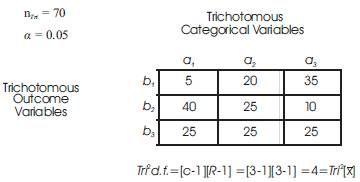
Table 1. Cognitive Science and Neuroscience in Distance Education Tri–Squared Test Research Analysis
The Tri–Square Test Formula for the Transformation of Trichotomous Qualitative Outcomes into Trichotomous Quantitative Outcomes to Determine the Validity of the Research Hypothesis:

Table 1 Research Report: Tri2 Critical Value Table = 9.488 (with d.f. = 4 at α = 0.05). For d.f. = 4, the Critical Value for p > 0.05 is 9.488. The Calculated Tri–Square Value is 40.5, thus, [the null hypothesis (H0) is rejected by virtue of the Tri–Squared hypothesis test which yields the following: Tri–Squared Critical Value of 9.488 < 40.5 the Calculated Tri–Squared Value].
Table 1 illustrates the qualitative transformation into quantitative data as a mathematical application of the Trichotomous–Squared (“Trichotomy–Squared”, “Tri– Squared” or “Tri–Square”) statistical Meta–Analysis procedure on 70 research articles that pertain to current advances in distance education. Table 1 shows that the research primarily and overwhelmingly does not include the use of cognitive science, neuroscience, and the science of design to increase the overall effectiveness of distance education courses (a1 b3 , a2 b3 , and a3 b3 all equal to 25). The mathematical formula for the Tri–Squared Meta–Analysis is reported above further illustrates through direct application, the final outcome of the research hypothesis test: the null hypothesis (H0) is rejected at p > 0.05 is 9.488 ( Osler, 2012). Thus, this illustrates that there is a clear lack of relevant research regarding the use of cognitive science, neuroscience, and the science of design to truly create effective and engaging distance education online courses. The area of focus in which the independent researcher-designed Inventive Investigative Instrument was used was to address the deficits in the application of cognitive science, neuroscience, and the science of design in online learning. Thus, the researcher advocates that a novel model is needed to address the lack of research regarding the implementation and use of cognitive science, neuroscience, and the science of design in distance education. As stated in the Table One Research Report the null hypothesis (H0) is rejected by virtue of the Tri–Squared hypothesis test which yields the following: Tri–Squared Critical Value of 9.488 < 40.5 the Calculated Tri–Squared Value. Thus the alternative hypothesis is accepted that states: H1: There will be significant differences in the research literature as it relates to the use of cognitive science, neuroscience, and the science of design to increase the overall effectiveness of distance education course design (Hypothesis H1).
The researcher exhausted the literature as it related to instructional design, distance education, online learning environments, cognitive and neuroscience, neuroeducation, brain-based learning and educational science, to determine if cognitive and neuroscience has been used to inform the design of online learning environments in distance education.
Of the 70 research articles used for this study, 45 of the articles dealt with the topic of distance education, instructional design and online learning environments. 20 out of the 70 research articles were related to the subject of Neuroeducation, brain-based learning and education science. The remaining 5 articles dealt specifically with the subjects of cognitive science and neuroscience. Additionally, many websites, news articles, audio and video presentations and books were referred to gain breadth and depth of the three main subject areas researched. The current imperative is to design curriculum and content within delivery formats in a pedagogically sound way and in a technologically effective manner ( Park, 2011). In all that was researched pertaining to this study, there was no model for the design of online learning environments that used cognitive and neuroscience research to inform the design. Therefore, the researcher presented the Optimal Learning Interface © Model in this paper to address the need for a model that could be used to design online learning environments with cognitive and neuroscience research as the basis for that design.
The researchers found that there were many emerging models and programs that are using cognitive and neuroscience research in education and the traditional classroom. Brain-Targeted Teaching, Brain-Based Learning, and Neuroeducation curriculums are taking the lead in presenting this knowledge to educators as a methodology for better pedagogy. The Optimal Learning Interface © Model presented by the researcher is only a support tool that provides a process for designing online learning environments to take advantage of the research that shows how the brain works and learns best. This model cannot replace all the necessary “best practices” that are required to have effective courses in distance education. However, this model can aid in the process of addressing the issues that are most prevalent in online learning, which is the lack of student motivation, engagement and retention, as well as minimize the effects of isolation in the asynchronous online learning environment as shown in Figure 2.
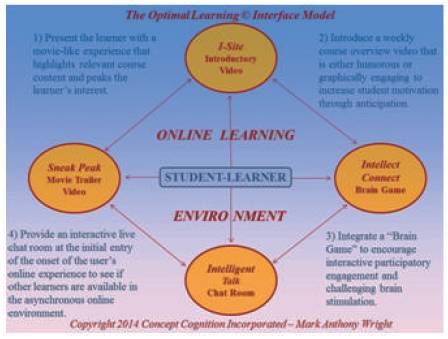
Figure 2. The Optimal Learning Interface © [OLI] Model
The single most important factor in our success at learning will be our degree of motivation, which in turn will determine our receptiveness and work ethic ( Searls, 2012). Most of the instructors expect online learning students, especially at the higher educational levels, to be independent learners who are self-motivated with strong time management skills. Research showed that although many students would agree that these traits and skills are necessary, they expected their instructors to help them with time management and to motivate and inspire them through active engagement in the teaching and learning process ( Jaggars, et al., 2013). The Optimal Learning Interface© Model is an interactive interface designed to motivate and engage students in the asynchronous online learning environment.
Figure 2. Summary: The Optimal Learning Interface© Model is shown in Figure 3 contains four main features that are based on how the sensory brain works and reacts to stimuli both auditory and visual. The move towards a more aesthetic look and feel is becoming more and more common in the design of both websites and LMSs. The transition that Blackboard made from Elluminate Live to Blackboard Collaborate is just one example of how the aesthetics were changed to have a softer look and feel. This same transition took place with Foliotek, the online ePorfolio tool used by many institutions of higher learning. The presentation mode provides a number of thematic options that can be used to display your portfolio with background visual images, colors, and icons that make for a pleasant look and feel. Similar design concepts, principles, and the integration of multimedia are used within the design of the Optimal Learning Interface© Model.
The following recommendations are made by the researchers based upon the study results:
The results yielded significant differences in the Tri–Squared Meta–Analysis of the research literature as it relates to the use of cognitive science, neuroscience, and the science of design to increase the overall effectiveness of distance education course design in terms of a Graphic User Interface model. Thus, this illustrates that there is a clear lack of relevant research regarding the use of cognitive science, neuroscience, and the science of design to truly create effective and engaging distance education online courses.
Current brain research is still in its infancy and the link between brain functions and development with learning science has yet to be fully understood ( Kumar & Yap, 2010). Successful online instruction requires new methods of course design and interaction among course participants ( Crawford-Ferre & Wiest, 2012). The integration of the knowledge of how the brain works and learns from cognitive and neuroscience research along with the sound history of instructional design and learning theories and models, and the use of multimedia can have a major impact in the field of distance education and online instructional design.
Gagne et al (2004) propose that the design of instruction should be with suitable attention to the conditions under which learning occurs, conditions which are both external and internal to the learner (pg. 12). Gagne et al (2004) also mentions cognitive processes that activate and modulate the flow of information during learning. The first three of these processes are: (1) Reception of stimuli by receptors, (2) Registration of information by sensory registers, and (3) Selective perception for storage in short-term or working memory (pg. 9). In Gagne's Nine Events of Instruction, the first event is to “gain attention”. Instructional multimedia is the integration of various forms of media in the instructional process. It is the technology that combines print, radio, television, animation, photographs, and other forms of illustration. Integration of different media multiplies the impact of a message. By logical extrapolation, researchers can say that instructional multimedia can be more effective, if it is backed up by scientific instructional design ( CEMCA, 2014). The Optimal Learning Interface © Model's use of these principles and processes of instruction with the incorporation of instructional multimedia and scientific research is a step in the right direction for distance education and the design of online learning environments. Ensuring these environments are offering a balance of challenge and support will provide a positive foundation for interaction between students and the asynchronous learning environment, encouraging further cognitive development and integrated learning styles ( Clark, 2012).