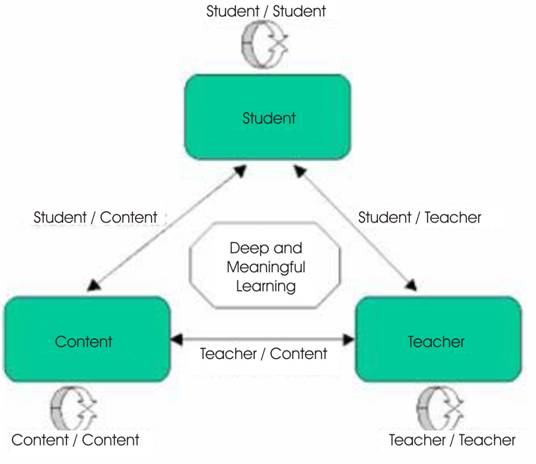
Figure 1. The Interaction Theory Typology (Anderson, T. D. & Garrison, R. D., 2003, p. 43)
This paper is a review of blended learning as a catalyst of optimizing the achievement of learning objectives. Blended learning forms an attempt to apply the right learning technologies to match the right personal learning styles to transfer the right skills to the right persons at the right times. The paper is about rethinking the teaching and learning processes through reconsidering the traditional concepts of university pedagogy, student attendance patterns and methods of learning. The paper uses three questionnaires to examine the environment of educational practices at Philadelphia University-Jordan as a model of Arab universities. It outlines the pros and cons of new technological devices currently used, or are projected to be used within the coming five years from the point of view of a stratified random sample of around (%42) of the faculty at Philadelphia University. It demarcates the challenges and risks waiting ahead from using such devices, and tries to describe some future directions in the field of blended learning. The paper also delineates the structure-map of a model of the teaching process of an e-learning module. Responses to the questionnaires indicate that online courses, social networks and text messaging notification will certainly be in use in university pedagogy within five years, while mashups and sensor networks have meager opportunity to prevail. Results show that the semester university system is expected to become obsolete due to the varied lengths of modules, and that university requirements will vary. Feasibility of tailoring programs according to student preferences has low opportunity of adoption. The responses indicate a high risk of students graduating without obtaining the basic knowledge of certain subjects due to easy access to information and research. Results also reveal an increased possibility of plagiarism, and that there is no expected increase in students engaging in unacceptable behavior towards faculty as a result of using new technological devices. The paper concludes that Arab universities are still lagging in adopting blended learning due to the inadequacy of organizational readiness, unqualified faculty, high cost of module production, and the unavailability of the infrastructure needed especially in rural areas. Collaborative work among universities seems essential to achieve positive change in the modes of education based on interactivity. Recommendations at university and governmental levels are highlighted to promote the implementation of blended learning at Arab universities.
Upon the advent of the third technological wave of information and communication technology that emerged in the twentieth century, specifically in the eighties, new education principles evolved. New terms, like “life-long learning”, “continuing education”, "edutainment" and “virtual education” were added to the education glossary. Computer-based education was projected to replace the campus-bound traditional model. The emerging concept of e-learning was expected to facilitate more flexible teaching and learning solutions through personalization, interactivity, accessibility, efficiency, and empowerment. However, e-learning is different from traditional education in that each method addresses the needs of different types of audience and employs different combinations of instructional delivery methods.
From an objective-oriented point of view that focuses on the achievement of objectives, e-learning is usually classified into three categories: entrainment, infotainment, and edutainment. The first means attaining training, the second means attaining information, and the third means attaining the affective objectives of education. Entrainment is of high importance in modern society, and can be achieved through apprenticeship and face-to-face as well as distance education. Infotainment and edutainment are considered the basic duties of educational institutions: the first is the main aim of traditional institutions, and the second is the category prevalent at the dawn of the third millennium.
To clarify the discrepancy between education and edutainment, it is noteworthy to point out that the main agent in the traditional education process is the teacher, while edutainment is student-centered. The gap between the infotainment duty of traditional institutions on the one hand and the modern edutainment category of education institutions on the other is tremendous, and bridging such a gap is necessary. Hence the need for a hybrid type of education that heavily depends upon interactivity among all constituents of the education process, by utilizing modern communication technologies both inside and outside the classroom. Such a mode of instruction is usually called "Blended Learning mode of education".
Blended learning (sometimes called hybrid) was introduced a decade ago, combining the diverse forms of face-to-face contact instruction with web-based teaching and online collaboration established among learners and faculty members. The evolution of this modality took several stages from on-campus traditional instruction to the personalized system of instruction, then to the computer-aided personalized system of instruction, and afterwards to e-learning that eventually took the form of blended learning.
Multiple studies demonstrated the effectiveness of blended learning, when right proportions are given to the right types of learners and for the right purposes. Three categories of blended learning are usually identified: the enabling blended learning that focuses on convenience and accessibility, the enhancing blended learning that augments but does not drastically change the pedagogical style, and the transforming blended learning that changes the teaching technology into an active model of learning technology. In 2000, a large proportion of university courses in the United States of America adopted certain forms of e-learning delivery systems, mainly synchronous, taking place at the same time, and interactive which stresses the give-and-take process between the teacher and student.
Avicenna Virtual Campus, a UNESCO administered project, had (15) centers in selected universities in the Mediterranean region. Philadelphia University in Jordan was among the participants in the first phase (2002-2006), and played a vital role in a second phase targeting Iraqi universities (2008-2012). Both phases promoted the concept of blended learning, and aimed at qualifying faculty members to utilize it in their educational practices.
To probe the availability of the blended learning modality in educational practices in Arab universities, the Arab Network for Open and Distance Education, abbreviated as ANODE, is in the process of synthesizing a comprehensive database on the utilization of all forms of distance education, e-learning, blended learning and information and communication technology-supported learning in institutions of higher education in the Arab region. This emanates from the need to a relevant comprehensive database that will promote researches in this pedagogical field.
This paper is intended to form a conceptual framework of the delivery systems utilized at Arab universities, and to probe the environments conducive to blended learning in Arab universities. The questions tackled in the paper are
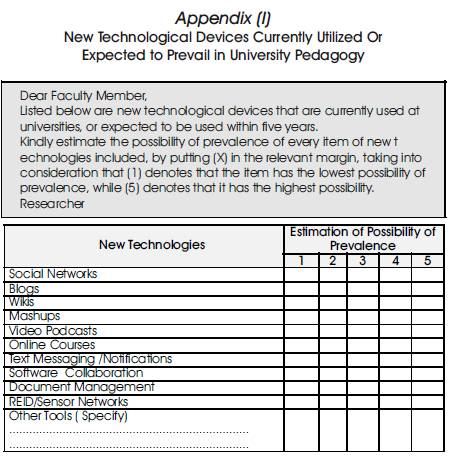
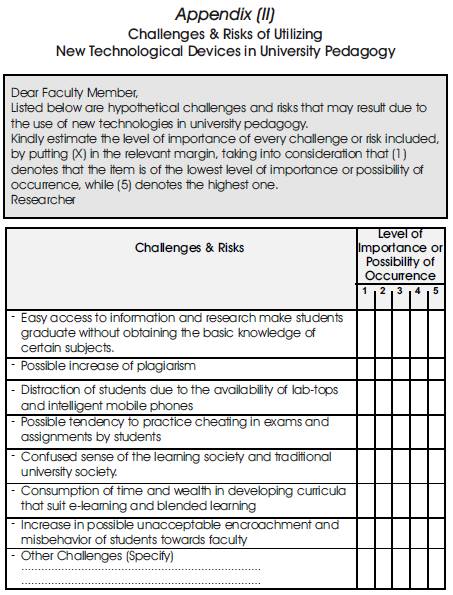
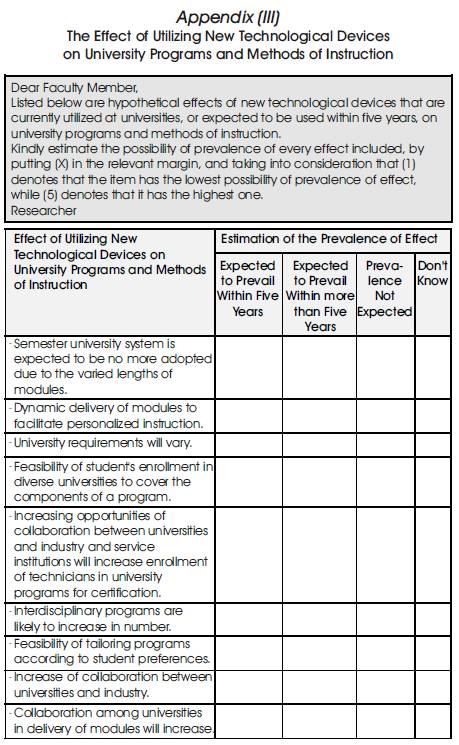
This paper is a descriptive study that utilizes three relevant questionnaires developed by a research team designated by The Economist as shown in Appendices I-III (Miniwatts Marketing Group, 2011). The questionnaires examine the positive and negative effects of new technologies on pedagogical practices at Philadelphia University, to serve as a model of Arab universities. Though the questionnaires were tested for reliability and validity by The Economist team, and found reliable and valid, the customized versions were reevaluated by a group of three Arab referees chosen by the researcher, and found suitable.
A stratified random sample was selected by the researcher. Out of 242 faculty members, 102 responded to the survey, comprising around (%42) of the whole population studied. The sample is distributed among eight faculties: Engineering, Pharmacy, Science, Nursing, Information Technology, Administrative and Financial Sciences, Arts, and Law. The sample was chosen with the help of faculty deans. Each faculty member was assigned a number. Those with odd numbers were chosen from the faculty lists. Excel is used for statistical analysis.
Two imperatives of nature should be adhered to at the dawn of the third millennium: change, and the denotation of the proverb “If you sow, then you will reap”. Observance of the proverb is a prerequisite for positive change, since it needs effort and patience. Four principles (usually referred to as 4Es) are considered prerequisites for leading change successfully: envision, enable, empower, and energize.
Information and communication technologies stimulated new ways of thinking about pedagogical issues, and led to significant change in the role of university faculty as well as change in the locus of control from teacher to learner. In the transition process from traditional to e-learning, and subsequently to the blended modality of learning, there has been "a refocusing shift from teacher to student, from content to experience and from technologies to pedagogies" (Oliver, M., & Trigwell, K., 2005). Such a process of change or refocusing can be ascribed to the fact that the criteria of success in contemporary society have been reformulated to comprise understanding, analysis, communication, and data-processing.
Four key words govern the modes of instruction that suit styles of learning of the interactive type of students who form a majority in the second decade of the twenty-first century: interactivity, collaboration, learning society, and networking facilitated by the world-wide web. In Interface design, interactivity is a give-and take process that uses computers and software as tools for the purpose of helping learners interact with others, words, numbers, and pictures. In instruction design, interactivity is an effective way to active learning. The learner tries to transform pieces of information into new personalized experiences applicable in new situations.
To attract more enrollees and meet the ever-rising costs of education, universities usually reduce barriers in order to facilitate easier access, improve curricula, and extend additional services. Blended learning is supposed to serve as a solution to increase access to higher education institutions, and reduce the costs of higher education. Institutions of higher education also tend to use blended instruction to improve pedagogical practices, maintain flexible learning environments, and improve cost-effectiveness (Graham, C.R., 2006). For faculty members, the major reason for the adoption of such a modality is increasing student engagement and involvement in the learning process. From the students' point of view, satisfaction with the blended learning modality can be attributed to the benefits of convenience, and feasibility of controlling the pace of learning.
From a holistic perspective, blended learning is defined as a delivery modality which combines traditional face-to-face teaching and online approaches to learning, using mobile technologies and “social software” to develop collaborative mechanisms of delivery systems for effective learning (Rosenberg, M. J., 2008). Social software denotes the software that allows the construction of new social ways for collaboration, such as communication, social networking, file and image sharing, blogs, and collaborative authoring. The main objective of blending is to achieve the best learning outcomes possible. It adheres to the norm of “fitness of purpose, and fitness for purpose”. That requires re-thinking the traditions of university teaching, attendance norms of students, methods of learning, and organizational readiness of institutions of higher education (Graham, C.R., 2006). “Organizational readiness” means the involvement of faculties, departments, support services and infrastructure (Dziuban, C., Hartman J., and Moskal, P., 2004).
Good hybrid learning can incorporate the following principles of good practice: promoting active learning through adequate interaction among students and faculty members, providing prompt feedback, enhancing reciprocity and cooperation among students, setting high expectations, and recognizing diversity in learning (Lin, H., 2007). It addresses the fulfillment of "the four conditions of effective adult learning: learner-centeredness, knowledge-centeredness, assessment-centeredness, and community-centeredness" (Shea, P., 2007). Successful implementation of blended learning requires redesigning the teaching and learning processes to attain learner-centeredness. In focusing on learning technology instead of delivery technology, “Blended learning aims at optimizing achievement of learning objectives by applying the right learning technologies to match the right personal learning styles to transfer the right skills to the right persons at the right times” (Singh, H., & Reed, C., 2001: p.2).
A blended module has (%30-%79) of online content delivery, with the remaining content delivered in a non-web based method such as the traditional face-to-face method of instruction (Allen, I.E., Seaman, J., & Garrett, R., 2007). This is analogous to the emerging hybrid vehicle, and proportions of fuel and auto-generated electricity consumed. Pace of instruction is usually affected by the delivery system, and in like manner the distance and speed of driving commonly influence the quantity of energy consumed.
Learning environments and forms of interaction vary according to the following dimensions: "pedagogical richness, access to knowledge, social interaction, cost effectiveness, and ease of revision" (Anderson, T. D. & Garrison, R. D., 2003, p. 42). Figure 1 illustrates the typology of the diverse forms of interaction. Teacher-student, student-student, and student-content forms of interaction are common to both traditional and blended learning. But three other distinctive effective forms should be considered for exploitation by faculty in blended learning environments: teacher-teacher interaction, which implies the potentiality of participation in professional as well as social networking; teacher-content interaction, that indicates the process faculty members undergo while developing and applying the learning content; and content-content interaction, denoting "the ability of learning resources to interact, update and improve without the direct intervention of humans" (Anderson, T. D. & Garrison, R. D., 2003, p. 42).
Figure 1. The Interaction Theory Typology (Anderson, T. D. & Garrison, R. D., 2003, p. 43)
A definite interaction equivalency theorem that helps faculty select the most effective type of interaction in education situations has two pillars: The first is that meaningful learning is sustained as long as one of the afore-mentioned three types of interaction is kept at a high level. Meanwhile, the other two can be eliminated or kept at minimal levels without affecting the educational experience. The second is that high levels of more than one of the interaction modes will likely provide more satisfying educational experiences, though such experiences may not be as cost effective as less interactive learning sequences (Anderson, T. D. & Garrison, R. D., 2003, p. 42).
Pre-service and in-service training modules on b-learning are indispensable to qualify faculty members to effectively design and administer modules using this delivery system. The topics that are suggested to be included in such a relevant faculty training course are: situational leadership, characteristics of adult learners, just-in-time teaching, thinking about learning and teaching, lifelong learning, learning society, and collaboration in module production.
Several pedagogical reasons make it essential to develop hybrid modules: personalization, engaging and motivating students, utilizing technology, building a class without walls, providing sufficient tutoring and online support, managing in-class and out-of-class time, and balancing face-to-face and online components. Additionally, simulations and visualization tools help in facilitating the understanding of ambiguous content.
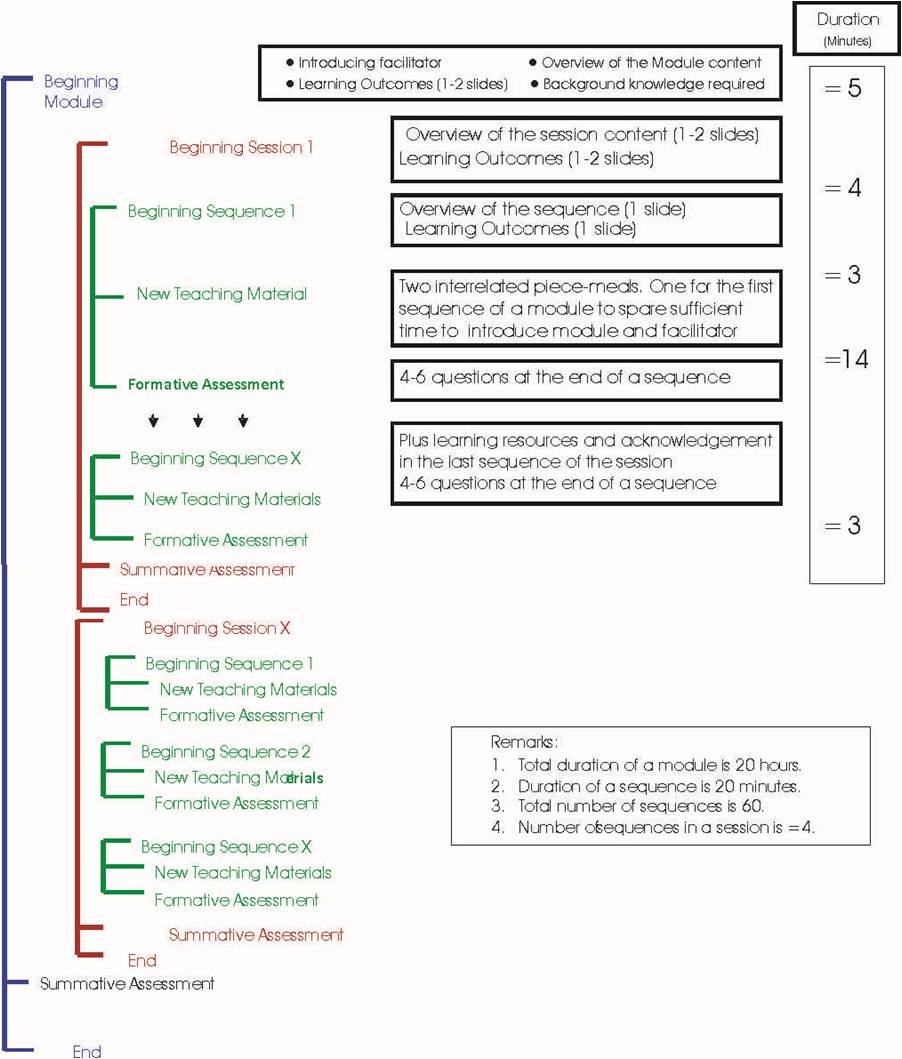
A typical module structure-map divides the module into sessions and sequences. A session comprises a minimum of four sequences. The duration of a sequence is twenty minutes. New teaching material is usually presented within (12-14) minutes duration divided into two piece-meals: one for the first sequence of a module to provide sufficient time to introduce the content of the module/session and facilitator.
Beginning a module, session or sequence takes (3-5) minutes. To begin a module, time is allocated to introduce the facilitator, give an overview of the module content, outline learning outcomes, and revision of the background knowledge required. To begin a session, the same duration is directed to provide an overview of the session content, learning outcomes, and diagnostic assessment. While beginning a sequence involves the presentation of an overview of the sequence, and outlining the learning outcomes.
Presenting new teaching material usually takes (12-14) minutes. And formative assessment in addition to learning resources and acknowledgment in the last sequence of the session or module takes around (3-5) minutes.
Such a division is based on the principle that the human memory span is around seven minutes. After which span, one is liable to become distracted. Another basic pedagogical principle is that learners are generally classified into ear persons, eye persons, and kinesthetic persons. Kinesthetic persons prefer to learn through playing. Eye persons prefer using graphics and colors as motivation agents in the learning process. Ear persons prefer listening, not just hearing. They also give more importance to the tone and pitch of voice of facilitators. For them, certain human and musical sounds act as motivation agents. All that should be taken into consideration by educationists upon choosing the proper mode of delivery, and in the production of e-courses. Figure 2 illustrates a model of the delivery process of a typical e-learning module, as adopted by Avicenna Virtual Campus.
In blended (hybrid) learning, the plan of instruction is usually redesigned to combine traditional face-to-face instruction and e-learning in an amalgamation suited to the needs and capabilities of learners, as illustrated in Figure 3.
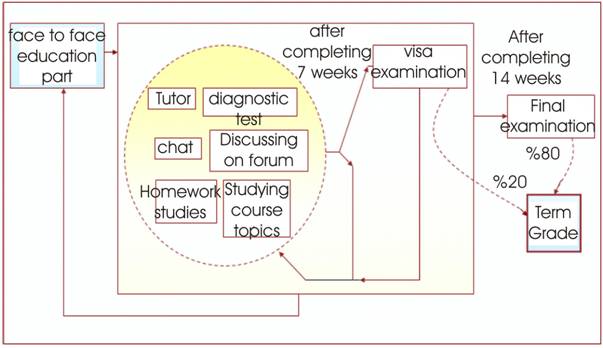
Figure 3. The Blended Learning Course Plan (Kose, U. & Deperlioglu, O., 2012, p. 116)
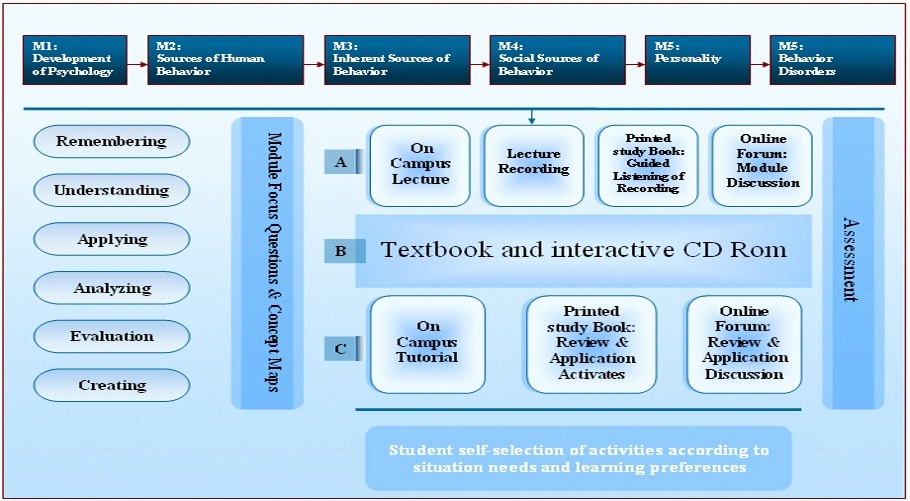
In order to design a suitable blend for hybrid instruction, learners are provided with blends usually composed by choosing from among the following four dimensions of blended learning
Figure 4 delineates the structural relation among objectives, content and process in the modality of blended learning.
Belief in change, as the first imperative of nature, formed a motivating agent to write this paper, since students in the modern age seem to have digital genes. Change is inevitable, despite the desperate opposition of traditional faculty members who may be lacking the skills and qualifications to cope with the provisions of the third technological wave.
The paper analyses the impact of technological development including email, Internet, the world-wide web and video-conferences on teaching methods at Philadelphia University, Jordan.
In response to the questionnaire attached in Appendix I, Philadelphia faculty rated the importance of new technological devices that are currently employed, or are projected to be in use within the coming five years, as follows:
-Online Courses (82%), -Social Networks (76%), -Text Messaging Notifications (74%), -Blogs (60%), -Wikis (70%), -Software Collaboration (70%), -Video Podcasts (64%), -Document Management (60%), - Mashups (58%), -REID/ Sensor Networks (52%).
In response to the questionnaire attached in Appendix II, faculty members estimated the projected effect of utilizing new technologies on the nature of programs and the modes of instruction as follows
In 2011, number of users of Internet facility in the Middle East was (68553666), representing (31.7%) of the total population (www.internationalstats.com/stats.htm). To compare with other regions and countries, users in Africa constitute (11.4%) of the population, Latin America (36.2%), Asia (23.8%), Europe (58.3%), and USA (78.3%). In Jordan, that can be interpreted as having two persons per family with access to Internet. Thus, application of such delivery system in Jordan universities, as a model of Arab universities, is feasible (www.internationalstats. Com/stats.htm).
Out of 242 faculty members at Philadelphia University, 102 responded to the questionnaires probing the challenges and risks of adopting e-learning and blended learning as supporting material. In response to the questionnaire shown in Appendix III, and in spite of the vivid advantages of such education practices, certain risks can be scrutinized and summarized according to degree of importance as viewed by respondents as follows
Responses to the questionnaires indicate that online courses, social networks and text messaging notification will certainly be in use in university pedagogy within five years, while mashups and sensor networks have meager opportunity to prevail. Results show that the semester university system is expected to become obsolete due to the varied lengths of modules, and university requirements will vary. Feasibility of tailoring programs according to student preferences has low opportunity of adoption. The responses indicate a high risk of students graduating without obtaining the basic knowledge of certain subjects due to easy access to information and research. Results also reveal an increased possibility of plagiarism, and that there is no expected increase in students engaging in unacceptable behavior towards faculty as a result of using new technological devices.
In general, technological developments and knowledge economy affect every facet of the teaching-learning process, programs of study, and learning resources. Proponents of lifelong education prevailing during the third technological wave assert that the alternative for the traditional university is a network or communication service that provides all learners with equal opportunities. The hybrid approach seems to have the best potentiality to improve students' learning, if certain risks are avoided. The rationale for promoting the adoption of such an approach is that it serves large numbers of learners. Collaborative work among universities is essential to achieve positive change in the modes of instruction, and to move towards virtual education based on interactivity.
Yet blended learning is unquestionably at odds with the current organizational structure of higher education institutions (Ross, B., & Gage, K., 2006). Arab universities are still lagging in adopting such an approach due to the unavailability of the infrastructure needed especially in rural areas, inadequacy of organizational readiness, unqualified faculty, and the high cost of module production.
Among the recommendations proposed for effective implementation of blended learning in Arab universities, the following points are highlighted:
At the university level, it is recommended to give more importance to communication and technical skills, as well as comprehending the cultural, environmental, economical, and socio-political issues. The recommendations also embrace the inclusion of certain programs, such as graphic design, as tens of billions of dollars are globally spent every year on the production of virtual courses. Provision of compulsory training for university faculty towards the deployment of information and communication technology in the teaching-learning process is a must. Additionally, participation of the private sector in strategic partnership investments in developing programs in the domain of virtual education, and collaboration among universities and publishers in adopting e-books are also recommended. Moreover, Arab governments have the responsibility of providing communication services at reasonable prices, and adopting reasonable standards for the accreditation of e-learning and b-learning programs.
The waves of change will assuredly surge, and the second imperative of nature, namely “If you sow, then you will reap”, should undoubtedly be adhered to. Such terms as collaboration, interactivity, long-life learning, e-learning and blended learning embody the characteristics of education practices in the current era. The changing role of faculty members in a connected classroom forms a catalyst which stimulates new ways of thinking about pedagogy issues. A framework of four pillars of learning has to be adopted: learning to know, learning to do, learning to live together, and learning to be. Present students will reach the apex of their productivity during the forties and fifties of the twenty-first century. A move from words to action is urgently needed in Arab universities. It is absolutely irrelevant to train students using the tools of instruction that were applicable in the industrial age. Besides, de-schooling society seems inevitable in the long run, and the current international move towards b-learning seems to form a transitional stride towards fully personalized learning. What revolutionary modalities are coming next..? Nobody can tell.