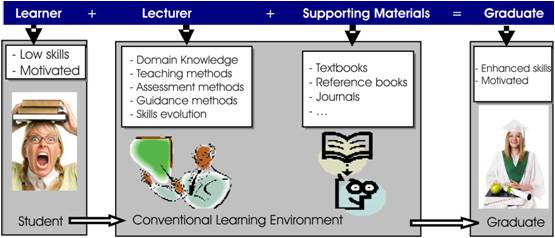
Figure 1. Conventional Learning Environment
Research on blended learning theory and practice is growing nowadays with a focus on the development, evaluation, and quality assurance of case studies. However, the enhancement of blended learning existing models, the specification of their online parts, and the quality assurance related specifically to them have not received enough attention. This paper presents in detail an enhancement, implementation, and evaluation of a rotational blended learning model. This model was adopted by the UNISCO Avicenna Virtual University. Also, its impact on some quality assurance criteria of the rotational blended learning model was presented. This research is unique in the sense that it specifies clearly the online part of the rotational blended learning model with its impact on the main quality assurance criteria.
Blended learning, in educational research, refers to a mixing of different learning models. It combines traditional face-to-face classroom model with computer-mediated support. Horn and Staker (Horn, M. and Staker, H., 2011) have identified six models of blended learning: (i) Face-to-Face driver where teachers deliver most of the curriculum in face-to-face classes. (ii) Rotation where the students rotate between a period of face-to-face tuition and a period of online study. (iii) Flex where the most learning is done in the online environment. (iv) Online lab where all course material and teaching is done online, but in a physical classroom on computer lab. (v) Self-blend which is a fully individualized approach, in this model the students take online classes a la carte. (vi) Online driver where Students work mainly online in a remote location and come into school for optional or required face-to-face classes.
The evaluation of this emerging learning approach constitutes an active topic in actual educational researches. Some researches deal with defining processes allowing its evaluation (Dziuban, C., 2012; Joosten, T., 2009), while others predict its impact on educational programmes (Joosten, T., and Barth, D., 2013). Results of its experimentation constitute a large research activity (Harding et al., 2005; Young, P. et al., 2010). The impact of the blended learning on higher education quality assurance benefits of a particular attention in these researches (Kidney, G. et al. 2007; Magdalena, J. and Harvey, M. 2010). However, these research deal only with e-learning, in general, and not with specific blended learning models, which is the goal of the study presented in this work.
This paper presents an evaluation of an enhanced rotational blended learning model applied on a computer science programme, at Philadelphia University, and identify some quality assurance criteria which are related specifically to blended learning and not, as it is generally the case in actual researches, to e-learning. In the following we will present an experimentation of an enhanced rotational blended learning model, its evaluation, and its impact on some Higher Education quality assurance criteria.
The learning environment, of this study, has evolved through the following stages: conventional, computer aided, and enhanced rotational blended.
This environment may be modeled by the following Figure 1. It takes as input a motivated low skilled learner and produces a graduate with enhanced skills. The conventional learning environment is composed by
This environment may be modeled by the following Figure 2. It takes as input a motivated low skilled learner and produces a graduate with enhanced skills. The computer aided learning environment is composed by
Figure 1. Conventional Learning Environment
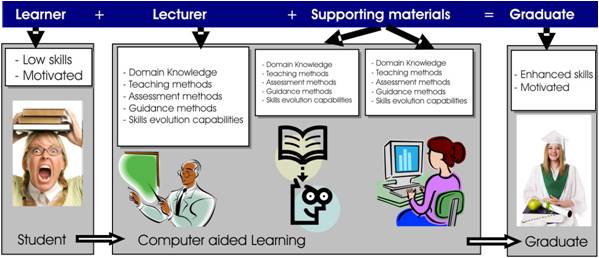
Figure 2. Computer Aided Learning Environment
Horn and Staker (Horn, M. and Staker, H., 2011) have defined the common feature, in the rotation model, is that “within a given course, students rotate on a fixed schedule between learning online in a one-to-one, self-paced environment and sitting in a classroom with a traditional face-to-face teacher. It is the model most in between the traditional face-to-face classroom and online learning because it involves a split between the two and, in some cases, between remote and onsite. The face-to-face teacher usually oversees the online work.”
This environment may be modeled by the following Figure 3. It takes as input a motivated low skilled learner and produces a graduate with enhanced skills. The computer aided learning environment is composed by
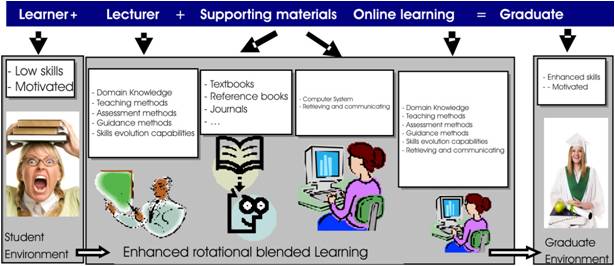
Figure 3. Enhanced Blended Learning Environment
The domain knowledge is organized in online learning sessions. Each session has the following architecture (Figure 4): title, overview, references and links, a quick revision of the precedent session, the knowledge presented in the session, an online assessment, and a summary. The affectation of student to a session might be explicit (by the lecturer or by the student) or implicit (automatically by the expert computer system according to its online assessment or to student guidance plan).
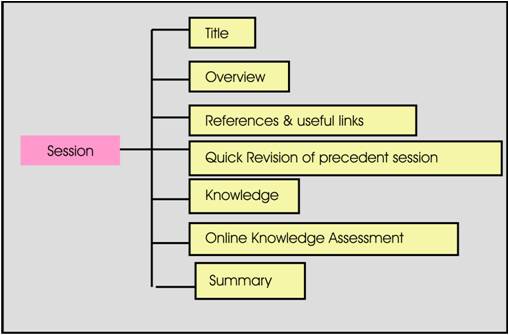
Figure 4. Domain Knowledge Organization
The teaching method consists of dividing each online course into several parts. Each part is composed of (Figure 5) a set of learning sessions, its tutorials, assignments, and online exams.
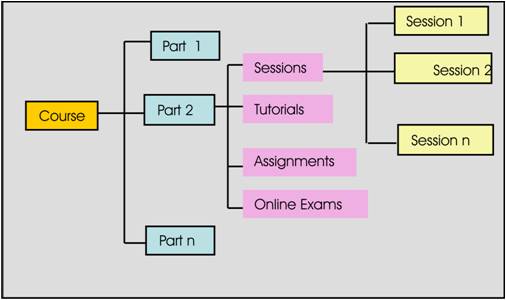
Figure 5. Online Course Architecture Organization
The skills of the expert computer system might evolve by evolving the teaching method: the online courses architectures and sessions' architectures, the student profiles and guidance plans, and the virtual lecturer decisions making.
The student assessment is achieved by: Quick revision at the beginning of each session, online assessment at the end of each session, tutorials and assignments, and final online exam at the end of the course.
The evaluation of this works covers its main contribution, its academic applications, its implementation issues, and its comparison with similar works.
This work has two mains contributions
For the rotational learning model the teaching methods should include the online ones (one to one, many to one, self learning, or assisted by lecturer) along with the face-to-face teaching methods. There is no criteria guiding the choice of an online teaching method, because it depends on local constraints, but may be important to encourage the self learning which develop the long life learning capability for students.
The face-to-face teaching mode uses the first, second, and final exams instruments, along with homework. However, the introduction of online learning might introduce new assessment instrument: the online exam which is an important assessment instrument.
The face-to-face course calendar arranges the content of the course by sessions. However, the online mode will introduce the used teaching methods for each session: face-to-face, online in room, mixed, online at home, etc.
The first part (enhanced rotational blended learning model) of our study was already applied in Avicenna virtual university, and may be used in any higher educational system. The second part (quality assurance of the rotational blended learning model) is not dissociable from the first part.
We have implemented the enhanced rotational blended learning model at Philadelphia University in the Faculty of Information Technology and in other faculties. So, it may be implemented in any educational institution providing the above learning resources.
The blended learning benefits are of high interest in the educational research community. Several recent experimentations were presented in the literature (Horn, M. and Staker, H., 2011; Young, P. et al., 2010; Sharpe, R. et al., 2006). However, none has presented the rotational blended learning model specification as we did or any enhancement to the known models.
The evaluations of blended learning (Joosten, T., 2009; Joosten, T., and Barth, D., 2013; Harding, A. et al., 2005; Young, P. et al., 2010) are many, various, based on real experiences, and leading to important conclusions concerning its importance, cost, impact on students and on education systems, etc. The impact on quality assurance (Kidney, G. et al., 2007; Magdalena, J. and Harvey, M., 2010) deals mainly with e-learning and not specifically with rotational blended learning as our work did. Kidney and colleagues (Kidney, G. et al., 2007) identify eight quality assurance strategies in use at the University of Houston-Clear Lake. The eight strategies are reviews of instructional design, web development, editing, usability and accessibility, maintainability, copyright, infrastructure impact, and content and rigor. Magdalena and Harvey (Magdalena, J. and Harvey, M., 2010) state that the study of the effectiveness of procedures to assure and enhance quality indicated that the main strategies for collecting student feedback (module evaluations and student representation) were strongly affected by features of the on-line delivery of the course. So, our work completes the similar ones by taking in depth quality assurance criteria into account.
The blended learning theory and practice researches are growing nowadays. This paper presents in, a full way, an enhancement, implementation, and evaluation of a rotational blended learning model. This model was adopted by the UNISCO Avicenna virtual university. Also, its impact on some quality assurance criteria was presented. This work is somehow unique in the sense that it specifies clearly the online part of the rotational blended learning model with its impact on main quality assurance criteria. It may be valuable to evaluate it with statistics collected from students' feedback, lecturer feedback, industrial societies which employ these students, students' progression, etc. The development of quality assurance processes and practices for this learning model, as it was done for the face-to-face model, is essential.