
Table 1. Significance of Difference in the Pretest Score of Speaking Skill between the Control and Experimental Groups
Language is the most important instrument for communication. It enables and facilitates both the speaker and the listener to exchange their thoughts and feelings. It is the basis for social, cultural, aesthetic, spiritual and economic development and growth of every human being. Unless the spoken language is free from errors and barriers, it can never be recognized and comprehended properly. Broadly speaking, the usage of contextual vocabulary, correct pronunciation, stress, intonation and other elements is essential for cultivating the speaking skill. Skill of speaking is very vital as it plays a pivotal role in each and every field, especially in education. This skill of speaking must be developed among the student community, particularly the student-teachers. Schools and colleges for years together follow various techniques and approaches in teaching English, but students in large number struggle to communicate in English as their of regional vernacular interrupts or throttles their flow of the alien language. Why is this problem? Who are responsible for it? How can it be rectified? What are the solutions to it? This research paper throws lights on these interrogations and finds answers for them. It also highlights the importance and effectiveness of multimedia in offering practice to develop the speaking skill of the student-teachers who are going to be the teachers in the future and carving their wards in developing this skill. The investigators have employed experimental method using Pre-test – Post-test Equivalent Group Design. The selection of 70 student-teachers from one of the colleges of education of Kanyakumari District, Tamil Nadu, has served both the sample groups. They have used two tools namely S. Jalota's Test of Intelligence for College Education Adults (JTICEA) and ReWi's Achievement Test in English Language Skills (RATELS) for the experiment. The multimedia module consisted of 30 units was prepared. The collected data were analysed by employing t-tests for dependent and independent variable and ANCOVA. It proves that the Multimedia Modular Approach is statistically more effective than the traditional method in developing speaking skill.
Language is the basis for social, cultural, aesthetic, spiritual and economic development and growth of every human being. It is the expression of human personality in words. It plays a vital role in the attainment of knowledge, experience and skill in any subject. The experiences and the activities of the present and the past of the human beings lead to the expansion of vocabulary in any language. Thus, language is a significant instrument in the life of any human being. Only a systematic education provides scope for fostering any language, particularly English (Jose & Dharma Raja, 2011: 20-21).
English, which has its own inherent qualities, is the most important Lingua Franca which is spoken far and wide. It is an essential instrument which develops international understanding and fosters brotherhood. Therefore, it has become an integral part of Indian Educational System. And it has been playing a vital role in the walks of every human being. Its neglect would be a heavy loss, not only in the field of science and technology, but also in the matter of human development (Jose & Dharma Raja, 2011).
Students, either at school or colleges of education, are taught English for about 5 to 7 hours a week. As they have poor exposure towards English, the teachers or educators use bilingual method for their easy understanding. They think that they create a constructive atmosphere to bring in English skills but fail to remember that they tarnish the entire English ambiance. On the other hand, the conventional methods make the students dependent on their mother tongue. Whatever they read, they translate it into their own vernacular. The interference of regional languages into the English classroom really strangulates the growth and development of language skills. Moreover, there is no special attention teachers pay exclusively for language skills and students are taught English only as a subject, not as a skill (Jose & Dharma Raja, 2011: 60). That's why many students and student-teachers are not able to speak English fluently and accurately. They find themselves unable to communicate it due to lack of vocabulary, spellings, correct pronunciation, proper sentence structure, and grammatical rules. That's why students fail to have flavour or love for English and their attitude towards learning the language becomes lethargic (Jose & Dharma Raja, 2011: 61). As they lack speaking skill, they hesitate to communicate anything to anyone in English. In many colleges of education teaching of English is done, but not practicing of English. At most importance must be given to the student-teachers in earning speaking skill because they are going to be the teachers or educators of thousands of students in the future.
It hardly needs to be pointed out how important is for any professional to have good command of the English language. Every organization demands effective and efficient professionals for the expansion of its growth. As Jesus (Mathew, 724: 9, 37) metaphorically says, “The harvest is plentiful but the workers are few,” there needs to be more competent teacher educators to turn out student-teachers equipped not only with knowledge of their domain but also with the latest technological and communicative skills. Their major drawback today is poor communication skill although they have immense knowledge in their own discipline. Only very few among them are able to converse in English. Most of the students are not even able to understand anything when people outside communicate with them. Many teachers feel diffident to speak in English. The same situation prevails in almost all the educational institutions started recently. Is it because of the ineffective techniques and methods employed in the process of teaching English at schools and colleges they attended? Of course, it could be one of the factors. But the prime factor is that the students are not given adequate training in mastering the language skills in B.Ed. Colleges.
The teacher educators in these colleges of education spend more than 150 hours per year in teaching English yet they fail to make their student-teachers proficient in it. Students learn theoretically, not practically though a lot of materials and equipment are accessible to train them. Through multimedia and modern technology, teacher-educators can offer their students not only affluent sources of authentic learning materials, but also attractive, animated pictures and pleasant sounds, which to a large extent overcome the lack of authentic language environment and arouse students' interest in learning English (Jose & Dharma Raja, 2011). Teacher educators ought to realize the fact that language skills can be cultivated in their student teachers through different visual aids.
It is the need of the hour that both teachers and the taught ought to come forward to develop a positive attitude towards technology. Technique in teaching is a factor which promotes or effectuates learning through teaching with the aid of sophisticated devices. The teacher must manipulate those devices in such a way that are stimulated to effective reaction. Teachers must realize the constant influence of several communication media inside and outside the classroom and know about the visual experiences which are very effective because the impressions created by the sense of sight cannot easily be effaced.
The major significance of this study is that it drives the educator and the educated to the realization of the importance of techno-pedagogic practices during the teaching-learning process. This study will add flavour to teacher-educators as well as student-teachers because the profit is being equally shared by the former and the latter. It will be extremely beneficial in the contemporary educational scenario as it looks for guaranteeing the suitable approach in teaching language skills to the student-teachers through multimedia modules.
The ultimate goal of the speaking skill in English is to enable the learner to communicate his or her thoughts, ideas, and feelings via oral language to meet the needs faced by them. Teaching speaking in English means adequacy of fluency and communicative effectiveness. Communication is a two way process in which the sender encodes the message in the form of words or images through a channel and the receiver decodes the message by interpreting and translating it into meaningful information. Unless the speaker and the listener are able to speak with good pronunciation, intonation, expression, stress and pause, both of them may fail to understand what they convey to each other. So this skill must be cultivated by all means.
Jeffrey & Peterson (1976: 27) state that the first step towards better communication is to develop an appreciation for the importance of speech in one's daily activity. The student's speech communication does not refer only to public addresses such as lectures, discourse, and political talks. While such speaking is important, the average person spends much more time communicating in less formal speech situations. So teacher educators should provide a platform for the student-teachers to develop their formal speech situations.
The teacher can suggest some imaginary situations or the students themselves may assume an imaginary situation and engage themselves in conversation. In such free oral practice, the students may be asked to build the content of a dialogue by giving one sentence each (Doff, 1988: 18). There will be some initial reluctance on the part of the students, but such reluctance can be overcome giving them enough confidence and assurance.
Speaking skill can be cultivated with the help of audio-visual aids. When a lecture or a talk in the form of video clip is played on screen to the student-teachers, they can very easily understand what the English speak, how they speak, how they pronounce every word and so on. They can very easily gather plenty of contextual vocabularies at different situations if a movie clip is screened (cohen et.al., 2000). It helps the student-teachers get accustomed with the native speaker of English. When it becomes a daily practice, speaking skill can be developed abundantly.
When teacher educators infuse their lecture with multimedia, the student-teachers can comprehend any complex content very easily and interestingly. Moreover, this will enable them to enhance communication skills; to acquire mastery over the expression of LSRW skills at the performance level; to make use of creative English; and to acquire good pronunciation and deliver speech accurately and fluently.
Teachers can elicit vocabulary, sentences and phrases from pictures which are displayed in the screen. Simple pictures having wonderful milieu and illustrating beautiful situations would be ideal for students who have already been familiar with words, phrases, and sentences and they can describe them easily. Though these are done in lower classes, it will be easier for the beginners who try to attain speaking skill. Doff (1988: 21) says that teachers can better give a story known to students which is now given in pictures and the students are asked to narrate it in English.
Dialogue or conversation is essential to elicit speaking. Teacher can encourage the students prepare for a dialogue under a given situation in screen. Teacher may guide the students but they should fade themselves from the dialogue gradually. “Fading involves the withdrawal of the teacher stimulus and participation in an activity as student interest mounts and the activity no longer needs to be sustained by teacher direction. More and more responsibility is passed on to the students (Bowen et al., 1985: 110).
Role play is perhaps the liveliest form to get the class involved in speaking. Role play brings situations from real life into the classroom. Students imagine and assume different roles. Roles such as friends, doctors, teachers, shopkeepers, police officers, characters from the plays, and popular television programmes have been suggested by Doff (1988: 28). These activities can be taught to the students through multimedia.
Language games such as puzzles, riddles, word building and sentence formation, play a major role in teaching language skills through multimedia. They create interest among the students. Huntoon (1994: 84) asserts that language games not only help the students use a lot of verb forms in their routine life but also assist them to master the structural and semantic conditions in which these verbs should be used.
Language learners who lack confidence in their ability to participate successfully in oral interaction often listen in silence while others do talking. One way to encourage such learners to begin to participate is to help them build up a stock of minimal responses that they can use in different types of exchanges. Such responses can be especially useful for beginners.
Some communication situations are associated with a predictable set of spoken exchanges - a script, greetings, apologies, compliments, invitations, and other functions that are influenced by social and cultural norms often follow patterns or scripts.
English pronunciation is still unduly neglected or ignored in many colleges and universities. This long term problem can be solved only if a compulsory phonetic course is introduced to the student-teachers. They must acquire accurate pronunciation as well as phonetic knowledge so as to be a model. If they make a great progress in their pronunciation and intonation, which in turn helps enormously in developing other basic skills, particularly speaking (Davidson, 2008: 284).
Learning gives birth to behavioural modification. Learning through multimedia affects all the three domains namely cognitive, affective, sensory motor or a fusion of all these in different proportions and delivers a quick outcome to the learners.
The students can cultivate their speaking skill with the help of multimedia. It assists them to distinguish the formal and informal styles of speaking; to differentiate the sounds; to develop phonemic knowledge; to pronounce every word accurately; to use suitable phrases in connection with different speeches in various occasions; to welcome a guest at a function; to bid farewell to someone leaving an institution/organization; to propose a vote of thanks at the close of a formal event; to extend an apology for building good social relations; and to describe places, objects events and people.
Multimedia Modular Approach refers to as a way or method of teaching a subject or a language part with a help of module which is nothing but a division of a selected segment into small units in accordance with the strength of the portion that is proposed to teach to the students through different media that include text, picture, animation, graphics, audio and video to make the teaching very effective. It is a planned and organized combination for deriving maximum output in a particular communication situation.
Multimedia approach may have great potential in facilitating autonomous language learning. It refers to situations in which 'learners become self-achieving and assess their progress. They can deliver authentic input, provide meaningful language learning tasks, deliver feedback on those tasks and can be manipulated according to the learning agenda of the user. Multimedia approach is an innovative technique which assists in teaching English language skills, particularly the Speaking skill.
In the light of the objectives, the following hypotheses were set up.
Jalota's Test of Intelligence for College Education Adults (JTICEA) was administered to establish the homogeneity. The scores were analysed statistically. Experimental method was employed using Pre-test – Post-test Equivalent Group Design (Best & Kahn, 2001).
For the present study, the population consisted of all the B.Ed. students who opted 'General English' as their optional subject. For the research study the sample consisted of 70 student-teachers drawn from Ponjesly College of Education in Kanniyakumari District. The investigator applied matched group technique to equate the sample. The sample groups were matched on the basis of intelligent test scores (Jalota's Intelligent Test) and the pretest scores. After forming the groups randomly, one group was named control and the other as experimental. The size of the sample for both the control and experimental groups is 35 each.
The investigator used two tools such as S. Jalota's Test of Intelligence for College Education Adults (JTICEA) and ReWi's Achievement Test in English Language Skills (RATELS). 'S. Jalota's Test of Intelligence for College Education Adults' is a standardized tool and it has been used to establish the homogeneity of both the control and experimental groups. This is a test of intelligence for college education adults and it contains 100 items. The items were constructed with validity and reliability by the tool maker. All the questions are asked in simple language. In each case, alternative answers are given, and the students are directed to choose right number against the right answer. Each right answer carries one mark. The questions which are not attempted are also to be treated as wrong answers. The total score can be interpreted as a grade on a 7-point Intelligence Grading Table. The intelligence grades are given as mental defect (0-17), Borderline (18-29), Dull Average (30-40) Average (41- 62), Bright Average (63-73), Superior (74-84) Very Superior 85 and above. The marks were awarded according the scoring key.
ReWi's Achievement Test in English Language Skills (RATELS) is a self-made tool. The objective type questions of 'ReWi's Achievement Test in English Language Skills' (RATELS) were framed for the four skills and were given to four experts for content validity. But the investigators have chosen the speaking skill and done the Pilot study for it. It was administered to the student-teachers. Data were collected for item validation. As per the suggestions of the four experts, a few questions were deleted and some of them were modified. The preliminary draft was consisted of 30 questions.
The content for speaking skill is selected and built step by step according to the ability of the student teachers. It consists of phonology, minimal pairs, pronunciation, strong and weak forms, dialogue, intonation, stress and rhythm, accent, syllables, description of people, place, events and objects, formal and informal styles of speaking and so on.
The objectives of the speaking skill consist of the identification of phonetic symbols for correct transcription and pronunciation; accuracy and fluency of speech while involving in conversations, reporting events, describing a daily routine and narrating past events; the expression of pleasure or displeasure while greeting one another; and customs of addressing a gathering, introducing oneself, offering felicitation and proposing vote of thanks (Sasikumar et al., 2010: 1-10).
The multimedia module consisted of 30 units was prepared. There are two audio and video clips found in every unit. The time-span of a single audio or video clip is five to ten minutes. The content of the skill, whether it is long or short, is accommodated according to the time consumption of one hour for each unit. All the contents in the units were fused with multimedia effect namely audio, video, graphics, sound and animation.
Content and face validity was established for the module. For establishing the content and face validity of RATELS, it was given to four experts (one from the department of multimedia and research centre; second one from the software industry; the third one from the department of psychology and the fourth from the Department of English) for the purpose of validation. As per their suggestions, various modifications, deletions and inclusions were done. Modifications were done in the edition of audio and video clips, deletion of blaring sound, music synchronization, voice modulation, intonation, pronunciation of certain words and so on. Again this module, after eliminating the errors was shown to multimedia experts for the final approval.
A Pilot study was conducted for the validation of the tool.
The procedure for item analysis is given below:
The reliability of RATELS was established by Split-half method. The test is divided into two equivalent halves by considering all the odd numbered items as a set and the even numbered items as a separate set. The reliability coefficient was calculated using Spearman-Brown prophecy formula and it was found to be 0.87 which indicates that the tool is highly reliable. As per the opinion of the experts, the tool holds adequate face and content validity. Finally, the treatment was administered to the student-teachers.
After establishing the groups, ReWe's Achievement Test in English Language Skills (RATELS) was administered as pretest to both the groups. Then the scores were tabulated. The experimental group was taught through Multimedia Modular Approach and the control group was taught the same module through traditional method for a period of two months, 4 hours a day. After the instructional treatment, the posttest was applied. The delayed posttest was conducted after 20 days from the posttest to find the retention of learning of the subjects. The adjusted posttest is done. It is nothing but the effect of the pretest means scores as a covariate are partialed out (undergoing changes) the resulting means of the posttest scores is what is known as the adjusted means of the posttest. Thus, the data were collected for analysis.
The t-tests for independent sample means and ANCOVA were the statistical techniques employed for interpreting the results. The results were interpreted with a level of significance at 0.01 level.
Ho 1: There is no significant difference between the control group taught by traditional method and the experimental group taught by multimedia modular approach in the pretest scores of speaking skill.
In the Table 1, since p value is greater than 0.05 in the speaking skill, the null hypothesis is accepted at 5% level of significance. Hence, it is concluded that there is no significant difference in the pretest score of speaking skill between the control and experimental groups.
Ho 2: There is no significant difference between the posttest scores of speaking skill of the control and experimental groups.
In the Table 2, since p value is less than 0.01 in the speaking skill, the null hypothesis is not accepted at1% level of significance. Hence, it is concluded that there is significant difference between control and experimental groups in the speaking skill at the posttest score. The mean scores show that the experimental group performed better than the control group in the posttest.
Ho 3: There is no significant difference between the pretest and posttest scores of the speaking skill of the experimental group.
In the Table 3, since p value is less than 0.01 in the scores of the speaking skill, the null hypothesis is not accepted at 1% level of significance. Hence, there is a significant difference between the pretest and the posttest scores of the experimental group. The mean scores show that the experimental group performed better in the posttest than the pretest.
Ho 4: There is no significant difference between the gain scores of the speaking skill of the control and the experimental groups.
In the Table 4, since p value is less than 0.01 in the gain scores of the speaking skill, the null hypothesis not accepted at 1% level of significance. Hence it is concluded that there is significant difference in the individual gain scores between the control and the experimental groups. The mean scores show that the experimental group gained more than the control group in speaking skill.
Ho 5: There is no significant difference between the delayed posttest scores of speaking skill of the control and the experimental groups.
In the Table 5, since p value is less than 0.01 in the speaking, the null hypothesis not accepted at 1% level of significance. Hence, it is concluded that there is significant difference in the delayed posttest scores of speaking skill between the control and the experimental groups. The mean scores of the speaking skill show that the experimental group performed better than the control group in the delayed posttest.
Table 1. Significance of Difference in the Pretest Score of Speaking Skill between the Control and Experimental Groups
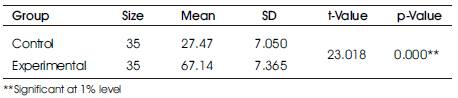
Table 2. Significance of Difference between the Posttest Scores of Speaking Skill of the Control and Experimental Groups
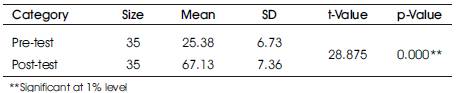
Table 3. Significance of Difference Between the Pretest and Posttest Scores of the Speaking Skill of the Experimental Group
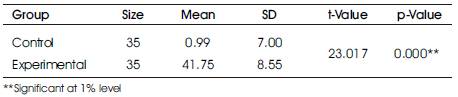
Table 4. Significance of Difference between the Control and Experimental Groups in the Gain Scores of Speaking Skill
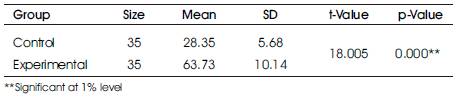
Table 5. Significance of Difference between the Delayed Posttest Scores of Speaking Skill of the Control and Experimental Groups
Ho 6a: There is no significant difference between the control and experimental groups in their speaking skill in the adjusted posttest.
The p value corresponding to the pretest score of speaking skill is greater than .05. It shows that there is no significant difference in speaking skill between the sample groups at pretest level. The p value corresponding to the posttest score of speaking skill is less than .01. It shows that the average score of speaking skill of experimental group is significantly above that of the control group at posttest level.
After correcting the final Speaking Skill core for difference in initial scores, F statistics is applied to the final score. The value of the ANCOVA (Fy. x =621.310) is significant at 0.01 level. From Fy.x, it is clear that the final average score on speaking skill, after adjusted for the initial difference in experimental group (67.36) differ significantly from that in the control group (27.25). So it can be concluded that the Multimedia Modular Approach is statistically more effective than the traditional method in developing speaking skill.
Ho 6b: There is no significant difference between the control and experimental groups in their speaking skill in the adjusted delayed posttest.
The p value corresponding to the pretest score of speaking skill is greater than .05. It shows that there is no significant difference in speaking skill between the sample groups at pretest level. The p value corresponding to the delayed posttest score of speaking skill is less than .01. It shows that the average score of speaking skill of experimental group is significantly above that of the control group at delayed posttest level.
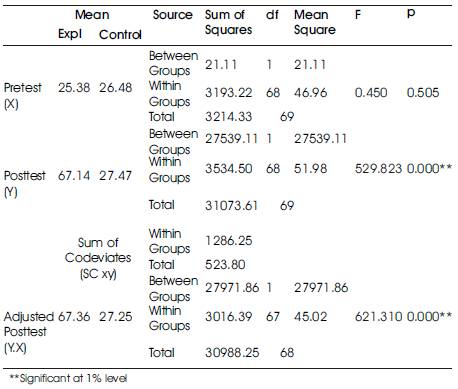
Table 6a. Comparison of Speaking Skill under Multimedia Modular Approach and Traditional Method in the Adjusted Posttest
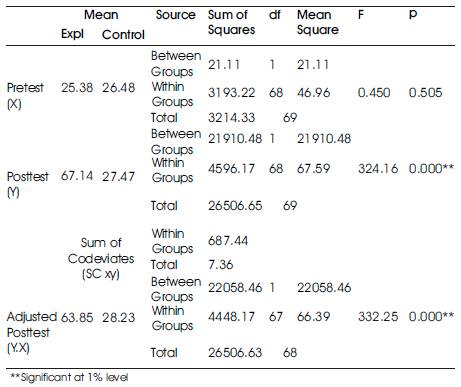
Table 6b. Comparison of Speaking Skill under Multimedia Modular Approach and Traditional Method in the Adjusted Delayed Posttest
After correcting the final speaking skill score for difference in initial scores, F statistics is applied to the final score. The value of the ANCOVA (Fy. x = 332.25) is significant at 0.01 level. From Fy.x, it is clear that the final average score on speaking skill, after adjusted for the initial difference in experimental group (63.85) differ significantly from that in the control group (28.23). So it can be concluded that the Multimedia Modular Approach is statistically more effective than the traditional method in developing speaking skill.
This research on speaking skill of the student-teachers divulges that the multimedia modular approach can be introduced to the educational institutions especially to the colleges of education for the betterment of the student-teachers and for the development of their communication skill. It is apparent that multimedia has the pedagogical strength and it fosters easy learning and better understating and helps to hold the power of retention for a long period and hence, the following are the recommendations to the educational clients.
University Grants Commission (UGC) can very seriously look into the communication skill of the teacher educators and their teaching competency. It can insist on the directors of Academic Staff Colleges (ASC) give practice to the teacher educators in their speaking skill through multimedia module along with computer literacy so that, they can transfer their learning to their wards in the colleges of education. This may pave the way for cultivating the speaking skill of the student-teachers. The National Council for Teacher Education (NCTE) should pay attention to the quality and the competency of student-teachers. It can insist on framing of curriculum for teacher education incorporated with multimedia for training teachers with regard to language teaching. National Assessment and Accreditation Council (NAAC) may insist on the colleges of education to provide ample opportunity and adequate facility to the student-teachers on the acquisition of speaking skill through multimedia technologies. As National Council of Educational Research and Training (NCERT) has lot of accountability in line with school education, it should insist on the ministry of education while making policy decisions, the importance of introducing techno-pedagogical practices in teaching English speaking skill so as to improve the communication skill of the student-teachers and thereby they can bestow efficient and prolific citizens to the nation.
The Regional Institute of English, South India has acquired a reputation for academic excellence at the national and international level. It also facilitates participation of staff in programmes ranging from short-term in-house workshops to national and international level events. Online learning programme is also in the pipeline. Most of the teacher educators do not know much about this institute. So, this institute can urge the government of India to insist on the teacher educators to undergo training for acquiring speaking skill so that they can give practice to the student-teachers very effectively and efficiently. The educational planners and the developers of curriculum for teacher education may prepare multimedia based resource materials for the student-teachers so as to cultivate their skills in language. The utility of techno-pedagogical devices enable the learners acquire proficiency in productive and receptive skills. Educationists may suggest and recommend the higher education regulatory bodies to insist on multimedia modular approach for colleges of education in order to help the student-teachers acquire speaking skill to become competitive teachers.
The colleges of education should produce proficient and effective teachers in speaking skill. They should appoint teacher educators with high proficiency in English language apart from adequate qualification. They should provide spacious language teaching multimedia laboratory. They should bestow sufficient training to the teacher educators in utilizing the multimedia equipment. Universities and Colleges of education should come forward to organize workshops on multimedia for teacher educators and their wards, in which they may be taught how to prepare for a powerpoint presentation; how to edit a picture or an audio-video clip which relevant or suitable for teaching; how to prepare a module for some language units; how to make use of hyperlinks; how to do movie makers; and how to generate effective pictures, animations, graphics and so on.
The Managements of the colleges of education must provide adequate infrastructure to establish a well-equipped multimedia language lab which should never be seen only headphones, CD players and dusted and outdated devices but with plenty of multimedia materials language learning software, internet facilities and so on. They can encourage the language educators to go for training or short-term course on ELT through multimedia. They can offer student-teachers affluent sources of authentic learning materials through multimedia. They should realize the necessity of establishing hi-tech language lab in their colleges of education. The principals of the colleges of education must instruct the teacher educators to prepare multimedia modules for teaching speaking skill and oversee whether the system functions properly or not. The principals can formulate a proper year plan in which teaching of speaking skill through multimedia should be enforced. Similarly, they should also help the student-teachers avail modern multimedia language centres and hi-tech resources. Teacher educators can make use of technology-based teaching methods and translate them into action in their routine teaching and make the student-teachers earn speaking skill. It is a pivotal requisite that the AV aids should be inter-woven with the lectures of teacher-educators.
In the epoch of 21st century, technology has penetrated its roots deeply into every field of education, too. The world is being shrunken and now it can be brought to the palm of every human being. It goes without saying that it is a period of rapid technological changes which have great impact on education. At this juncture, the student-teachers ought to be very much aware of their speaking skill. They should equip themselves with profound knowledge of multimedia applications in education in order to develop their proficiency in English language and may lay foundation for teaching speaking skill through multimedia to their students. It invokes the students' interest and makes their learning easy and effective.