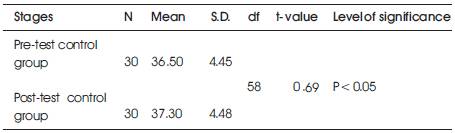
Table 1. Showing achievement mean scores between pre-test of control group and post-test of Control group.
The study substantiates that the effectiveness of Discovery Learning method in learning English Grammar for the learners at standard V. Discovery Learning is particularly beneficial for any student learning a second language. It promotes peer interaction and development of the language and the learning of concepts with content. Reichert and Raimond (2005) suggest that Discovery learning is a highly student-centered and self-directed form of learning. According to Allen (2002), in an example of discovery learning in action, Daimler Chrysler uses guided discovery learning principles for teaching maintenance engineers to troubleshoot automotive electrical systems. The Main Objectives of the study are (i) To diagnose the problems of the learners in learning English Grammar through conventional methods. (ii). To find out the significant difference in achievement mean score between the pre-test of control group and post-test of control group. (iii). To find out the significant difference in achievement mean score between the pre-test of Experimental group and post-test of Experimental group. (iv). To find out the significant difference in achievement mean score between the post-- test of controlled group and the second post-test of treatment given controlled group.(v).To find out the impact of Discovery Learning Strategies in learning English Grammar. The Methodology: adopted in the study was Rotational group Experimental method. The sample for the study was Sixty students of standard V from Bommanampalayam Middle School. The Instrumentation used in this study was Researcher's self-made achievement test the activities designed for the study are Diagnose the problems, Designing the Discovery learning, Face–to- Face interaction, Internet interaction, Team interaction, Team pair Table and Presentation. The Findings to the study revealed that discovery Learning Strategies is more effective than traditional methods in learning English Grammar for the learners at standard V. It can be implemented to all other the languages learning.
Discovery Learning is a method of inquiry-based instruction and is considered a constructivist based approach to education. A review of the literature suggests that discovery learning occurs whenever the learner is not provided with the targe mation or conceptual understanding and must find it independently and with only the provided materials. Within discovery-learning methods, there is an opportunity to provide the learners with intensive or, conversely, minimal guidance, and both types can take many forms (e.g., manuals, simulations, feedback, example problems). The extent to which the learner is provided with assistance seems to be contingent upon the difficulty in discovering the target information with less assistance. The information must be discovered by the learner within the confines of the task and its material. Students have more responsibility in learning the concept in Discovery Learning. It enables the learners to learn English in their own pace.
Acquisition of functional English grammar is inevitable for the children. Learners of standard V in Bommanampalayam Middle School had problems in learning English Grammar through the traditional method. Hence the investigator tried to use the Discovery method in learning English grammar.
As early as the 1950s, research had begun to investigate the effects of discovery learning methods in comparison with other forms of instruction. Bruner (1961) and others (Ausubel, 1964; Craig, 1965; Guthrie, 1967; Kagan, 1966; Kendler, 1966; Kersh, 1958, 1962; Ray, 1961; Scandura, 1964; Wittrock, 1963; Worthen, 1968) advocated learning situations that elicited explanations or self-guided comprehension from learners and that provided opportunities for learners to gain insights into their domains of study. Bruner emphasized that such discovery-based learning could enhance the entire learning experience while also cautioning that such discovery could not be made a priori or without at least some base of knowledge in the domain in question. Bruner's article has often been cited as support for discovery learning. Louis Alfieri, Patricia J. Brooks, and Naomi J. Aldrich, Harriet R. Tenenbaum examined the effects of unassisted discovery learning versus explicit instruction, and the 2nd examined the effects of enhanced and/or assisted discovery versus other types of instruction (e.g., explicit, unassisted discovery). Random effects analyses of 580 comparisons revealed that outcomes were favorable for explicit instruction when compared with unassisted discovery under most conditions (d - 0.38, 95% CI [-.44, .31]). In contrast, analyses of 360 comparisons revealed that outcomes were favorable for enhanced discovery learning when compared with other forms of instruction (d0.30,95% CI [.23, .36]). The findings suggested that unassisted discovery does not benefit learners, whereas feedback, worked examples support the Discovery learning. Mc Donold Betty (2011) seeks to suggest that discovery learning is more effective in a collaborative atmosphere of students sharing each other. A review of the literature suggests that discovery learning occurs whenever the learner is not provided with the target information or conceptual understanding and must find it independently and with only the provided materials. Within discoverylearning methods, there is an opportunity to provide the learners with intensive or, conversely, minimal guidance, and both types can take many forms (e.g., manuals, simulations, feedback, example problems). The extent to which the learner is provided with assistance seems to be contingent upon the difficulty in discovering the target information with less assistance and also on the instructional methodologies to which it is being compared. Common to all of the literature, however, is that the target information must be discovered by the learner within the confines of the task and its material.
The independent variable - Discovery learning and the dependent variable namely achievement score were used in the study.
The responsibility of the researcher is to see that the study is conducted with maximum care in order to be reliable. However, the following delimitations could not be avoided in the present study. (i). The study is confined to 60 students of standard V studying in Bommanampalayam Middle School. (ii). The study is confined to learning English grammar of the Tamilnadu state board English text book.
Rotational group Experimental method was adopted in the study.
Sixty pupils studying in standard V from Bommanampalayam Middle School, Kalveeranpalayam were selected as sample for the study. Thirty students were considered as Controlled group and another thirty were considered as Experimental group.
Researcher's self-made achievement test was used as a tool for the study. The achievement test was consisted of twenty five questions.
The investigator's self made Achievement test was used for the pretests and post tests of both control groups and experimental groups. The same question was used for both pre and post tests to evaluate the pupils' skills of grammar in English through objective types of question which carried one mark for each question and contained 25 marks.
In order to ascertain the feasibility of the proposed research and also the adequacy of the proposed tools for the study, a pilot study had been undertaken. During the pilot study, the problem under study had been finely tuned. Sufficient number of model question papers were prepared and distributed to 10 students of standard V in Bommanampalayam Middle School for the pilot study. This exercise was repeated twice over two sets of 10 students each. The clarification raised by the students was cleared then and there and the filled answer scripts were collected by the researcher. These students were selected in such a way that they were not part of either the control group or experimental group.
A test is reliable if it can be repeated with a similar data set and yields a similar outcome. The expectation of a good research is that it would be reliable. It refers to the trustworthiness or consistency of measurement of a tool whatever it measures. Under this study, the reliability had been computed using test-retest method and the calculated value comes to 0.86. The value is quite significant and implies that the tools adopted were reliable. Hence the reliability was established for the study.
The concept of validity is fundamental to a research result. A result is internally valid if an appropriate methodology has been followed in order to yield that result. A test is said to be valid if it measures what it intends to measure. The expert opinion of the co staff was obtained before freezing the design of the tools. Subject experts and experienced teachers were requested to analyse the tool. Their opinions indicated that the tool had content validity.
The following activities were designed
The researcher administered pre-test to the pupils with the help of the teachers. The question paper and response sheets were given to the individual learners and collected and evaluated learning obstacles of the learners were identified by the pre-test. The causes of low achievement by unsuitable methods were found out. Discovery method was used in the classroom for learning grammar for one week. The post-test was administered and the effectiveness of Discovery method was also found.
Statistical technique ‘t’ test was applied for the study.
Students of standard V have problems in learning grammar in English. In the pre-test, students score 18% marks in learning English grammar through conventional method and the Experimental group students score 82% marks. It substantiated that Students of standard V had problems in learning grammar by using conventional methods in English.
Hypothesis 1There is no significant difference between the pre-test of control group and post-test of control group in achievement mean scores of the pupils in learning grammar in English.
In Table 1, the calculated 't' value is (0.69) less than table value (2.00). Hence null hypothesis is accepted at 0.05 levels. Hence there is no significant difference between the pre test of control group and post test of control group in achievement mean scores of the learners in learning grammar by conventional methods.
Table 1. Showing achievement mean scores between pre-test of control group and post-test of Control group.
There is no significant difference between the pre test of Experimental group and post test of Experimental group in achievement mean scores of the pupils in learning English grammar.
In Table 2, the calculated ‘t' value is (19.08) greater than table value (2.00). Hence null hypothesis is rejected at 0.05 levels. Hence there is significant difference between the pre test of Experimental group and post test experimental group in achievement mean scores of the learners of English in grammar.
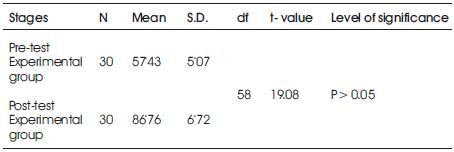
Table 2. Showing achievement mean scores between pre-test of Experimental group and post-test of Experimental group.
There is no significant difference in achievement mean score between the post-test of controlled group and the second post-test of treatment given controlled group.
In Table 3, the calculated 't' value is (15.83) greater than table value (2.00). Hence null hypothesis is rejected at 0.05 levels. Hence there is significant difference between the pre-test of Experimental group and post test experimental group in achievement mean scores of the learners of English in grammar.
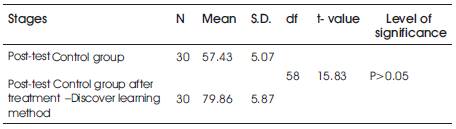
Table 3. Difference in achievement mean score between the post-test of controlled group and the second post-test of treatment given controlled group.
Learning grammar by using Discovery method is more effective than existing methods.
Achievement mean scores of the learners in post-test of control group is 57.43 and the achievement mean scores of the learners post-test of Experimental group is 86.76.Score of the post-test of Experimental group (86.78) is greater than Pre-test of Experimental group (57.43) It shows that learning through Discovery learning is more effective than conventional methods.
The study highlights the problems faced by the learners in acquiring grammatical competency in English by using discovery approaches. Discovery learning is more effective in acquiring grammatical competency in English. Hence it will be more supportive to promote the competency of the learners in grammar. Like the effective methods of using Discovery learning method was attracted the young learners in learning English grammar.